Conor is a Chicago based Motivational Humorous Business Speaker, Author and History buff.
** ** **
.
1923: Ballyseedy – Irish Civil War Horror
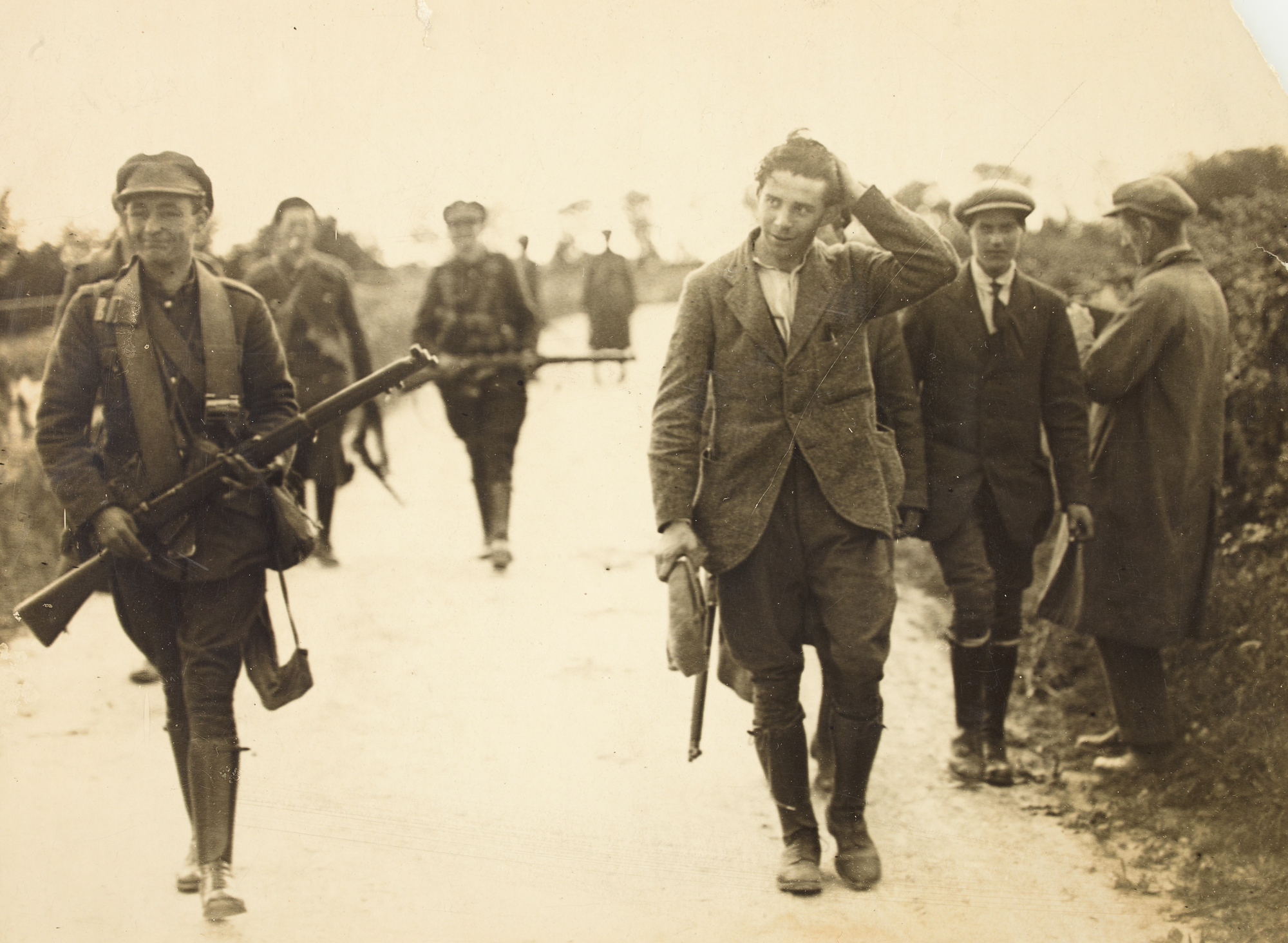
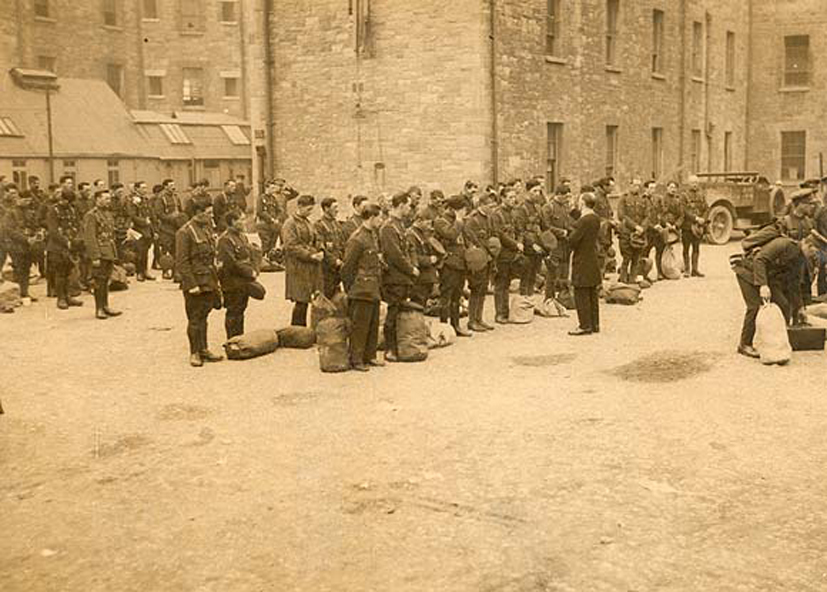
A prisoner under escort at the South Western Front during the Irish Civil War. Given the situation, everyone looks remarkably relaxed. (Source: NLI)
The horror of the Irish civil war continues. In Ballyseedy Co. Kerry, eight anti-treaty volunteers and prisoners are killed by a mine explosion. The exact details are murky. Official government sources state that the men were killed while clearing mines left by anti-treaty forces. Conversely anti-treaty sources claim the men were attached to a mine which was then detonated in retaliation for an explosion the previous day which killed six government forces in Knocknagashel, (30 miles away).
It is now widely accepted that the men were executed. At this stage in the vicious civil war, the government had approved execution of anti-treaty forces, though this does not excuse the atrocity at Ballyseedy. For three generations following the Irish civil war, the country was riven by the pain and anguish of the violent conflict. Ballyseedy is just one example of the horrors inflicted by both sides.
The first US Ambassador to Ireland Frederick A. Sterling finishes his mission in Ireland. Sterling first presented his credentials 1927.
.
** ** **
.
1957: Fianna Fáil Wins General Election
Fianna Fáil returns to government winning 78 seats in the sixteenth Dail.Fianna Fáil would win majorities in the elections of 1961, 1965, 1965. Eamonn De Valera would remain as Taoiseach until 1959, when he would hand power over to Sean Lemass.
Taoiseach Eamonn De Valera 1957-1959
.
Fianna Fáil would win majorities in the elections of 1961, 1965, 1965. Eamonn De Valera would remain as Taoiseach until 1959, when he would hand power over to Sean Lemass.
.
** ** **
.
1961: President Kennedy News Conference – Nothing Ever Changes!
In response to a question at presidential press conference on governments including “Brazil, Ireland and Sweden” calling for nuclear free zones, President John F. Kennedy responded:
“In addition, I am not convinced that this makes–is a total solution. If you have a missile that can carry a bomb 5,000 miles, does it really make that much–a significant difference, if you don’t have a bomb stationed in this area, but you have it 5,000 miles behind which can cover that area.”
Some people would suggest that some things never change! At the press conference, the following exchange took place:
“Mr. President, Congress has been in session for about two months now, and has not accomplished very much. Would you care to comment on how you feel about this present case?
THE PRESIDENT: Well, I must say that always in the first part of March, we read about that Congress hasn’t done much, and in fact last year at this time I think not a single bill had been passed of any proportion–at the end of the year almost thirty bills.”
This history is written by Irish author, business keynote speaker and award winning humorist IrishmanSpeaks – Conor Cunneen. If you spot any inaccuracies or wish to make a comment, please don’t hesitate to contact us via the comment button.
Visit Conor’s YouTube channel IrishmanSpeaksto Laugh and Learn.
Tags: Best Irish Gift, Creative Irish Gift, Unique Irish Gifts, Irish Books, Irish Authors, Today in Irish History TODAY IN IRISH HISTORY (published by IrishmanSpeaks)
Conor is a Chicago based Motivational Humorous Business Speaker, Author and History buff.
** ** **
.
1831: General Philip (Little Phil) Sheridan
Birth of cival war general Philip Sheridan. Sheridan’s parents had emmigrated from County Cavan. In his memoir, Sheridan writes:
“My parents, John and Mary Sheridan, came to America in 1830, having been induced by the representations of my father’s uncle, Thomas Gainor, then living in Albany, N. Y., to try their fortunes in the New World: They were born and reared in the County Cavan, Ireland, where from early manhood my father had tilled a leasehold on the estate of Cherrymoult; and the sale of this leasehold provided him with means to seek a new home across the sea. My parents were blood relations—cousins in the second degree—my mother, whose maiden name was Minor, having descended from a collateral branch of my father’s family. Before leaving Ireland they had two children, and on the 6th of March, 1831, the year after their arrival in this country, I was born, in Albany, N. Y., the third child in a family which eventually increased to six—four boys and two girls.”
Sheridan’s diminutive stature of 5 feet five inches earned him the nickname “Little Phil.) He was involved in the Battle of Perryville, Chickamauga and participated in the Chatanooga and Appotamatox campaigns.
.
GeneralPhilip Sheridan
.
Below: Portrayal of a mournful Philip Sheridan in John Ford’s Rio Grande
“Sheridan was a first lieutenant in the regiment in which I had served eleven years, the 4th infantry, and stationed on the Pacific coast when the war broke out. He was promoted to a captaincy in May, 1861, and before the close of the year managed in some way, I do not know how, to get East. He went to Missouri. Halleck had known him as a very successful young officer in managing campaigns against the Indians on the Pacific coast, and appointed him acting-quartermaster in south-west Missouri. There was no difficulty in getting supplies forward while Sheridan served in that capacity; but he got into difficulty with his immediate superiors because of his stringent rules for preventing the use of public transportation for private purposes. He asked to be relieved from further duty in the capacity in which he was engaged and his request was granted. When General Halleck took the field in April, 1862, Sheridan was assigned to duty on his staff. During the advance on Corinth a vacancy occurred in the colonelcy of the 2d Michigan cavalry. Governor Blair, of Michigan, telegraphed General Halleck asking him to suggest the name of a professional soldier for the vacancy, saying he would appoint a good man without reference to his State. Sheridan was named; and was so conspicuously efficient that when Corinth was reached he was assigned to command a cavalry brigade in the Army of the Mississippi. He was in command at Booneville on the 1st of July with two small regiments, when he was attacked by a force full three times as numerous as his own. By very skilful manoeuvres and boldness of attack he completely routed the enemy. For this he was made a brigadier-general and became a conspicuous figure in the army about Corinth.”
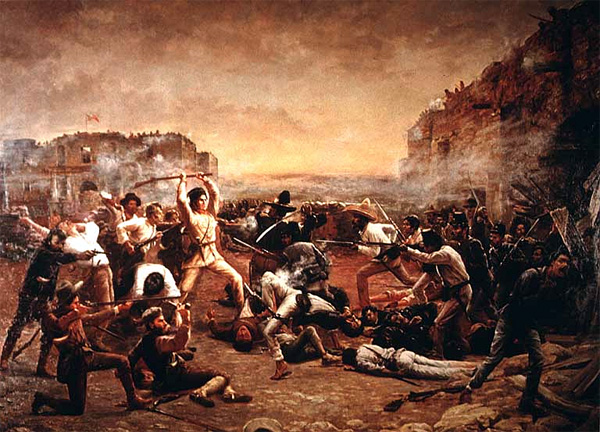
An estimated 200 men die at the battle of the Alamo including Davy Crockett who was of Irish extraction. At least ten of the defenders were actually Irish born fighters. Some of the Irish who died include Samuel E. Burns (b.1810), Andrew Duvalt (b.1804) who immigrated to Texas by way of Missouri and settled in Gonzales. He was a plasterer by trade. James McGee, James Rusk, Burke Tranmel (b.1810), Sergeant William B. Ward (b.1806) When the Mexican army appeared on February 23, 1836, Ward was seen manning the artillery position at the Alamo’s main gate, while the rest of the garrison retreated into the Alamo.
Death of Irish nationalist leader John Redmond. Although a somewhat peripheral figure in Irish politics following the 1916 rising, he had been hugely influential and effective in gaining acceptance for Irish Home Rule. In1912, the House of Commons passed the Irish Home Rule bill which allowed for Irish self-government. Unionist intransigence delayed implementation of Home Rule for two years. The commencement of World War I forced a further delay until after a war which was expected to be shortlived! It would be 1922 before Ireland reached any form of independence following a brutal war of Independence 1919-1921.
.
.
.
Although a somewhat peripheral figure in Irish politics following the 1916 rising, he had been hugely influential and effective in gaining acceptance for Irish Home Rule. In1912, the House of Commons passed the Irish Home Rule bill which allowed for Irish self-government. Unionist intransigence delayed implementation of Home Rule for two years. The commencement of World War I forced a further delay until after a war which was expected to be shortlived! It would be 1922 before Ireland reached any form of independence following a brutal war of Independence 1919-1921.
.
** ** **
.
1988: Three IRA Killed in Gibralter
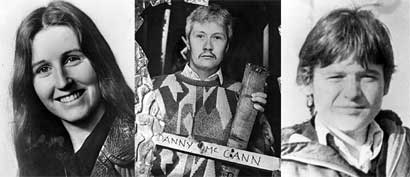
Mairead Farrell, Danny McCann, Sean Savage
Three IRA activists (two men, one woman) are shot dead in Gibraltar by the SAS. The three–Daniel McCann, Sean Savage and Mairead Farrell–had primed a car bomb to explode 48 hours later during a ceremony involving the 1st Battalion Royal Anglian Regiment who had recently deployed from Northern Ireland.The shooting sparked massive controversy raising claims of a shoot-to-kill policy. The official response was that the SAS (aware of the IRA mission) thought the IRA members were about to detonate a bomb immediately. While the official inquest found the shootings justified, in 1995 the European Court of Justice ruled that the fundamental right to life of the IRA members had been violated.
.
Thames TV Documentary: Death on the Rocks
.
The main witness mentioned in the above article–Carmen Proetta, paid dearly for her testimony as she was subject to a Whitelall inspired publicity campaign denigrating her character. The London based Independentnewspaper wrote in 1995:
“Carmen Proetta, the key witness to challenge the Government’s account of the Gibraltar killings, is still paying the price.
Yesterday she travelled to Ireland to pursue yet another law suit arising out of what appeared to be a campaign to discredit her organised by security sources. She was falsely accused of being involved in vice and drugs and of having anti-British views. “The Tart of Gib” screamed one Sun headline.
Now 51, she still works as a translator, as she did at the time her appearance on the Death on the Rock brought her unwanted fame. She lives in a modest bungalow bought with the pounds 300,000-plus damages she is estimated to have received from several British newspapers.”
This history is written by Irish author, business keynote speaker and award winning humorist IrishmanSpeaks – Conor Cunneen. If you spot any inaccuracies or wish to make a comment, please don’t hesitate to contact us via the comment button.
Visit Conor’s YouTube channel IrishmanSpeaksto Laugh and Learn.
Tags: Best Irish Gift, Creative Irish Gift, Unique Irish Gifts, Irish Books, Irish Authors, Today in Irish History TODAY IN IRISH HISTORY (published by IrishmanSpeaks)