Conor is a Chicago based Motivational Humorous Business Speaker, Author and History buff.
*********************** WATCH: A Short History of Ireland
***********************
.
1945: Eamonn De Valera Responds to Churchill Criticism
Eamonn De Valera responds to Churchill’s comments of May 13 where he criticized De Valera’s decision to maintain Ireland’s neutrality during the war.
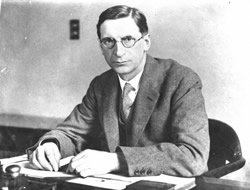
Eamonn De Valera
Few outside of Ireland could understand the neutral stance of the Irish Free State during the war. Churchill most certainly did not when he said:
“Owing to the action of Mr de Valera, so much at variance with the temper and instinct of thousands of Southern Irishmen who hastened to the battle-front to prove their ancient valour, the approaches and the Southern Irish ports and airfields could so easily have guarded were closed by the hostile aircraft and U-boats. This was indeed a deadly moment in our life, and if it had not been for the loyalty and friendship of Northern Ireland we would have been forced to come to close quarters with Mr. de Valera or perish forever from the earth.”
.
Churchill and De Valera 1953
.
De Valera can claim little credit for offering condolences to Germany on the death of Hitler, but his response to Churchill is generally accepted as one of his finest moments and generated huge support and pride in the Irish Free State.
“It is indeed fortunate that Britain’s necessity did not reach the point when Mr. Churchill would have acted. All credit to him that he successfully resisted the temptation which, I have not doubt, may times assailed him in his difficulties and to which I freely admit many leaders might have easily succumbed. It is indeed; hard for the strong to be just to the weak, but acting justly always has its rewards.
By resisting his temptation in this instance, Mr. Churchill, instead of adding another horrid chapter to the already bloodstained record of the relations between England and this country, has advanced the cause of international morality an important step-one of the most important, indeed, that can be taken on the road to the establishment of any sure basis for peace.”
This history is written by Irish author, business keynote speaker and award winning humorist IrishmanSpeaks – Conor Cunneen. If you spot any inaccuracies or wish to make a comment, please don’t hesitate to contact us via the comment button.
Visit Conor’s YouTube channel IrishmanSpeaksto Laugh and Learn.
Tags: Best Irish Gift, Creative Irish Gift, Unique Irish Gifts, Irish Books, Irish Authors, Today in Irish History TODAY IN IRISH HISTORY (published by IrishmanSpeaks)
Conor is a Chicago based Motivational Humorous Business Speaker, Author and History buff.
*********************** WATCH: A Short History of Ireland
***********************
.
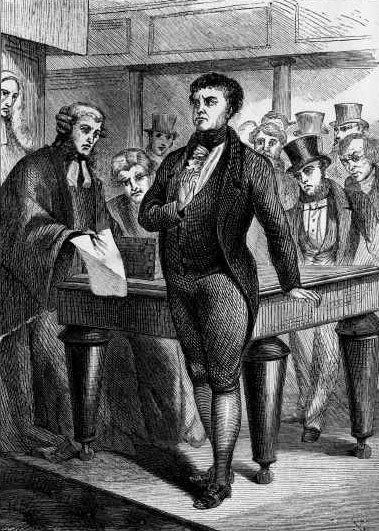
1829: Daniel O’Connell Refuses to take Oath of Supremacy
Roman Catholic Daniel O’Connell attempts to take his seat in the House of Commons. He refuses to take the Oath of Supremacy which stated “the sacrifice of the Mass, and the invocation of the Blessed Virgin Mary and other saints, as now practiced in the Church of Rome, are impious and idolatrous.”
O’Connell refused the oath stating “I decline, Mr. Clerk, to take this oath: part of it I know to be false; another part I believe not to be true.”
Daniel O’Connell refusing to take oath
Solicitor-General Nicholas Conyngham Tindal moved that his seat be declared vacant and another election ordered; O’Connell was elected unopposed on 30 July 1829. Following the introduction of The Catholic Relief Act of 1829, O’Connell was able to take his seat in Parliament.
.
.
1847: Death of Daniel O’Connell
Eighteen years after refusing to take the Oath of Supremacy, Daniel O’Connell – The Great Emancipator – dies in Genoa age 71. O’Connell was the prime mover in attaining Catholic Emancipation – allowing Catholics to sit in Parliament.
Daniel O’Connell was born in Cahirciveen, Co Kerry. O’Connell would go on to be one of the most important figures in Irish political and Catholic civil rights history.
O’Connell was a rock star politician and fine orator who drew huge crowds. His actions, and the concerns of Prime MinisterDuke of Wellington (born Dublin 1769) that the continued refusal to provide the vote to Catholics would generate further unrest ensured the passing of the Catholic Emancipation Act. O’Connell was so popular that King George IV complained “‘O’Connell! God damn the scoundrel.’ Oh, the Duke of Wellington is King of England, O’Connell is King of Ireland and I suppose I am only considered as Dean of Windsor’.
Daniel O’Connell originally won a by-election in County Clare in 1828 defeating William Vesey Fitzgerald. but was not allowed take his seat refusing to swear an Oath of Supremacy that was incompatible with his Catholic faith.
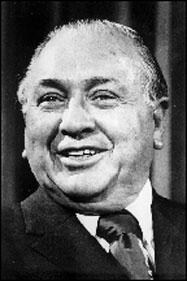
Richard J. Daley, who would go on to become “Da Mare” of Chicago is born. Daley’s ancestors left Ireland at the time of the famine, settling in Chicago, a city that he ruled with an iron fist in his time as Mayor from 1955-1976. Daley was one of the last old style politicians (although some would say his son Richard M. Daley followed suit) who doled out favors and positions to friends, colleagues and cronies. His handling of the Democratic Convention riots of 1968 was a very public blot on his profile as Chicago police engaged in what was described as a “police riot.” Daley’s response was “The confrontation was not caused by the police. The confrontation was caused by those who charged the police. Gentlemen, let’s get this thing straight, once and for all. The policeman is not here to create disorder. The policeman is here to preserve disorder.”
Daley’s speaking style provided a font of humor for comedians and satirists. In For the Love of Being Irish, author Conor Cunneen quotes Daley as saying of how he had been treated by critics: “They have vilified me, they have crucified me; yes, they have even criticized me.”
Daley is often credited with stealing the election for John Fitzgerald Kennedy in 1960 by ensuring the democratic candidate won Illinois. While there may be some truth that a number of Kennedy supporters voted early and often, Illinois was not critical. Even had the vote gone the other way and the states 27 Electoral College votes went to Nixon, Kennedy had sufficient electoral college votes, as his final victory margin was 303 to Nixon’s 219.
Richard J. Daley Telephone Conversation with JFK
Daley’s ability to make things happen are evidenced in a telephone conversation he had with JFK on October 28th, 1963 in relation to civil rights legislation the President was pushing.
JFK: (IL. Democratic Congressman) Roland Libonati is sticking it right up us.
Daley: Is, he is?
JFK: Yeah, because he’s standing with the extreme liberals who are gonna end up with no bill at all. Then when we put together, uh, he’ll, gonna vote for the extreme bill. Then I asked him, “If you’ll vote for this package which we got together with the Republicans which gives us about everything we wanted,” and he says, “No.”
Daley: Daley: He’ll vote for it. He’ll vote for any goddamned thing you want….. That’s better. But he’ll do it. The last time I, I told him, “Now look it, I don’t give a goddamned what it is, you vote for, for anything the President wants and this is the way it will be and this is the way we want it and that’s the way it’s gonna be.”
Birth of heavyweight boxer “Irish” Jerry Quarry who is the only fighter to have fought Muhammad Ali and Joe Frazier twice. He lost each fight and was virtually a punch bag for Ali in his second fight. Quarry was voted the most popular boxer in the sport by Boxing Illustrated for three years running 1968-1970, partly because he was promoted as the “Great White Hope.” Quarry was a very brave fighter as many YouTube videos will attest, but he paid a brutal price for twenty-eight years in the ring and a record of 53-9-4, suffering from dementia pugilistica before his death.
The first clip highlights one of Quarry’s best performances against Ernie Shavers.
Roscommon born Father Edward J. Flanagan (b. 1886), founder of Boys Town dies while travelling in Germany. He was a true friend to children in need who stated ““There are no bad boys. There is only bad environment, bad training, bad example, bad thinking.”
.
Roscommon born Father Flanagan
.
The website www.boystown.org says “On December 12, 1917, Father Flanagan opened his first Boys’ Home in a run-down Victorian mansion in downtown Omaha. In 1921, the Boys’ Home moved to Overlook Farm, its present location near 139th and West Dodge Road. Father Flanagan and Boys Town became internationally known with the help of the 1938 movie, “Boys Town.” He became an acknowledged expert in the field of child care, and toured the United States discussing his views on juvenile delinquency.”
Flanagan’s great work was portrayed (in a very Hollywood style) in Boys Town starring Spencer Tracy who was of Irish extraction.
This history is written by Irish author, business keynote speaker and award winning humorist IrishmanSpeaks – Conor Cunneen. If you spot any inaccuracies or wish to make a comment, please don’t hesitate to contact us via the comment button.
Visit Conor’s YouTube channel IrishmanSpeaksto Laugh and Learn.
Tags: Best Irish Gift, Creative Irish Gift, Unique Irish Gifts, Irish Books, Irish Authors, Today in Irish History TODAY IN IRISH HISTORY (published by IrishmanSpeaks)








 Today In Irish History