

September 1: TODAY in Irish History:
** ** **

Colonel Randall McGavock
Snippets of Irish History by Conor Cunneen IrishmanSpeaks 
Conor is a Chicago based Motivational Humorous Business Speaker, Author and History buff.
***********************
***********************
NEW NEW

SHEIFGAB! Staying Sane, Motivated and Productive in Job Search.
An insightful, realistic, yet humorous book on the job search process by Today in Irish History Curator Conor Cunneen
Special accessible price for job seekers on Kindle of $2.99
.
.
1856: Nationalist Leader John Redmond
Nationalist politician and MP John Edward Redmond is born in Waterford. Redmond is one of the lost heroic figures of Irish politics. A loyal follower of Parnell (even after his downfall) the moderate Redmond succeeded in having a Home Rule bill passed in 1914 that would have given Ireland a level of legislative autonomy. Loyalist intransigence and the advent of World War I delayed the implementation of the bill which fell by the wayside following the 1916 Rising and British attempts to introduce conscription into Ireland.
Redmond has also received a bad press because (like many Irish at the time) he encouraged fellow Irishmen to join the British army to fight for, as he saw it, the rights of small nations. Indeed his brother and fellow Nationalist MP, Willie was killed in 1917 fighting for the Royal Irish Rangers at the Battle of Messines.
.

- John Redmond 1856-1918

.
.
1861: Irish in Confederate Army
The 10th Tennessee Infantry Regiment enters Confederate service. Company D was known as the Rebel Sons of Erin because so many of them were Irish. Indeed, the roster of Company D reads like any small town in a 19th century Irish village.
Owen Bollin, John Brennan, Patrick Brien, William Burks, Michael Cochran, Peter Collins, Mike Conley, Patsey Connas, Patrick Connell, James Connelly, Jimmy Connolly, John Connoly, Mike Corcoran, Martin Creahan, Michael Deharty, John Delany, W. H. Dempsey, Martin Devaney, William Dolaney, Thomas Donlon, Anthony Doudon, Michael Dougherty, James Dwyer, Edmund Eagan, Anthony Egan, Morris Fitzgerald, William Fitzgerald, Martin Flaherty, Patrick Gallagher, Patrick Hackett, Owen E. Haley, Patrick Haney, Daniel Harrington, James Hartnett, John Joyce, Michael Kelly, John Kenney, Michael Levins, James Loughlin, John Lucas, John Madden, Amable Martin, Walter McAvellay, William R. McGinley, John McGurty, Frank McKenney, Thomas McNichols, Francis J. Mellville, George W. Miller, Timothy Mohan, Michael Mullin, Thomas Mulry, Daniel Murphy, Michael Murphy, P. W. Murphy, Michael O’Sullivan, Pierce Pendergast, Patrick Riley, Michael Riordan, William Roach, John Ryan, Richard Shea, Eugene Sullivan. Source TenthTennessee.org
.
The regiment was led by Randall McGavock whose parents had emigrated from Ireland in the 1820s. McGavock features strongly in the memoirs of Galway born Patrick Griffin, who entered service as a seventeen year old and was a loyal aide and friend to McGavock.

- Colonel Randall McGavock
.
Writing of McGavock’s death at the Battle of Raymond, he said “I was standing about two paces in the rear of the line and Col. McGavock was standing about four paces in my rear. We had been under fire about twenty minutes, when I heard a ball strike something behind me. I have a dim remembrance of calling to God. It was my colonel. He was about to fall. I caught him and eased him down with his head in the shadow of a little bush. I knew he was going, and asked him if he had any message for his mother. His answer was: “Griffin, take care of me! Griffin, take care of me!” I put my canteen to his lips, but he was not conscious. He was shot through the left breast, and did not live more than five minutes.
.
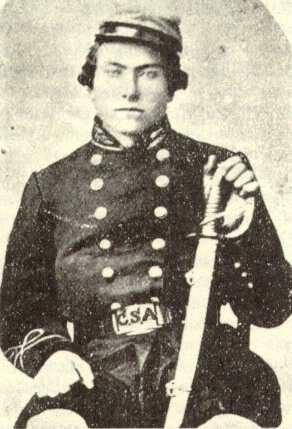
- Galway born Patrick Griffin

.
While the Fighting 69th on the Union side is the most famous “Irish Brigade,” it is estimated that at least 30,000 Irish fought on the Confederate side. Much of the enlistment was due to the geography they lived in and conscription but for many irish, the South was a more natural associate than a Northern government that was perceived as being anti-Catholic, pro WASP and anti-Irish and of course the big neighbor attempting to exert its will on the little guy was reminiscent of the English-Irish relationship.
Probably, the best known Irish soldier on the Confederate side was Cork born Patrick Cleburne who was killed in the slaughter at Franklin. General Cleburne is recognized as one of the most effective leaders on either side during the conflict.

- Patrick Cleburne, the “Stonewall of the West.” Robert E. Lee referred to Cleburne as a “a meteor shining from a clouded sky.”

.
Writing in Co Aytch, a truly interesting memoir by Confederate soldier Sam Watkins says of Cleburne at the Battle of Ringgold Gap:
“Cleburne had had the doggondest fight of the war. The ground was piled with dead Yankees; they were piled in heaps. The scene looked unlike any battlefield I ever saw. From the foot to the top of the hill was covered with their slain, all lying on their faces. It had the appearance of the roof of a house shingled with dead Yankees. They were flushed with victory and success, and had determined to push forward and capture the whole of the Rebel army, and set up their triumphant standard at Atlanta—then exit Southern Confederacy. But their dead were so piled in their path at Ringgold Gap that they could not pass them. The Spartans gained a name at Thermopylae, in which Leonidas and the whole Spartan army were slain while defending the pass. Cleburne’s division gained a name at Ringgold Gap, in which they not only slew the victorious army, but captured five thousand prisoners besides. That brilliant victory of Cleburne’s made him not only the best general of the army of Tennessee, and covered his men with glory and honor of heroes, but checked the advance of Grant’s whole army.”
FREE Download of Co. Aytch at Project Gutenberg
.
Other Irish Confederates:
SEE: Confederate Chaplain John Bannon
.
SEE: details of Confederate Colonel Joseph Kelly
.

- Colonel Joseph Kelly

Three cheers for the Irish Brigade
Three cheers for the Irish Brigade.
And all true-hearted Hibernians
In the ranks of Kelly´s Irish Brigade!
You call us rebels and traitors, but yourselves have thrown off that name of late.
You were called it by the English invaders at home in seventeen and ninety-eight.
The name to us is not a new one, though ´tis one that never will degrade
Any true-hearted Hibernian in the ranks of Kelly´s Irish Brigade
.
.
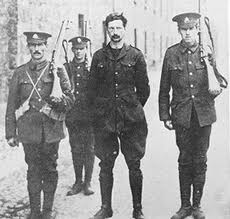
1864: Roger Casement
Roger Casement is born in Dublin to a wealthy protestant family, he initially served in the British diplomatic corps mainly in Africa. His work on exposing the horrific conditions that Belgium subjected native Congolese labor to won him international renown. He was knighted in 1911.
But his allegiance was to an independent Ireland and he helped found the Irish Volunteers in 1913. He was arrested in 1916 attempting to import German arms into Ireland. Britain saw this as a treasonous act. He was executed August 3 1916.
.
.
WATCH: A Short History of Ireland
Want to learn more about Ireland? See these images and more in the acclaimed For the Love of Being Irish


___________________________________
This history is written by Irish author, business keynote speaker and award winning humorist IrishmanSpeaks – Conor Cunneen. If you spot any inaccuracies or wish to make a comment, please don’t hesitate to contact us via the comment button.
Visit Conor’s YouTube channel IrishmanSpeaks to Laugh and Learn.
Tags: Best Irish Gift, Creative Irish Gift, Unique Irish Gifts, Irish Books, Irish Authors, Today in Irish History TODAY IN IRISH HISTORY (published by IrishmanSpeaks)




 Today In Irish History