Archive for ‘Irish in Civil War’

June 23,

Taoiseach Sean Lemass – Colonel John Burke

June 23: TODAY in Irish History:

** ** **

Taoiseach Sean Lemass


Snippets of Irish History by Conor Cunneen IrishmanSpeaks 

Conor is a Chicago based Motivational Humorous Business Speaker, Author and History buff.

***********************

***********************

NEW                    NEW

Product Details

SHEIFGAB! Staying Sane, Motivated and Productive in Job Search.

An insightful, realistic, yet humorous book on the job search process by Today in Irish History Curator Conor Cunneen

Special accessible price for job seekers on Kindle of $2.99

.

shamrockshamrockshamrockshamrockshamrockshamrockshamrockshamrock

.

1914: Colonel John Burke

Death of Dunmanway, Co. Cork born US Army Colonel John Burke. The Irish have a fine heritage and history in the US military including some like John King who is a two time recipient of the Medal of Honor. John Burke did not exactly fit that mould. He was courtmartialled following the Battle of Antietam for alleged cowardice. The facts are somewhat sketchy but the website Antietam on the web reports:

“It is not certain where Col Burke was during the battle on September 17th. LCol Fowler reported that “after the first advance [17 Sept] from the meadow upon the plowed field, the colonel not being present, as a necessity I, without orders, assumed command.”

Apparently, during the brigade’s charge on the Sunken Road, he “fell behind his troops, dismounted, and hid in a ‘fold’ in the ground, perhaps unable to face the enemy fire. Up to Antietam Burke had reportedly been a fine officer called, “a splendid tactician”. The outcome of Burke’s court martial was dismissal from the service”
(Walker)”

“During the battle Gen Meagher was incapacitated and, as the senior colonel, Burke assumed command of the brigade for the remainder of September 17, and later was charged with abandoning his regiment during the fight.”

.

shamrockshamrockshamrockshamrockshamrockshamrockshamrockshamrock

.

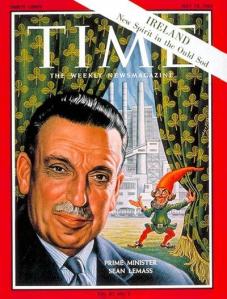
1959: Taoiseach Sean Lemass

Sean Lemass becomes Taoiseach following the election of Eamonn De Valera as President of Ireland. Lemass would bring elements of modern international thinking and economics to a nation bedevilled by De Valera’s isolationist and anti-English thinking. His partnership in economic affairs with Sean T. Whitaker is seen by many as the start of modern Ireland. In 1396, Lemass visited the White House and met with JFK.
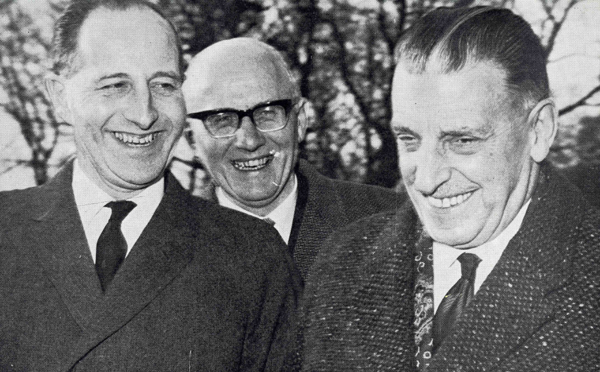
In 1965 Lemass met the Prime Minister of Northern Ireland (Terence O’Neill) meet for the first time since the partition of Ireland in 1922. It was a truly historic meeting that began a thaw in relations between the two states. The meeting at Stormont Castle of two distrustful parties was so momentous and prone to disruption that it was not announced prior to the event. The meeting evoked generally positive reaction in the Republic but caused major problems for O’Neill. While moderate unionists supported talks on non-constitutional issues such as co-operation on tourism, the meeting did not sit well with Protestant fundamentalist like Rev. Ian Paisley who saw it as the start of a sell out. O’Neill paid a reciprocal visit to Dublin in February.
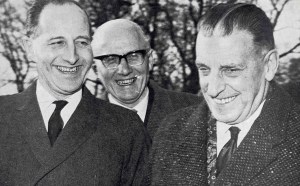
Terence O'Neill and Sean Lemass
Terence O’Neill and Sean Lemass

Sean Lemass had a strong republican background. Born in Dublin in 1899, he participated in the 1916 Rising, fighting in the GPO (General Post Office). He was also in the Irish Republican Army during the War of Independence. He was arrested in 1920 and interned for a year. He joined with De Valera on the anti-treaty side and was in the Four Courts as second in command at the start of the Civil War.

Lemass was first elected as a Sinn Féin Teachta Dála (TD) for the Dublin South constituency in a by-election on 18 November 1924 and was re-elected at each election until his retirement in 1969. He was a founder-member of Fianna Fáil in 1926, serving in numerous cabinet positions under Eamonn De Valera until he became Taoiseach in 1959.
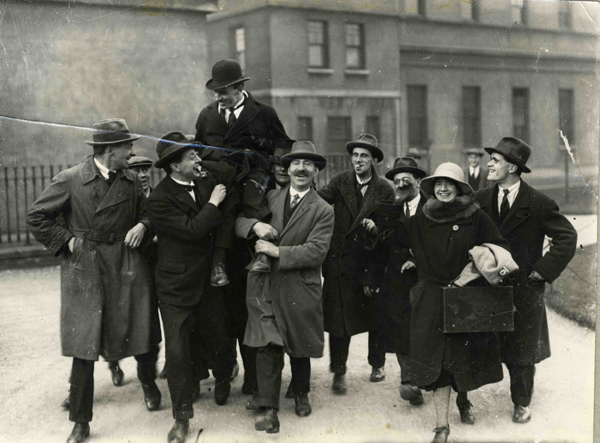
sean lemass 1924 election

A victorious Sean Lemass 1924 General Election

.

shamrockshamrockshamrockshamrockshamrockshamrockshamrockshamrock

.

WATCH: A Short History of Ireland

Want to learn more about Ireland? See these images and more in the acclaimed For the Love of Being Irish

Irish gift ideas. Best selling Irish booksRonnie Drew and Luke Kelly - Musical Irish Gifts to the worldJoyce Image in For the Love of Being IrishMichael Collins: Image from For the Love of Being Irish

___________________________________

This history is written by Irish author, business keynote speaker and award winning humorist IrishmanSpeaks – Conor Cunneen. If you spot any inaccuracies or wish to make a comment, please don’t hesitate to contact us via the comment button.

Visit Conor’s YouTube channel IrishmanSpeaks to Laugh and Learn.

Tags: Best Irish Gift, Creative Irish Gift, Unique Irish Gifts, Irish Books, Irish Authors, Today in Irish History TODAY IN IRISH HISTORY (published by IrishmanSpeaks)


June 20,

Irish Military Heroes, Union General Robert Nugent, Audie Murphy – Birth of Wolfe Tone

June 20: TODAY in Irish History:

** ** **

Colonel Robert Nugent 1824-1901

Snippets of Irish History by Conor Cunneen IrishmanSpeaks 

Conor is a Chicago based Motivational Humorous Business Speaker, Author and History buff.

***********************

***********************

NEW                    NEW

Product Details

SHEIFGAB! Staying Sane, Motivated and Productive in Job Search.

An insightful, realistic, yet humorous book on the job search process by Today in Irish History Curator Conor Cunneen

Special accessible price for job seekers on Kindle of $2.99

.

shamrockshamrockshamrockshamrockshamrockshamrockshamrockshamrock

.

1763: Wolfe Tone

Birth of Irish patriot Theobald Wolf Tone. Tone was one of the founding fathers of the United Irishmen which with the aid of France attempted to gain independence for Ireland. On October 12 1798, he was captured off the coast of Donegal in the French shop Hoche as it attempted to land French invastion forces. On November 10th, he was found guilty of treason and sentenced to be hanged. Before this sentence could be carried out, he attempted suicide by cutting his throat. He died a long lingering death 9 days later on November 19th.

File:Theobald Wolfe Tone - Project Gutenberg 13112.png

.

shamrockshamrockshamrockshamrockshamrockshamrockshamrockshamrock

.

1901: County Down born General Robert Nugent

Colonel Robert Nugent 1824-1901

Death of Kilkeel, Co. Down born  (June 27, 1824) General Robert Nugent served in the U.S. Army during the American Civil War and the Indian Wars. He served with the Irish Brigade’s 69th Infantry Regiment, from its days as a National Guard unit and into its incorporation into the Union Army at the start of the war, and was one of its senior officers at the First Battle of Bull Run. His obituary in the Brooklyn Eagle read:

General Robery Nugent died at his home,
332 McDonough street, yesterday, as the
final result of a bullet wound in the stomach
received at the battle of Fredericksburg, De-
cember 13, 1862, while leading his command
up Marye’s Hill.  For seventeen years he
suffered from chronic dyspepsia. General
Nugent was born in Killkeel, County Down,
Ireland, July 24, 1824, and came to New York
when a young man. He joined the Seventh
Regiment as a private and afterward was a
captain in the Fourteenth Regiment. In 1853
he became a member of the Sixty-ninth
Regiment, New York State Militia, and rose
to the colonelcy before the beginning of the
Civil War.  At the firing on Fort Sumter he
led the regiment to Virginia. On it return
he helped organize the Sixty-ninth New York
Volunteers, which was the first in Meagher’s
Irish Brigade. He served as colonel of the
regiment until 1862, when, General Meagher
becoming incapacitated, he succeeded to the
command of the Irish Brigade.  It was while
leading this charge that he received the
wound that finally caused his death. He was
carried from the field and brevetted for his
bravery. During his convalescence in New
York he was appointed deputy provost mar-
shal of New York and Brooklyn, serving as
such from May to November, 1863. During
that time the draft riots took place. He
returned to the Army, reaching the rank of
brigadier general. At the close of the war
he became a captain in the regular Army
and commanded a company in many battles
in Montana, Dakota, and Wyoming, against
the Sioux and other Indians, being with Gen-
eral Miles in the battles against Sitting Bull.
In 1877 he was retired as major and returned
to Brooklyn to live. His wife, three daugh-
ters and a son survive him

.

shamrockshamrockshamrockshamrockshamrockshamrockshamrockshamrock

.

1924: Audie Murphy is born in Texas to share-cropping parents of Irish descent. He would become the most decorated US soldier of World War II.

Audie Murphy 1924-1971

His Citation for the Medal of Honor reads:

Second Lt. Murphy commanded Company B, which was attacked by six tanks and waves of infantry. 2d Lt. Murphy ordered his men to withdraw to a prepared position in a woods, while he remained forward at his command post and continued to give fire directions to the artillery by telephone. Behind him, to his right, one of our tank destroyers received a direct hit and began to burn. Its crew withdrew to the woods. 2d Lt. Murphy continued to direct artillery fire, which killed large numbers of the advancing enemy infantry. With the enemy tanks abreast of his position, 2d Lt. Murphy climbed on the burning tank destroyer, which was in danger of blowing up at any moment, and employed its .50 caliber machine gun against the enemy. He was alone and exposed to German fire from three sides, but his deadly fire killed dozens of Germans and caused their infantry attack to waver. The enemy tanks, losing infantry support, began to fall back. For an hour the Germans tried every available weapon to eliminate 2d Lt. Murphy, but he continued to hold his position and wiped out a squad that was trying to creep up unnoticed on his right flank. Germans reached as close as 10 yards, only to be mowed down by his fire. He received a leg wound, but ignored it and continued his single-handed fight until his ammunition was exhausted. He then made his way back to his company, refused medical attention, and organized the company in a counterattack, which forced the Germans to withdraw. His directing of artillery fire wiped out many of the enemy; he killed or wounded about 50. 2d Lt. Murphy’s indomitable courage and his refusal to give an inch of ground saved his company from possible encirclement and destruction, and enabled it to hold the woods which had been the enemy’s objective.”

Murphy was awarded thirty two other medals for gallantry including the Distinguished Service Cross, the Silver Star, four Purple Hearts, a Bronze Star, and the French and Belgian Croix de Guerre.

Following the war, Murphy became a movie actor, starring in numerous films including his own bio-pic To Hell and Back.

.

.

shamrockshamrockshamrockshamrockshamrockshamrockshamrockshamrock

.

WATCH: A Short History of Ireland

Want to learn more about Ireland? See these images and more in the acclaimed For the Love of Being Irish

Irish gift ideas. Best selling Irish booksRonnie Drew and Luke Kelly - Musical Irish Gifts to the worldJoyce Image in For the Love of Being IrishMichael Collins: Image from For the Love of Being Irish

___________________________________

This history is written by Irish author, business keynote speaker and award winning humorist IrishmanSpeaks – Conor Cunneen. If you spot any inaccuracies or wish to make a comment, please don’t hesitate to contact us via the comment button.

Visit Conor’s YouTube channel IrishmanSpeaks to Laugh and Learn.

Tags: Best Irish Gift, Creative Irish Gift, Unique Irish Gifts, Irish Books, Irish Authors, Today in Irish History TODAY IN IRISH HISTORY (published by IrishmanSpeaks)