Archive for ‘Irish War of Independence’

April 23,

The Day Before 1916 Rising – 1918 Anti-Conscription Strike at Today in Irish History

April 23: TODAY in Irish History:

** ** **
Eoin McNeil

Snippets of Irish History by Conor Cunneen IrishmanSpeaks

Conor is a Chicago based Motivational Humorous Business Speaker, Author and History buff.

.

shamrockshamrockshamrockshamrockshamrockshamrockshamrockshamrock

.

1916: The Day Before the Rising

Approximately 1,000 copies of The Proclamation of the Irish Republic are printed in Liberty Hall in a print office set up by James Connolly. The proclamation will be read by Patrick Pearse outside the General Post Office on Sackville Street (now called O’Connell Street) on Monday April 24th.

The proclamation was printed secretly on an old and poorly maintained Wharfedale Stop Cylinder Press in the printing office that had been set up by James Connolly in the basement in the original Liberty Hall in Beresford Place, Dublin.

.

READ: Printing of Proclamation

.

All seven signatories of the Proclamation Pearse, James Connolly, Thomas Clarke, Thomas MacDonagh, Sean MacDermott, Joseph Plunkett and Eamonn Ceannt would be executed by British authorities.

Easter Sunday was a day of confusion and indecision amongst the rebel movement. The Irish Volunteers Chief of Staff, Eoin MacNeil, in defiance of Patrick Pearse, cancelled the planned manoeveres of volunteers, by placing a notice in that morning’s newspapers. Pearse and company had expected the manoeveres to be the instigation of a Rising, he and his colleagues knew had little chance of success. McNeil’s cancellation occured partly because he had only just become aware of the true nature of the manoeveres and also due to the capture of Roger Casement and the major arms shipment aboard the Aud of the coast of Kerry.

.
An noon on Easter Sunday, Pearse and the Military Council decided to postpone the insurrection until the follow day, Easter Monday April 24th. Despite a long and bleak history of failed insurrections due to leaks and informers to British authorities, it appears that for once the Irish rebels were able to keep their plans secret.

.

shamrockshamrockshamrockshamrockshamrockshamrockshamrockshamrock

.

1918: General Strike against Conscription

Irish Trade Unions call a general strike in protest against the imposition of conscription in Ireland. The British Military Service Act of 1916 introduced conscription into mainland Britain. At the time, Ireland was excluded. However, with manpower at a  critical level in 1918, the government of Lloyd George started agitating for conscription of Irish males and on April 16, 1918 formally extending conscription to Ireland. Not surprisingly, it provoked a firestorm of resentment. While an estimated 200,000 Irish fought in the British Army during World War I, many had enlisted in the idealistic early days of 1914, partly prompted by Irish politician John Redmond, although the bulk of the soldiers were from Ulster.

Britain’s reaction to the 1916 Rising generated huge resentment and virulent opposition to most things English. Thus the proposed conscription legislation was seen as anathema to the Irish who no longer believed that the war to end all wars was to save the small countries of Europe.

The General Strike and anti-conscription activity gained huge support including a statement from the Irish Catholic hierarchy part of which read:

“To enforce conscription here without the consent of the people would be perfectly unwarrantable and would soon and inevitably end in defeating its own purposes.

‘Had the government in any reasonable time given Ireland the benefit of the principles, which are declared to be at stake in the war, by concession of a full measure of self-government, there would have been no occasion for contemplating forced levies for her now. What between mismanagement and mischief-making this country has already been deplorably upset, and it would be a fatal mistake, surpassing the worst blunders of the past four years, to furnish a plea now for desperate courses by an attempt to enforce conscription. With all the responsibility that attaches to our pastoral office, we feel bound to warn the government against entering on a policy so disastrous to the public interest, and to all order, public and private.”

In the light of intense opposition that almost certainly would have led to violence, the British government did not implement conscription in Ireland.
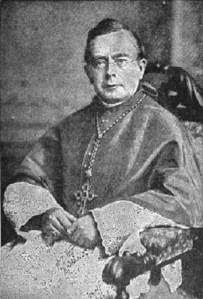
Dublin Archbishop William Walsh who led opposition to conscription


.

shamrockshamrockshamrockshamrockshamrockshamrockshamrockshamrock

.

Want to learn more about Ireland? See these images and more in the acclaimed For the Love of Being Irish

Irish gift ideas. Best selling Irish booksRonnie Drew and Luke Kelly - Musical Irish Gifts to the worldJoyce Image in For the Love of Being IrishMichael Collins: Image from For the Love of Being Irish

___________________________________

This history is written by Irish author, business keynote speaker and award winning humorist IrishmanSpeaks – Conor Cunneen. If you spot any inaccuracies or wish to make a comment, please don’t hesitate to contact us via the comment button.

Visit Conor’s YouTube channel IrishmanSpeaks to Laugh and Learn.

Tags: Best Irish Gift, Creative Irish Gift, Unique Irish Gifts, Irish Books, Irish Authors, Today in Irish History TODAY IN IRISH HISTORY (published by IrishmanSpeaks)

Tags:
April 14,

Titanic Hits Iceberg – IRA Executes Sir Arthur Vicars – Irish Civil War Commences at Today in Irish History

April 14: TODAY in Irish History:

** ** **

sir arthur vicars
Sir Arthur Vicars 1862-1921

Snippets of Irish History by Conor Cunneen IrishmanSpeaks 

Conor is a Chicago based Motivational Humorous Business Speaker, Author and History buff.

.

shamrockshamrockshamrockshamrockshamrockshamrockshamrockshamrock

.

1912: Titanic Hits Iceberg

Titanic sea trials April 2

Titanic on sea trials April 2

Timeline of that fateful night:

7.30pm: Warnings of large icebergs from the California are delivered to the bridge of Titanic and Captain Smith.

9.20pm: Smith retires for the night

9.40pm: Another warning about icebergs is received by Titanic. This message apparently is not passed on to the bridge. The British Inquiry found that “the evidence establishes quite clearly that Captain Smith, the Master, Mr. Murdoch, the first officer, Mr. Lightoller, the second officer, and Mr. Moody, the sixth officer, all knew on the Sunday evening that the vessel was entering a region where ice might be expected”

10.55: Titanic radio operators receive message from the California that it is stopped in ice field. Harried Titanic radio operator Evans responds “”Shut up, shut up. You’re jamming my signal. I’m busy.”

11.40 pm: Lookouts spot iceberg about 500 yards away and call out warning.

11.41 pm: The starboard (right) side of the ship is reefed open.

The injuries to the ship, were of such a kind that she foundered in two hours and forty minutes. The British Inquiry into the sinking found that “The collision with the iceberg…… caused damage to the bottom of the starboard side of the vessel at about 10 feet above the level the keel, but there was no damage above this height. There was damage in: – The forepeak, No. 1 hold, No. 2 hold, No. 3 hold, No. 6 boiler room, No. 5 boiler room. ………. As the ship was moving at over 20 knots, she would have passed through 300 ft. in less than 10 seconds, so that the damage was done in about this time.

.

shamrockshamrockshamrockshamrockshamrockshamrockshamrockshamrock

.

1917: The Horrors and Humor of War

Journalist Philip Gibbs

Journalist Philip Gibbs

English war journalist Philip Gibbs notes in his diary on this day in 1917 about a “queer tale” featuring a beloved Irish priest Father Malone who was chaplain to troops in World War I:

The colonel of the Leinsters told another queer tale of an Irishman in the outskirts of Lens. The colonel saw him after the battle of Bois-en-Hache, which was a terrible affair and a fine feat of arms in the mud and snow, bringing back a German horse under machine-gun fire and shrapnel. He was guiding this poor lean beast over frightful ground, round the edge of monstrous shell-craters, through broken strands of barbed wire, and across trenches and parapets. “What are you doing with that poor brute?” asked the commanding officer. “Sure, sir,” said the Irishman, “I’m bringing the horse back for Father Malone to ride.” The horse was in the last stages of starvation, and the padre weighs nineteen stone, according to the popular estimate of the men, who adore him, and that is part of the story’s humour, though the Irish soldier was very serious. It is a tribute, anyhow, to the affection of the men for this Irish padre-a laughing giant of a man—who is always out in No Man’s Land when there are any of his lads out there,[117] going as far as the German barbed wire to give the last rites to dying men.”

The anecdote is published in Gibbs book  In from Bapaume to Passchendaele,

.

shamrockshamrockshamrockshamrockshamrockshamrockshamrockshamrock

.

1921: IRA Execute Sir Arthur Vicars

sir arthur vicars

Sir Arthur Vicars 1862-1921

Sir Arthur Vicars is executed by the IRA in Kerry. Vicars, who played a pivotal (and probably negligent) role in the theft of the Irish Crown Jewels in 1907, was executed by the IRA. Born in England, Vicars spent most of his life in Ireland where he was Custodian of the Irish Crown Jewels at the time they were stolen. Vicars was dismissed from his post as a result. The jewels have never been found.

The IRA’s claim that Vicar’s was informing are disputed by his Valet Michael Murphy. Murphy in his own words was “associated with the IRA” and became a Captain in the Irish Army following Independence. In a statement he gave to the Bureau of Military history in 1955, he states “I do not believe he (Vicars) was a spy or got a fair trial.”

.

READ:  New York Times article on death of Sir Arthur Vicars

.

shamrockshamrockshamrockshamrockshamrockshamrockshamrockshamrock

.

1922: Occupation of the Four Courts and Civil War

Approximately 200 Anti-Treaty forces under the leadership of Rory O’Connor occupy the Four Courts in Dublin. The Irish Civil War had begun. The pro-Treaty government tried desperately to avoid a violent response to the occupation, but it and Michael Collins had was forced in June when the garrison kidnapped Free State Army General and Deputy Chief of Staff J.J. O’Connell. The bombing of the Four Courts June 28 would be the first action of Irish against Irish.

Kevin O'Higgins best man at Rory O'Connor Wedding

De Valera (anti-Treaty), Kevin O’Higgins (pro-Treaty) at Rory O’Connor (anti-Treaty) (right) wedding. O’Higgins as Minister for Justice would sign the execution order for O’Connor in December 1922.

.

shamrockshamrockshamrockshamrockshamrockshamrockshamrockshamrock

.

Want to learn more about Ireland? See these images and more in the acclaimed For the Love of Being Irish

Irish gift ideas. Best selling Irish booksRonnie Drew and Luke Kelly - Musical Irish Gifts to the worldJoyce Image in For the Love of Being IrishMichael Collins: Image from For the Love of Being Irish

___________________________________

This history is written by Irish author, business keynote speaker and award winning humorist IrishmanSpeaks – Conor Cunneen. If you spot any inaccuracies or wish to make a comment, please don’t hesitate to contact us via the comment button.

Visit Conor’s YouTube channel IrishmanSpeaks to Laugh and Learn.

Tags: Best Irish Gift, Creative Irish Gift, Unique Irish Gifts, Irish Books, Irish Authors, Today in Irish History TODAY IN IRISH HISTORY (published by IrishmanSpeaks)