Archive for ‘The Troubles’

October 16,

Michael Collins – The Big Fella at Today in Irish History

October 16: TODAY in Irish History:

** ** **

Curated by Conor Cunneen IrishmanSpeaks

Conor is a Chicago based Motivational Humorous Business Speaker, Author and History buff.

** ** **

 1890: Michael Collins

The Big Fella is born in West Cork. Thirty one years later, he was in London negotiating the Anglo Irish treaty that brought independence to 26 counties of Ireland but resulted in a vicious civil war where he lost his life. Collins emigrated to London aged fifteen where he joined Sinn Fein and the Gaelic League. He returned to Ireland in time to take part in the 1916 Rising. As with most other Irish rebels, he was released by British authorities in 1917 – a fateful and fatal decision as many (most) of those released were soon to take up arms again against Britain with the onset of the Irish War of Independence.

.
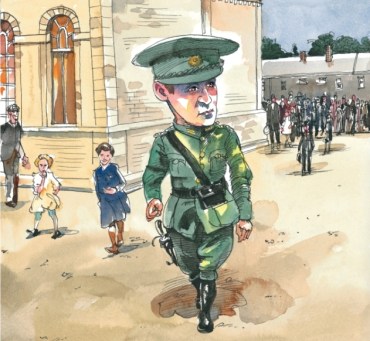
Michael Collins the big fella

Michael Collins illustration in For the Love of Being Irish

.

Collins can credibly be called the father of modern guerilla warfare. His ability to ambush, harass and execute British forces is of legend. While often perceived in romantic terms, Collins was a brutally effective rebel leader who led a passionate group of ultimately successful independence fighters often killing fellow Irishmen  e.g. members of the Royal Irish Constabulary.

.

Writings by Michael Collins

.

FREE Download : The Path to Freedom by Michael Collins .

.

On November 21, 1920, Collins’ men wiped out much of British intelligence in Dublin. The so called Cairo gang was targeted and executed by the IRA. A total of fifteen people were killed, although some may not have been intelligence men. The killings engendered vicious reprisal from British troops who the same day went to a football game in Croke Park and fired indiscriminately into the crowd. Fourteen spectators were killed.

.

A Young Michael Collins

Michael Collins 1919

.

The IRA guerilla activity eventually forced British Prime Minister Lloyd George to agree to peace talks in London where Michael Collins played a prominent role. After signing the Anglo Irish treaty on December 6, 1921, he wrote a friend “I have signed my death warrant.”

Unfortunately, he was right. De Valera and other anti-Treaty politicians rejected a democratic Dail vote accepting the Treaty, an action which resulted in the Irish Civil War. Collins was killed in an action in his native Co. Cork, August 22nd 1922.

.

SEE: Rare Footage of Michael Collins. Despite the credits, this is unlikely to be in Armagh which is not in “Southern Ireland.”

.

His once adversary, Winston Churchill wrote of The Big Fella, “Michael Collins was a man of dauntless courage.”

.

READ: Churchill on Michael Collins

.

Lloyd George said “His engaging personality won friendships even amongst those who met him as foes and to all who met him, the news of his death comes as a personal sorrow.”

Author Tim Pat Coogan in Michael Collins – A Biography quotes Collins’ nemesis de Valera “It is my considered opinion that in the fullness of time history will record the greatness of Michael Collins and it will be recorded at my expense.”

De Valera supporters often doubt whether he made that statement, but few can doubt its sentiment.

.

READ: Detailed Biography of Michael Collins at Military History Online

.

READ:

** ** **

Want to learn more about Ireland? See these images and more in the acclaimed For the Love of Being Irish

Irish gift ideas. Best selling Irish booksRonnie Drew and Luke Kelly - Musical Irish Gifts to the worldJoyce Image in For the Love of Being IrishMichael Collins: Image from For the Love of Being Irish


___________________________________

This history is written by Irish author, business keynote speaker and award winning humorist IrishmanSpeaks – Conor Cunneen. If you spot any inaccuracies or wish to make a comment, please don’t hesitate to contact us via the comment button.

Visit Conor’s YouTube channel IrishmanSpeaks to Laugh and Learn.

Tags: Best Irish Gift, Creative Irish Gift, Unique Irish Gifts, Irish Books, Irish Authors, Today in Irish History TODAY IN IRISH HISTORY (published by IrishmanSpeaks)

October 13,

Loyalist Ceasefire. Irish Medal of Honor Winner. St. Andrews Agreement on This Day in Irish History

October 13: TODAY in Irish History:

** ** **

Curated by Conor Cunneen IrishmanSpeaks

Conor is a Chicago based Motivational Humorous Business Speaker, Author and History buff.

** ** **

1875: John Francis O’Sullivan – Medal of Honor

County Kerry born John Francis O’Sullivan is awarded the Medal of Honor for gallantry during the Indian Wars. His Citation reads: The President of the United States of America, in the name of Congress, takes pleasure in presenting the Medal of Honor to Private John Francis O’Sullivan, United States Army, for gallantry in a long chase after Indians on 8 December 1874, while serving with Company I, 4th U.S. Cavalry, in action at Staked Plains, Texas.

O’Sullivan is buried in Woodside, New York.

.

** ** **

.

1994: Loyalist Ceasefire announced.

Loyalist para-military groups announce ceasefire in Northern Ireland. Loyalist leader Gusty Spence who had been convicted of killing a Catholic barman in 1966 read a statement on behalf of the Combined Loyalist Military Command consisting of Ulster Volunteer Force, Ulster Defence Association and the Red Hand Commando stating that the Command would “cease operational hostilities.” The move came after a similar announcement by the IRA seven weeks previously.

The loyalists also offered a statement of remorse. Gusty Spence, who had been convicted of a sectarian murder almost thirty years previously read the statement and offered an apology.

“In all sincerity, we offer to the loved ones of all innocent victims over the past 25 years abject and true remorse – Let us firmly resolve to respect our differing views of freedom, culture and aspiration and never again permit our political circumstances to degenerate into bloody warfare.”

.

Gusty Spence Announces Loyalist Ceasefire

.

** ** **

2006: St. Andrews Agreement.

A momentous day in Northern Irish politics as parties from both sides of the divide come together to sign the St Andrews in relation to the devolution of power to Northern Ireland. The agreement resulted from multi-party talks held in St Andrews in Fife, Scotland, from 11 October to 13 October 2006, between the two governments and all the major parties in Northern Ireland, including the Democratic Unionist Party (DUP) and Sinn Féin. It resulted in the restoration of the Northern Ireland Assembly, the formation (on 8 May 2007) of a new Northern Ireland Executive and a decision by Sinn Féin to support the Police Service of Northern Ireland, courts and rule of law.

READ: St. Andrews Agreement


** ** **

Want to learn more about Ireland? See these images and more in the acclaimed For the Love of Being Irish

Irish gift ideas. Best selling Irish booksRonnie Drew and Luke Kelly - Musical Irish Gifts to the worldJoyce Image in For the Love of Being IrishMichael Collins: Image from For the Love of Being Irish

BUY Quality Quality Guinness and Ireland Rugby Shirts

Guinness Rugby Shirts - Brilliant!Rugby Shirt - Ireland

___________________________________

This history is written by Irish author, business keynote speaker and award winning humorist IrishmanSpeaks – Conor Cunneen. If you spot any inaccuracies or wish to make a comment, please don’t hesitate to contact us via the comment button.

Visit Conor’s YouTube channel IrishmanSpeaks to Laugh and Learn.

Tags: Best Irish Gift, Creative Irish Gift, Unique Irish Gifts, Irish Books, Irish Authors, Today in Irish History TODAY IN IRISH HISTORY (published by IrishmanSpeaks)