Posts tagged ‘1798 rebellion’

July 2,

Execution of Father John Murphy – Irish Brigade at Gettysburg

July 2: TODAY in Irish History:

** ** **

Father Murphy 1798

Snippets of Irish History by Conor Cunneen IrishmanSpeaks 

Conor is a Chicago based Motivational Humorous Business Speaker, Author and History buff.

***********************

***********************

NEW                    NEW

Product Details

SHEIFGAB! Staying Sane, Motivated and Productive in Job Search.

An insightful, realistic, yet humorous book on the job search process by Today in Irish History Curator Conor Cunneen

Special accessible price for job seekers on Kindle of $2.99

.
shamrockshamrockshamrockshamrockshamrockshamrockshamrockshamrock

.

1798: Execution of Father John Murphy

After enduring dreadful torture, Father John Murphy is executed, and his decapitated head displayed on a pike for his part in the 1798 Rebellion.

Father John Murphy

Murphy is an iconic figure in Irish rebel history who is celebrated in the song Boolavogue.

“Then Father Murphy from old Kilcormack

Spurred up the rocks with a warning cry:

‘Arm! Arm!’ he cried, ‘For I’ve come to lead you;

For Ireland’s freedom we’ll fight or die!”

Murphy, like most of the Catholic clergy did not support the original uprising, but following a skirmish where two English yeoman were killed, he realized it was “fight or die.” Over a five week period, he led a scattered, brave and ultimately futile insurrection against an increasingly vicious English response which involved murder and mass rape. The Irish rebels were no saints themselves indulging in sectarian outrages including burning of Protestants to death. Murphy was not directly involved in these atrocities, some of which were reactive and some borne from a deep hatred of English occupation.

The rebel priest was an effective leader of the 5,000 plus rebels winning a number of battles against the English including famously taking Enniscorthy on May 28th. The rebels suffered a fatal defeat at the Battle of Vinegar Hill on June 21 which effectively ended the rebellion.

FOR MORE ON FATHER MURPHY

.

shamrockshamrockshamrockshamrockshamrockshamrockshamrockshamrock

.

1800:  Act of Union. Ireland Loses Legislative Body

The Act of Union is passed which united the Kingdom of Great Britain and the Kingdom of Ireland to create the United Kingdom of Great Britain and Ireland. The act mean Ireland lost its own independent Parliament and was now to be ruled from England. It would be 1922 before Ireland regained legislative independence.

.

shamrockshamrockshamrockshamrockshamrockshamrockshamrockshamrock

.
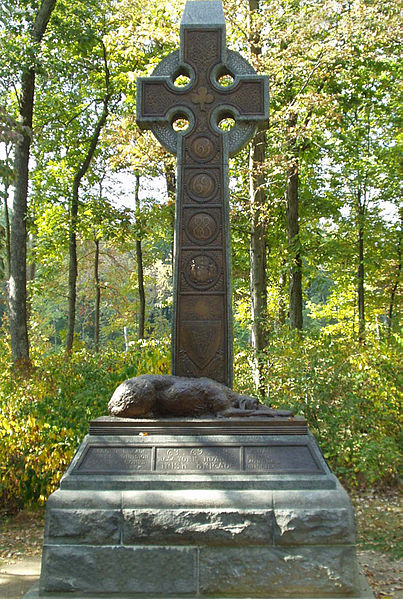
1863:Irish Brigade at Gettysburg

More than six hundred men of the Irish Brigade fight at Gettysburg, losing one third of their number in The Wheatfield. The Irish Brigade suffered severe losses during the Civil War, initially starting with over 2,500 volunteers. The Brigade distinguished itself in numerous conflicts including Chancellorsville, Fair Oaks and Fredericksburg.

Irish Brigade monument at Gettysburg

According to The US Army Center of Military History, the Irish Brigade comprised

28th Massachusetts

63d New York (2 companies)

69th New York (2 companies)

88th New York (2 companies)

116th Pennsylvania (4 companies)

Colonel Richard Byrnes of 28th Massachusetts reported:

“At 3p.m., July 2 the order was given to advance and the regiment proceeded a short distance forward and to the left, and then was ordered back to its original position. Soon after was ordered to move to the left, and about 5:30 o’clock became engaged with the enemy, who were posted in an advantageous position on the crest of a rocky hill. We forced them to retire from this eminence, and advanced over the top and almost to the bottom of the other side of the hill, being all the time exposed to a very severe fire of musketry, and losing many men in killed and wounded.

About 7 p.m., finding all save this regiment were retiring from the hill, and that the enemy were on both our flanks, as well as in front, I brought my command from the field, losing many men from the concentrated fire of the rebels. Our loss in this action was 100 in killed, wounded, and missing, out of 224 taken into the engagement.”

One of those who died at Gettysburg on July 2nd was Cavan-born Colonel Patrick “Paddy” O’Rorke, who was killed at Little Round Top.

File:ColPatrickORorke.jpg

Colonel Paddy O’Rorke

.

Interestingly, the Irish Brigade commenced in a rather inauspicious manner and not with universal buy-in. In his memoirs, General William T. Sherman writes of the early days of the war:

“Soon after I had assumed the command, a difficulty arose in the Sixty-ninth, an Irish regiment. This regiment had volunteered in New York, early in April, for ninety days; but, by reason of the difficulty of passing through Baltimore, they had come via Annapolis, had been held for duty on the railroad as a guard for nearly a month before they actually reached Washington, and were then mustered in about a month after enrollment. Some of the men claimed that they were entitled to their discharge in ninety days from the time of enrollment, whereas the muster-roll read ninety days from the date of muster-in.

One day, Colonel Corcoran explained this matter to me. I advised him to reduce the facts to writing, and that I would submit it to the War Department for an authoritative decision. He did so, and the War Department decided that the muster-roll was the only contract of service, that it would be construed literally; and that the regiment would be held till the expiration of three months from the date of muster-in, viz., to about August 1, 1861. General Scott at the same time wrote one of his characteristic letters to Corcoran, telling him that we were about to engage in battle, and he knew his Irish friends would not leave him in such a crisis. Corcoran and the officers generally wanted to go to the expected battle, but a good many of the men were not so anxious.”

READ: Report on Colonel Paddy O’Rorke

.

SEE: Website dedicated to Irish Brigade at Gettysburg

.

shamrockshamrockshamrockshamrockshamrockshamrockshamrockshamrock

.

Want to learn more about Ireland? See these images and more in the acclaimed For the Love of Being Irish

Irish gift ideas. Best selling Irish booksRonnie Drew and Luke Kelly - Musical Irish Gifts to the worldJoyce Image in For the Love of Being IrishMichael Collins: Image from For the Love of Being Irish

BUY Quality Quality Guinness and Ireland Rugby Shirts
Guinness Rugby Shirts - Brilliant!Rugby Shirt - Ireland


For the Love of Being Irish written by Chicago based Corkman Conor Cunneen and illustrated by Mark Anderson is an A-Z of all things Irish. This is a book that contains History, Horror, Humor, Passion, Pathos and Lyrical Limericks that will have you giving thanks (or wishing you were) For the Love of Being Irish

Watch For the Love of Being Irish author Conor Cunneen – IrishmanSpeaks on his Youtube channel IrishmanSpeaks. Laugh and Learn.

___________________________________

This history is written by Irish author, business keynote speaker and award winning humoristIrishmanSpeaks – Conor Cunneen. If you spot any inaccuracies or wish to make a comment, please don’t hesitate to contact us via the comment button.

Visit Conor’s YouTube channel IrishmanSpeaks to Laugh and Learn. Tags: Best Irish Gift, Creative Irish Gift, Unique Irish Gifts, Irish Books, Irish Authors, Today in Irish History TODAY IN IRISH HISTORY (published by IrishmanSpeaks)


.

shamrockshamrockshamrockshamrockshamrockshamrockshamrockshamrock

.

WATCH: A Short History of Ireland

Want to learn more about Ireland? See these images and more in the acclaimed For the Love of Being Irish

Irish gift ideas. Best selling Irish booksRonnie Drew and Luke Kelly - Musical Irish Gifts to the worldJoyce Image in For the Love of Being IrishMichael Collins: Image from For the Love of Being Irish

___________________________________

This history is written by Irish author, business keynote speaker and award winning humorist IrishmanSpeaks – Conor Cunneen. If you spot any inaccuracies or wish to make a comment, please don’t hesitate to contact us via the comment button.

Visit Conor’s YouTube channel IrishmanSpeaks to Laugh and Learn.

Tags: Best Irish Gift, Creative Irish Gift, Unique Irish Gifts, Irish Books, Irish Authors, Today in Irish History TODAY IN IRISH HISTORY (published by IrishmanSpeaks)


June 4,

Lord Edward Fitzgerald

Important Figures in Irish History

** ** **

Lord Edward Fizgerald

Lord Edward Fitzgerald

Snippets of Irish History by Conor Cunneen IrishmanSpeaks 

Conor is a Chicago based Motivational Humorous Business Speaker, Author and History buff.

***********************

***********************

NEW                    NEW

Product Details

SHEIFGAB! Staying Sane, Motivated and Productive in Job Search.

An insightful, realistic, yet humorous book on the job search process by Today in Irish History Curator Conor Cunneen

Special accessible price for job seekers on Kindle of $2.99

.

shamrockshamrockshamrockshamrockshamrockshamrockshamrockshamrock

.

Biography of Lord Edward Fitzgerald from The Dictionary of National Biography Vol 19, Sir Sidney Lee

Lord Edward Fitzgerald, Irish patriot, was one of the seventeen children of James Fitzgerald, viscount and first duke of Leinster by Emilia Mary, daughter of Charles, duke of Richmond. His father died in 1773, and his mother married William Ogilvie. The Duke of Richmond lent his house at Aubigny in France to the family, who resided there till 1779; Ogilvie undertook Edward’s education, which had been commenced by a tutor named Lynch.

The boy had a marked military bent, and on returning to England joined the Sussex militia, of which his uncle, the Duke of Richmond, was colonel. He next entered the 96th infantry as lieutenant, served with it in Ireland, exchanged into the 19th in order to get foreign service, and in 1781 went out to Charleston. His skill in covering a retreat got him the post of aide-de-camp to Lord Rawdon, on whose retirement he rejoined his regiment. At the engagement of Eutaw Springs, August 1781, he was wounded in the thigh, was left senseless on the field, and might have succumbed had not a negro, Tony, carried him to his hut and nursed him. Tony was thenceforth, to the end of Fitzgerald’s life, his devoted servant or slave. After his recovery Fitzgerald was on O’Hara’s staff at St. Lucia, but soon returned to Ireland, where his eldest brother had him elected M.P. for Athy.

He voted in the Dublin parliament in the small minority with Grattan and Curran. After a course of professional study at Woolwich a disappointment in love drove him to New Brunswick to join his regiment, the 54th, of which he was now major. Cobbett was the sergeant-major, and was grateful to Fitzgerald for procuring him his discharge, describing him to Pitt in 1800 as the only really honest officer he had ever known. Infected by the fashionable Rousseau admiration for savage life, Fitzgerald made his way by compass through the woods from Frederickton to Quebec, was formally admitted at Detroit into the Bear tribe, and went down the Mississippi to New Orleans, but was refused the expected permission to visit the Mexican mines.

On returning home he found himself M.P. for Kildare, became intimate with the whig leaders in London, joined in April 1792 their Society of the Friends of the People, shared their enthusiasm for the French revolution, and in October 1792 visited Paris. He stayed at the same hotel as Paine, took his meals with him, and at a British dinner to celebrate French victories joined in Sir Robert Smith’s toast to the abolition of all hereditary titles. Cashiered from the army for attendance at this revolutionary banquet, he was not, however, so immersed in politics as to neglect the theatres. Hence his brief courtship and his marriage, 27 December 1792. He took his bride over to Ireland, and six days after his arrival at Dublin caused a scene in parliament by describing the lord-lieutenant and the majority as ‘the worst subjects the king has.’ He was ordered into custody, but refused to make any serious apology.

Lord Edward Fitzgerald

When not attending parliament he enjoyed the society of his wife and child and of his flowers at Kildare. His dismissal from the army and the political reaction consequent on the atrocities in France converted the light-hearted young nobleman into a stern conspirator. Early in 1796 he joined the United Irishmen, who now avowedly aimed at an independent Irish republic, and in May he went with Arthur O’Connor to Bâle to confer with Hoche on a French invasion; but the Directory, apprehensive of accusations of Orleanism, on account of Pamela’s supposed kinship with the Orleans family, declined to negotiate with Fitzgerald, who rejoined his wife at Hamburg, leaving O’Connor to treat with Hoche. Returning to Ireland he visited Belfast with O’Connor, then a candidate for Antrim, but in July 1797 he declined to solicit re-election, telling the Kildare voters that under martial law free elections were impossible, but that he hoped hereafter to represent them in a free parliament.

In the following autumn the United Irishmen became a military organisation, 280,000 men, according to a list given by Fitzgerald to Thomas Reynolds, being prepared with arms, and a military committee, headed by Fitzgerald, was deputed to prepare a scheme of co-operation with the French, or of a rising if their arrival could not be awaited. Fitzgerald was himself colonel of the so-called Kildare regiment, but induced Reynolds to take his place. The latter alleges that three months after his appointment he learned the intention of the conspirators to begin the rising by murdering eighty leading noblemen and dignitaries, and that to save their lives he gave the authorities information which led to the arrest, on 12 March 1798, at Oliver Bond’s house, of the Leinster provincial committee. He does not state whether Fitzgerald was cognisant of the intended murders, but anxious for his escape he had on the 11th given him a vague warning and urged flight, whereupon Fitzgerald expressed a desire to go to France that he might induce Talleyrand to hasten the invasion. Owing perhaps to Reynolds’s warning, Fitzgerald was not at Bond’s meeting; but being told there was no warrant against himself was about to enter his own house, then being searched by the police, when Tony, on the look-out, gave him timely notice.

So far from distrusting Reynolds, Fitzgerald, while in concealment, sent for him on the 14th and 15th, the first time to propose taking refuge in Kilkee Castle, the property of the Duke of Leinster, then occupied by Reynolds. Reynolds objected to the plan as unsafe, and next day took him fifty guineas and a case of pocket pistols. Reynolds clearly gave no information of these interviews, and Lord-chancellor Clare, if not other members of the Irish government, was also desirous of an escape. Fitzgerald, however, remained in or near Dublin, paid two secret visits, once in female attire, to his wife, who had prudently removed from Leinster House, walked along the canal at night, and actively continued preparations for a rising fixed for 23 May. The authorities were therefore obliged in self-defence to take more serious steps for his apprehension, and on 11 May they offered a reward of £1,000.

Madden gives reasons for thinking that the F. H. or J. H. (the first initial was indistinctly written in the original document from which he copied the entry) to whom on 20 June the sum was paid, was John Hughes, a Belfast bookseller, one of Fitzgerald’s so-called body-guard. However this may be, the authorities knew that on the 19th he would be at Murphy’s, a feather dealer. Fitzgerald, having dined, was lying with his coat off on a bed upstairs, and Murphy was asking him to come down to tea, when Major Swan and Ryan mounted the stairs and entered the room. After a desperate struggle, in which Ryan was mortally wounded, Fitzgerald was captured. Shot in the right arm by Major Sirr, who had also entered the room, his wound was pronounced free from danger, whereupon he said, ‘I am sorry for it.’ He was taken first to the castle and then to Newgate. Inflammation set in; his brother Henry and his aunt (Lady Louisa Conolly) were allowed to see him in his last moments, and on 4 June he expired. His remains were interred in St. Werburgh Church, Dublin, and Sirr, forty-three years later, was buried a few paces off in the churchyard. A bill of attainder was passed against Fitzgerald, but the government allowed his Kilrush estate, worth about £700 a year, to be bought by Ogilvie at the price of the mortgage, £10,400, and in 1819 the attainder was repealed. Fitzgerald was of small stature (Reynolds says 5 feet 5 inches, Murphy 5 feet 7 inches), and Moore, who once saw him in 1797, speaks of his peculiar dress, elastic gait, healthy complexion, and the soft expression given to his eyes by long dark eyelashes. He left three children: Edward Fox (1794-1863), an officer in the army; Pamela, wife of General Sir Guy Campbell; and Lucy Louisa, wife of Captain G. F. Lyon, R.N.

.

shamrockshamrockshamrockshamrockshamrockshamrockshamrockshamrock

.

Conor Cunneen on The Irish in the American Civil War

Want to learn more about Ireland? See these images and more in the acclaimed For the Love of Being Irish

Irish gift ideas. Best selling Irish booksRonnie Drew and Luke Kelly - Musical Irish Gifts to the worldJoyce Image in For the Love of Being IrishMichael Collins: Image from For the Love of Being Irish

___________________________________

This history is written by Irish author, business keynote speaker and award winning humorist IrishmanSpeaks – Conor Cunneen. If you spot any inaccuracies or wish to make a comment, please don’t hesitate to contact us via the comment button.

Visit Conor’s YouTube channel IrishmanSpeaks to Laugh and Learn.

Tags: Best Irish Gift, Creative Irish Gift, Unique Irish Gifts, Irish Books, Irish Authors, Today in Irish History TODAY IN IRISH HISTORY (published by IrishmanSpeaks)