Posts tagged ‘1798 rebellion’

May 23,

1798 Rebellion Starts – Good Friday Agreement Approved at Today in Irish History

May 23: TODAY in Irish History:

** ** **

Good Friday Agreement: Ahern and Blair

Snippets of Irish History by Conor Cunneen IrishmanSpeaks 

Conor is a Chicago based Motivational Humorous Business Speaker, Author and History buff.

.
shamrockshamrockshamrockshamrockshamrockshamrockshamrockshamrock

.

1796: Waterford Architect John Roberts

Death of Waterford architect John Roberts (b. 1712). Much of Waterford bears testimony to Roberts skills. He has the rare distinction of designing both the Catholic and Protestant Cathedrals in a city (especially given the times he lived in.) Roberts first major assignment was to complete the Bishop’s Palace on The Mall of Dr. Richard Chevenix, the Church of Ireland Bishop of Waterford & Lismore. His other designs include the forecourt of Curraghmore House for the Marquis of Waterford, Newtown House (now Newtown School) for John Wyse and Faithlegg House for the Bolton family. In 1785 he built the residence of William Morris, now the Harbour Commissioners’ headquarters and the Chamber of Commerce. In 1787 he was commissioned to build a new Leper Hospital on John’s Hill. Roberts also built the Assembly Rooms on the Mall in 1788, which is now the Theatre Royal and City Hall.

Waterford Cathedral by John Roberts

.

READ: Biography of John Roberts at Dictionary of Irish Architects

.

1798: Rebellion

The short lived, brutal 1798 Rebellion instigated by the United Irishmen commences when on the night of the 23rd May, the mail coaches leaving Dublin were seized – as a signal to those United Irishmen outside the capital that the time of the uprising had arrived.

Founded in 1791, The United Irishmen had been inspired by the French Revolution. Led by Theobald Wolfe Tone, Thomas Russell, Henry Joy McCracken and William Drennan, their idealistic goal was to unite Protestant, Catholic and Dissenter into one political movement to rid Ireland of English rule. The seizure of the mail coaches did not evoke a rising in Dublin as planned and over the coming days mis-matched Irish rebels throughout the country, but especially Wexford, were put to the sword by a brutal English response.

The 1798 Rebellion was the bloodiest in Irish History. Over two months, atrocities occurred on both sides. The number of casualties among the Irish – rebels and civilians  – ranges from 10,000 to 50,000. English military casualties (many of them Irish) are estimated between 1,000-2,000 with possibly another 1,000 civilians loyal to the crown also killed.

.

United Irishmen Leader Henry Joy McCracken

.

X

.

shamrockshamrockshamrockshamrockshamrockshamrockshamrockshamrock

.

1998: Good Friday Referendum

Results of the referendums held in Republic of Ireland and Northern Ireland on the Good Friday Agreement show a massive majority in support of the Agreement  on both sides of the border.

Good Friday Architects Bertie Ahern and Tony Blair

The questions asked of each electorate were different.

In the North, 71% said “Yes” to “Do you support the Agreement reached at the multi-party talks on Northern Ireland and set out in Command Paper 3883?”

In the Republic, 94% of those who went to the polls voted “Yes” to the question “Do you approve of the proposal to amend the Constitution contained in the (19th Amendment to the Constitution) undermentioned Bill? The amendment relinquished the Republic of Ireland’s claim to Northern Ireland which had been enshrined in the 1937 Constitution, just 15 years after Ireland was partitioned.

The deleted articles read:

Article 2: The national territory consists of the whole island of Ireland, its islands and the territorial seas.

Article 3: Pending the re-integration of the national territory, and without prejudice to the right of the Parliament and Government established by this Constitution to exercise jurisdiction over the whole of that territory, the laws enacted by that Parliament shall have the like area and extent of application as the laws of Saorstát Éireann and the like extra-territorial effect.

The deleted articles were replaced with:

2. It is the entitlement and birthright of every person born in the island of Ireland, which includes its islands and seas, to be part of the Irish nation. That is also the entitlement of all persons otherwise qualified in accordance with law to be citizens of Ireland. Furthermore, the Irish nation cherishes its special affinity with people of Irish ancestry living abroad who share its cultural identity and heritage.

3.1. It is the firm will of the Irish nation, in harmony and friendship, to unite all the people who share the territory of the island of Ireland, in all the diversity of their identities and traditions, recognising that a united Ireland shall be brought about only by peaceful means with the consent of a majority of the people, democratically expressed, in both jurisdictions in the island. Until then, the laws enacted by the Parliament established by this Constitution shall have the like area and extent of application as the laws enacted by the Parliament that existed immediately before the coming into operation of this Constitution.

3.2. Institutions with executive powers and functions that are shared between those jurisdictions may be established by their respective responsible authorities for stated purposes and may exercise powers and functions in respect of all or any part of the island.

FOR MORE DETAIL ON THE GOOD FRIDAY AGREEMENT

.

shamrockshamrockshamrockshamrockshamrockshamrockshamrockshamrock

.

Want to learn more about Ireland? See these images and more in the acclaimed For the Love of Being Irish

Irish gift ideas. Best selling Irish booksRonnie Drew and Luke Kelly - Musical Irish Gifts to the worldJoyce Image in For the Love of Being IrishMichael Collins: Image from For the Love of Being Irish

___________________________________

This history is written by Irish author, business keynote speaker and award winning humorist IrishmanSpeaks – Conor Cunneen. If you spot any inaccuracies or wish to make a comment, please don’t hesitate to contact us via the comment button.

Visit Conor’s YouTube channel IrishmanSpeaks to Laugh and Learn.

Tags: Best Irish Gift, Creative Irish Gift, Unique Irish Gifts, Irish Books, Irish Authors, Today in Irish History TODAY IN IRISH HISTORY (published by IrishmanSpeaks)


March 14,

Birmingham Six Freed after Sixteen Years – Robert Emmet at Today in Irish History

March 14: TODAY in Irish History:

** ** **

Snippets of Irish History by Conor Cunneen IrishmanSpeaks 

Conor is a Chicago based Motivational Humorous Business Speaker, Author and History buff.

***********************
WATCH: A Short History of Ireland

***********************


shamrock shamrock

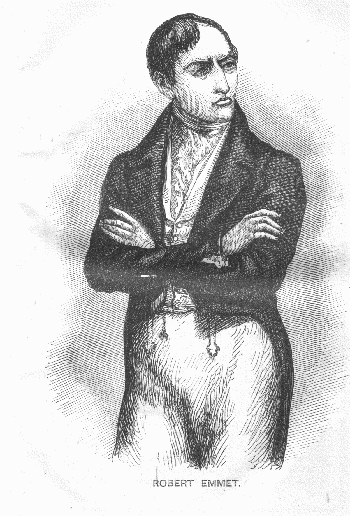
1778: Robert Emmet

Robert Emmet is born into a wealthy Protestant Dublin family. He would go on to become one of Ireland’s most famous (but also pretty incompetent) rebels who would be executed for high treason.

.

Robert Emmet 1778-1803

.

In 1803, Emmet would be  captured in Dublin on August 25th following a hopelessly unsuccessful attempt at insurrection. In one sense, Emmet’s rebellion deserves little more than a footnote in history. The rebellion itself was more a riot than a full scale insurrection, but it garnered major publicity when the Lord Chief Justice of Ireland was killed in the affray.

Robert Emmet’s place in history is primarily due to his powerful speech from the dock where he said:

“Let no man write my epitaph; for as no man who knows my motives dare now vindicate them, let not prejudice or ignorance, asperse them. Let them and me rest in obscurity and peace, and my tomb remain uninscribed, and my memory in oblivion, until other times and other men can do justice to my character. When my country takes her place among the nations of the earth, then and not till then, let my epitaph be written. I have done.”

Emmet’s burial place is unknown.

READ: Full Text of Robert Emmet’s Speech from the Dock.

shamrock shamrock

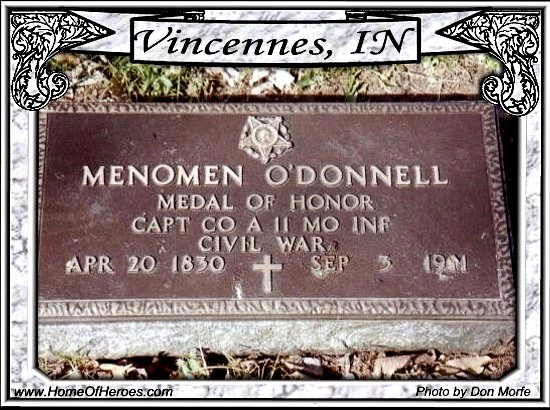
1864: Menomen O’Donnell – Medal of Honor Recipient

Irish born Lieutenant Menomen O’Donnell is involved in action at Fort DeRussey  on this day and also at Vicksburg for which he receives the Medal of Honor. His citation reads:

The President of the United States of America, in the name of Congress, takes pleasure in presenting the Medal of Honor to First Lieutenant Menomen O’Donnell, United States Army, for extraordinary heroism on 22 May 1863 while serving with Company A, 11th Missouri Infantry, in action at Vicksburg, Mississippi. First Lieutenant O’Donnell voluntarily joined the color guard in the assault on the enemy’s works when he saw indications of wavering and caused the colors of his regiment to be planted on the parapet. At Fort DeRussey, Louisiana, on 14 March 1864, he voluntarily placed himself in the ranks of an assaulting column (being then on staff duty) and rode with it into the enemy’s works, being the only mounted officer present, was twice wounded in battle.

Menomen O'Donnell headstone  irish medal of honor winners

shamrock shamrock

1921: Six IRA Volunteers Executed

British authorities hang six IRA volunteers for crimes of high treason and murder. There is some strong evidence to suggest at least some of the men were innocent of the crimes they were accused of although all had been involved in violent acts against British forces in Ireland.

shamrock shamrock

1923: Irish Government Executes Sixteen Rebels

More executions on this date in Irish history. This time the new Irish government which has taken a strong stance against anti-treaty activists executes sixteen anti-Treatyites between March 12-March 14.

shamrock shamrock

1991: Birmingham Six Freed

The "Birmingham Six"

The “Birmingham Six”

Birmingham Six are freed after 16 years in jail. The six innocent men – Paddy Joe Hill, Hugh Callaghan, Richard McIlkenny, Gerry Hunter, Billy Power and Johnny Walker had been found guilty of placing bombs in Birmingham pubs in 1974 that killed 21 people and injured more than 100. At a time when public fury was at its height following the bombings, an over-zealous West-Midland police force beat confessions out of the innocent men and fabricated / altered notes of the confessions. One of the six Paddy Hill stated on his release “”The police told us from the start they knew we hadn’t done it. They didn’t care who had done it.”

As early as 1976, Fathers Denis Faul and Raymond Murray published a detailed document questioning the men’s convictions.

.

READ: The Birmingham Framework: Six Innocent Men Framed for the Birmingham Bombings by Fr. Denis Faul and Fr. Raymond Murray (1976)

.

SEE: ITV Program on Birmingham Six.

.

The Provisional IRA had planted bombs in two pubs: The Mulberry Bush bomb was followed minutes later by a bomb in the nearby Tavern in the Town. The IRA had phoned a warning twelve minutes before the first bomb went off, but the bombs went off as police were trying to clear the pubs. One of the ironies of the murderous attack was that a number of the victims were second-generation Irish.

.

SEE: ITV Program on Birmingham Six

shamrock shamrock

Want to learn more about Ireland? See these images and more in the acclaimed For the Love of Being Irish

Irish gift ideas. Best selling Irish booksRonnie Drew and Luke Kelly - Musical Irish Gifts to the worldJoyce Image in For the Love of Being IrishMichael Collins: Image from For the Love of Being Irish

___________________________________

This history is written by Irish author, business keynote speaker and award winning humorist IrishmanSpeaks – Conor Cunneen. If you spot any inaccuracies or wish to make a comment, please don’t hesitate to contact us via the comment button.

Visit Conor’s YouTube channel IrishmanSpeaks to Laugh and Learn.

Tags: Best Irish Gift, Creative Irish Gift, Unique Irish Gifts, Irish Books, Irish Authors, Today in Irish History TODAY IN IRISH HISTORY (published by IrishmanSpeaks)