Posts tagged ‘Famous Irish Americans’

May 28,

Actor and Hero Audie Murphy – Irish Civil War Ends – Archbishop Thomas Croke at Today in Irish History

May 28: TODAY in Irish History:

** ** **

Audie Murphy 1924-1971

Audie Murphy 1924-1971

Snippets of Irish History by Conor Cunneen IrishmanSpeaks 

Conor is a Chicago based Motivational Humorous Business Speaker, Author and History buff.

***********************
WATCH: A Short History of Ireland

***********************

NEW                    NEW

Product Details

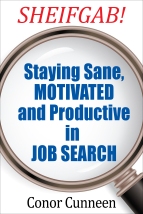
SHEIFGAB! Staying Sane, Motivated and Productive in Job Search.

An insightful, realistic, yet humorous book on the job search process by Today in Irish History Curator Conor Cunneen

Special accessible price for job seekers on Kindle of $2.99

.

.

shamrockshamrockshamrockshamrockshamrockshamrockshamrockshamrock

.

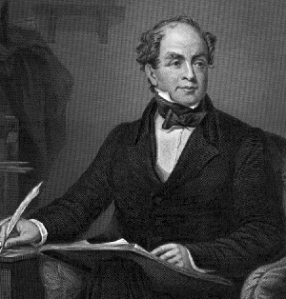
1779Songwriter Thomas Moore

Thomas Moore 1779-1852

Poet and songwriter Thomas Moore is born in Dublin, Moore wrote some of Ireland’s finest melodies including The Minstrel Boy: She is far from the Land: Believe me, if all those endearing young charms and literally hundreds of others.

Moore was also an accomplished satirist and poet who in Enigma wrote about the growing public debt….. (even back then!!!)

Come riddle-me-ree, come riddle-me-ree,
And tell me, what my name may be.
I am nearly one hundred and thirty years old,
And therefore no chicken, as you may suppose; —
Though a dwarf in my youth (as my nurses have told),
I have, ev’ry year since, been outgrowing my clothes;
Till, at last, such a corpulent giant I stand,
That if folks were to furnish me now with a suit,
It would take ev’ry morsel of scrip in the land
But to measure my bulk from the head to the foot.

Click for a comprehensive list of Thomas Moore’s works.

.

shamrockshamrockshamrockshamrockshamrockshamrockshamrockshamrock

.

 1824: Archishop Thomas William Croke

Birth of Thomas William Croke in County Cork. Croke became the second Catholic Bishop of Auckland New Zealand before returning to Ireland as Archbishop of Cashel and Emly.

He was a strong and public supporter of Irish nationalism aligning himself with the Irish National Land League during the Land War, and wit the chairman of the Irish Parliamentary Party, Charles Stewart Parnell, although he distanced himself from disgraced Parnell after the politician’s liaison with Kitty O’Shea became public.

The main GAA stadium in Dublin – Croke Park – is named in his honor.

Archbishop Thomas Croke

.

shamrockshamrockshamrockshamrockshamrockshamrockshamrockshamrock

.

1923: End of Irish Civil War

After close to a year of brutal internecine conflict, Eamonn De Valera calls a halt to the Civil War.He issued a statement to the Anti-Treaty forces accepting defeat at the hands of a Free State government.

“Soldiers of the Republic. Legion of the Rearguard: The Republic can no longer be defended successfully by your arms. Further sacrifice of life would now be in vain and the continuance of the struggle in arms unwise in the national interest and prejudicial to the future of our cause. Military victory must be allowed to rest for the moment with those who have destroyed the Republic.”

Nothing was achieved by De Valera and his supporters when they rejected a democratic Dail vote approving the Treaty and pitching the country into civil war. The country would be bitterly divided for generations following a war that took the life of Michael Collins. Almost 100 years later, despite all De Valera’s rhetoric, the island of Ireland is still a two-nation state.

.

READ: Overview of Irish Civil War

.

The Madness Within – The Irish Civil War

.

shamrockshamrockshamrockshamrockshamrockshamrockshamrockshamrock

.

1971: Actor and Hero Audie Murphy

Audie Murphy dies in a plane crash. Murphy – born in Texas to share-cropping parents of Irish descent – was the most decorated US soldier of World War II

Audie Murphy 1924-1971

His Citation for the Medal of Honor reads:

Second Lt. Murphy commanded Company B, which was attacked by six tanks and waves of infantry. 2d Lt. Murphy ordered his men to withdraw to a prepared position in a woods, while he remained forward at his command post and continued to give fire directions to the artillery by telephone. Behind him, to his right, one of our tank destroyers received a direct hit and began to burn. Its crew withdrew to the woods. 2d Lt. Murphy continued to direct artillery fire, which killed large numbers of the advancing enemy infantry. With the enemy tanks abreast of his position, 2d Lt. Murphy climbed on the burning tank destroyer, which was in danger of blowing up at any moment, and employed its .50 caliber machine gun against the enemy. He was alone and exposed to German fire from three sides, but his deadly fire killed dozens of Germans and caused their infantry attack to waver. The enemy tanks, losing infantry support, began to fall back. For an hour the Germans tried every available weapon to eliminate 2d Lt. Murphy, but he continued to hold his position and wiped out a squad that was trying to creep up unnoticed on his right flank. Germans reached as close as 10 yards, only to be mowed down by his fire. He received a leg wound, but ignored it and continued his single-handed fight until his ammunition was exhausted. He then made his way back to his company, refused medical attention, and organized the company in a counterattack, which forced the Germans to withdraw. His directing of artillery fire wiped out many of the enemy; he killed or wounded about 50. 2d Lt. Murphy’s indomitable courage and his refusal to give an inch of ground saved his company from possible encirclement and destruction, and enabled it to hold the woods which had been the enemy’s objective.”

Murphy was awarded thirty two other medals for gallantry including the Distinguished Service Cross, the Silver Star, four Purple Hearts, a Bronze Star, and the French and Belgian Croix de Guerre.

Following the war, Murphy became a movie actor, starring in numerous films including his own bio-pic To Hell and Back.

.

.

June 1, 1971, Audie Murphy

.

shamrockshamrockshamrockshamrockshamrockshamrockshamrockshamrock

.

Want to learn more about Ireland? See these images and more in the acclaimed For the Love of Being Irish

Irish gift ideas. Best selling Irish booksRonnie Drew and Luke Kelly - Musical Irish Gifts to the worldJoyce Image in For the Love of Being IrishMichael Collins: Image from For the Love of Being Irish

___________________________________

This history is written by Irish author, business keynote speaker and award winning humorist IrishmanSpeaks – Conor Cunneen. If you spot any inaccuracies or wish to make a comment, please don’t hesitate to contact us via the comment button.

Visit Conor’s YouTube channel IrishmanSpeaks to Laugh and Learn.

Tags: Best Irish Gift, Creative Irish Gift, Unique Irish Gifts, Irish Books, Irish Authors, Today in Irish History TODAY IN IRISH HISTORY (published by IrishmanSpeaks)


May 15,

“Da Mare” Richard J. Daley – Father Flanagan of Boys Town – Jerry Quarry at Today in Irish History

May 15 :TODAY in Irish History:

** ** **

Father Flanagan 1886-1948

Snippets of Irish History by Conor Cunneen IrishmanSpeaks 

Conor is a Chicago based Motivational Humorous Business Speaker, Author and History buff.

***********************
WATCH: A Short History of Ireland

***********************

shamrockshamrockshamrockshamrockshamrockshamrockshamrockshamrock

.

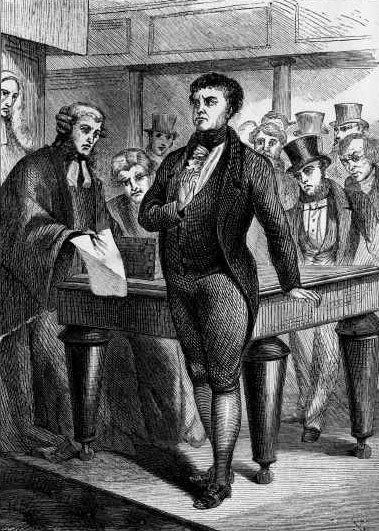
1829: Daniel O’Connell Refuses to take Oath of Supremacy

Roman Catholic Daniel O’Connell attempts to take his seat in the  House of Commons. He refuses to take the Oath of Supremacy which stated “the sacrifice of the Mass, and the invocation of the Blessed Virgin Mary and other saints, as now practiced in the Church of Rome, are impious and idolatrous.”

O’Connell refused the oath stating “I decline, Mr. Clerk, to take this oath: part of it I know to be false; another part I believe not to be true.”

Daniel O’Connell refusing to take oath

Solicitor-General Nicholas Conyngham Tindal moved that his seat be declared vacant and another election ordered; O’Connell was elected unopposed on 30 July 1829. Following the introduction of The Catholic Relief Act of 1829, O’Connell was able to take his seat in Parliament.

.

shamrockshamrockshamrockshamrockshamrockshamrockshamrockshamrock

.

1847: Death of Daniel O’Connell

Eighteen years after refusing to take the Oath of Supremacy, Daniel O’Connell – The Great Emancipator – dies in Genoa age 71. O’Connell was the prime mover in attaining Catholic Emancipation – allowing Catholics to sit in Parliament.

Daniel O’Connell was born in Cahirciveen, Co Kerry. O’Connell would go on to be one of the most important figures in Irish political and Catholic civil rights history.

O’Connell was a rock star politician and fine orator who drew huge crowds. His actions, and the concerns of Prime Minister Duke of Wellington (born Dublin 1769) that the continued refusal to provide the vote to Catholics would generate further unrest ensured the passing of the Catholic Emancipation Act. O’Connell was so popular that King George IV complained “‘O’Connell! God damn the scoundrel.’ Oh, the Duke of Wellington is King of England, O’Connell is King of Ireland and I suppose I am only considered as Dean of Windsor’.

Daniel O’Connell originally won a by-election in County Clare in 1828 defeating William Vesey Fitzgerald. but was not allowed take his seat refusing to swear an Oath of Supremacy that was incompatible with his Catholic faith.

.

Daniel O'Connell
Daniel O’Connell 1775-1847

.

Page on Daniel O’Connell in FOR THE LOVE OF BEING IRISH. by Conor Cunneen. Illustrations by Mark Anderson

Page on Daniel O’Connell in FOR THE LOVE OF BEING IRISH.

PURCHASE AUTHOR SIGNED COPY

.

READ: Detailed Biography of O’Connell at History of Parliament

.

shamrockshamrockshamrockshamrockshamrockshamrockshamrockshamrock

.

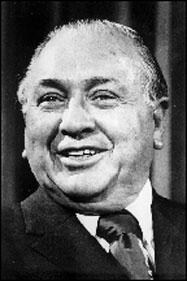
1902: Richard J. Daley – “Da Mare”

Richard J. Daley 1972-1976

Richard J. Daley, who would go on to become “Da Mare” of Chicago is born. Daley’s ancestors left Ireland at the time of the famine, settling in Chicago, a city that he ruled with an iron fist in his time as Mayor from 1955-1976. Daley was one of the last old style politicians (although some would say his son Richard M. Daley followed suit) who doled out favors and positions to friends, colleagues and cronies. His handling of the Democratic Convention riots of 1968 was a very public blot on his profile as Chicago police engaged in what was described as a “police riot.” Daley’s response was “The confrontation was not caused by the police. The confrontation was caused by those who charged the police. Gentlemen, let’s get this thing straight, once and for all. The policeman is not here to create disorder. The policeman is here to preserve disorder.”

Daley’s speaking style provided a font of humor for comedians and satirists. In For the Love of Being Irish, author Conor Cunneen quotes Daley as saying of how he had been treated by critics: “They have vilified me, they have crucified me; yes, they have even criticized me.”

Daley is often credited with stealing the election for John Fitzgerald Kennedy in 1960 by ensuring the democratic candidate won Illinois. While there may be some truth that a number of Kennedy supporters voted early and often, Illinois was not critical. Even had the vote gone the other way and the states 27 Electoral College votes went to Nixon, Kennedy had sufficient electoral college votes, as his final victory margin was 303 to Nixon’s 219.

Richard J. Daley Telephone Conversation with JFK

Daley’s ability to make things happen are evidenced in a telephone conversation he had with JFK on October 28th, 1963 in relation to civil rights legislation the President was pushing.

JFK: (IL. Democratic Congressman) Roland Libonati is sticking it right up us.

Daley: Is, he is?

JFK: Yeah, because he’s standing with the extreme liberals who are gonna end up with no bill at all. Then when we put together, uh, he’ll, gonna vote for the extreme bill. Then I asked him, “If you’ll vote for this package which we got together with the Republicans which gives us about everything we wanted,” and he says, “No.”

Daley: Daley: He’ll vote for it. He’ll vote for any goddamned thing you want….. That’s better. But he’ll do it. The last time I, I told him, “Now look it, I don’t give a goddamned what it is, you vote for, for anything the President wants and this is the way it will be and this is the way we want it and that’s the way it’s gonna be.”

Daley and JFK - 1963   AP
Daley and JFK – 1963                                 

.

LISTEN to Daley / Kennedy Phone Conversation

.

Daley on 1968 Chicago Riots

.

.

shamrockshamrockshamrockshamrockshamrockshamrockshamrockshamrock

.

1945: Boxer “Irish” Jerry Quarry

Jerry Quarry

Birth of heavyweight boxer “Irish” Jerry Quarry who is the only fighter to have fought Muhammad Ali and Joe Frazier twice. He lost each fight and was virtually a punch bag for Ali in his second fight. Quarry was voted the most popular boxer in the sport by Boxing Illustrated for three years running 1968-1970, partly because he was promoted as the “Great White Hope.” Quarry was a very brave fighter as many YouTube videos will attest, but he paid a brutal price for twenty-eight years in the ring and a record of 53-9-4, suffering from dementia pugilistica before his death.

The first clip highlights one of Quarry’s best performances against Ernie Shavers.

This clip shows Quarry being outclassed by “Irishman” Muhammad Ali with commentary by broadcaster and commentator Eamonn Andrews

Quarry was never a great boxer, but he never gave up.

.

READ: A Boxing Fan’s Perspective on Jerry Quarry

.

shamrockshamrockshamrockshamrockshamrockshamrockshamrockshamrock

.

1948: Death of Father Flanagan

Roscommon born Father Edward J. Flanagan (b. 1886), founder of Boys Town dies while travelling in Germany. He was a true friend to children in need who stated ““There are no bad boys. There is only bad environment, bad training, bad example, bad thinking.”

.

Roscommon born Father Flanagan

.

The website www.boystown.org says “On December 12, 1917, Father Flanagan opened his first Boys’ Home in a run-down Victorian mansion in downtown Omaha. In 1921, the Boys’ Home moved to Overlook Farm, its present location near 139th and West Dodge Road. Father Flanagan and Boys Town became internationally known with the help of the 1938 movie, “Boys Town.” He became an acknowledged expert in the field of child care, and toured the United States discussing his views on juvenile delinquency.”

Flanagan’s great work was portrayed (in a very Hollywood style) in Boys Town starring Spencer Tracy who was of Irish extraction.

.

shamrockshamrockshamrockshamrockshamrockshamrockshamrockshamrock

.

Want to learn more about Ireland? See these images and more in the acclaimed For the Love of Being Irish

Irish gift ideas. Best selling Irish booksRonnie Drew and Luke Kelly - Musical Irish Gifts to the worldJoyce Image in For the Love of Being IrishMichael Collins: Image from For the Love of Being Irish

___________________________________

This history is written by Irish author, business keynote speaker and award winning humorist IrishmanSpeaks – Conor Cunneen. If you spot any inaccuracies or wish to make a comment, please don’t hesitate to contact us via the comment button.

Visit Conor’s YouTube channel IrishmanSpeaks to Laugh and Learn.

Tags: Best Irish Gift, Creative Irish Gift, Unique Irish Gifts, Irish Books, Irish Authors, Today in Irish History TODAY IN IRISH HISTORY (published by IrishmanSpeaks)