Posts tagged ‘famous irish’

November 6,

Johnny Giles, Owen Roe O’Neill, Bill Clinton at Today in Irish History

November 6: TODAY in Irish History:

** ** **

Snippets of Irish History by Conor Cunneen IrishmanSpeaks

Conor is a Chicago based Motivational Humorous Business Speaker, Author and History buff.

** ** **

.

1649: Death of Eoghan Ruadh O’Neill (Owen Roe O’Neill)
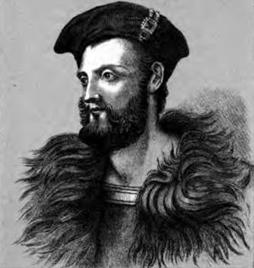
Owen_Roe_O'Neill Eoghan Ruadh O'Neill

Eoghan Ruadh O’Neill 1590-1649

.

O’Neill was an Irish warlord who with the support of Spain rebelled against English rule. Romanticized in Irish history partly because of the poem written by Young Ireland founder Thomas Davis who wrote The Lament for Eoghan Ruadh O’Neill. Despite Davis’ reference to O’Neill being poisoned, there is no clear evidence as to how he died.

The Lament for Eoghan Ruadh O’Neill.

“Did they dare, did they dare, to slay Eoghan Ruadh O’Neill?”

“Yes, they slew with poison him they feared to meet with steel.”

“May God wither up their hearts! May their blood cease to flow!

May they walk in living death, who poisoned Eoghan Ruadh!”

“Though it break my heart to hear, say again the bitter words.

From Derry, against Cromwell, he marched to measure swords:

But the weapon of the Sacsanach met him on his way,

And he died at Cloch Uachtar upon St. Leonard’s day.

“Wail, wail ye for the Mighty One! Wail, wail ye for the Dead!

Quench the hearth, and hold the breath–with ashes strew the head.

How tenderly we loved him! How deeply we deplore!

Holy Saviour! but to think we shall never see him more.

“Sagest in the council was he, kindest in the hall!

Sure we never won a battle–’twas Eoghan won them all.

Had he lived–had he lived–our dear country had been free;

But he’s dead, but he’s dead, and ’tis slaves we’ll ever be.

“O’Farrell and Clanrickarde, Preston and Red Hugh,

Audley and MacMahon, ye are valiant, wise, and true;

But–what, what are ye all to our darling who is gone?

The Rudder of our Ship was he, our Castle’s corner stone!

“Wail, wail him through the Island! Weep, weep for our pride!

Would that on the battle-field our gallant chief had died!

Weep the Victor of Beann-bhorbh[79]–weep him, young men and old;

Weep for him, ye women–your Beautiful lies cold!

“We thought you would not die–we were sure you would not go,

And leave us in our utmost need to Cromwell’s cruel blow–

Sheep without a shepherd, when the snow shuts out the sky–

Oh! why did you leave us, Eoghan? Why did you die?

“Soft as woman’s was your voice, O’Neill! bright was your eye,

Oh! why did you leave us, Eoghan? Why did you die?

Your troubles are all over, you’re at rest with God on high,

But we’re slaves, and we’re orphans, Eoghan!–why didst thou die?”

READ: Biography of Eoghan Ruadh O’Neill (Owen Roe O’Neill)

.

** ** **

.

1940: Johnny Giles

One of Ireland’s greatest ever soccer players, Johnny Giles is born in Dublin. His stature in the game is evidenced by the fact in 2003 he was a winner of UEFA’s Jubilee Award as the best Irish player of the past 50 years.

The diminutive Giles (5 ft 7 in) was a magnificent footballer whose passing ability was legendary. He was also tough as nails and some non-Irish (or non Leeds United) supporters might even suggest he did not always play the ball!

.

.

Originally discovered by legendary Manchester United scout Billy Behan, he signed for the Red Devils in 1957. Although he won an FA Cup medal with United in 1963, United manager Matt Busby failed to appreciate his talent and he was but a peripheral figure as the manager rebuilt a team decimated by the Munich air crash.

Giles dropped down a division to sign for Leeds United in 1963 after which both he and Leeds grew in stature and success.

Following a very successful playing career, Giles went on to manage Ireland and a number of clubs including West Brom Albion. The little fella can be seen regularly in RTE studios providing superb analysis of international and Premier League soccer.

Read: Profile Johnny Giles

.

** ** **

.

1996: Bill Clinton is re-elected President.

Clinton does not have Irish heritage, but his presidency will likely be seen as one that had the greatest impact on Ireland. It is quite likely that the Northern Ireland peace process and the Good Friday agreement would never have happened without his cajoling and support.

In 1995, speaking to the employees of the Mackie Plant in sectarian divided Belfast, he said:

“Here in Northern Ireland, you are making a miracle, a miracle symbolized by those two children who held hands and told us what this whole thing is all about. In the land of the harp and the fiddle, the fife and the lambeg drum, two proud traditions are coming together in the harmonies of peace. The cease-fire and negotiations have sparked a powerful transformation.”

.
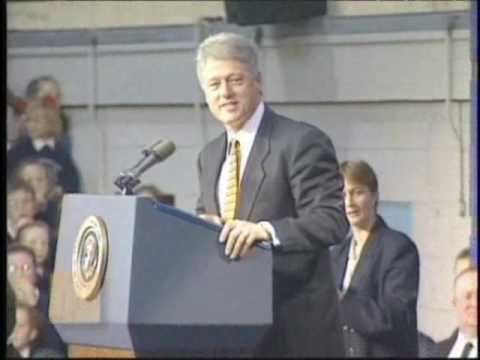
clinton mackie plant november 95

Bill Clinton speaking at Mackie Plant Belfast 1995

READ: Bill Clinton Mackie Plant speech

In Ireland (as it seems in so many other places), Bill Clinton is a rock star.

.

** ** **

Want to learn more about Ireland? See these images and more in the acclaimed For the Love of Being Irish

Irish gift ideas. Best selling Irish booksRonnie Drew and Luke Kelly - Musical Irish Gifts to the worldJoyce Image in For the Love of Being IrishMichael Collins: Image from For the Love of Being Irish

___________________________________

This history is written by Irish author, business keynote speaker and award winning humorist IrishmanSpeaks – Conor Cunneen. If you spot any inaccuracies or wish to make a comment, please don’t hesitate to contact us via the comment button.

Visit Conor’s YouTube channel IrishmanSpeaks to Laugh and Learn.

Tags: Best Irish Gift, Creative Irish Gift, Unique Irish Gifts, Irish Books, Irish Authors, Today in Irish History TODAY IN IRISH HISTORY (published by IrishmanSpeaks)

Tags:
October 14,

New York Born Eamonn de Valera. Thomas Davis. United Irishmen on this day in Irish History

October 14: TODAY in Irish History:

** ** **

Curated by Conor Cunneen IrishmanSpeaks

Conor is a Chicago based Motivational Humorous Business Speaker, Author and History buff.

** ** **

1791: Society of United Irishmen

Society of United Irishmenfounded at a meeting attended by Wolfe Tone, Henry Joy McCracken and Thomas Russell. One of the resolutions passed read: That no reform is just which does not include Irishmen of every religious persuasion.

.

** ** **

.

1814: Thomas Davis – Young Irelander

Thomas Davis, writer, poet and architect the Young Ireland movement is born in Mallow. In his short thirty one years, Davis made a major contribution to Irish history.  He was one of the leading lights of the Young Ireland movement, editor of The Nation newspaper and composed one of Ireland’s most famous nationalist songs A Nation Once Again. He also wrote wrote the Lament for Owen Roe O’Neill.

.

Thomas Davis Irish poet and nationalist

Thomas Davis 1814-1845

.

** ** **

.

1880: Captain Charles Boycott

Charles Boycott 1832-1897

Charles Boycott 1832-1897

Captain Charles Boycott, who would be responsible for giving the English language the word “boycott” writes to the Times of London about his situation in Ireland.

THE STATE OF IRELAND

Sir, The following detail may be interesting to your readers as exemplifying the power of the Land League. On the 22nd September a process-server, escorted by a police force of seventeen men, retreated to my house for protection, followed by a howling mob of people, who yelled and hooted at the members of my family. On the ensuing day, September 23rd, the people collected in crowds upon my farm, and some hundred or so came up to my house and ordered off, under threats of ulterior consequences, all my farm labourers, workmen, and stablemen, commanding them never to work for me again.

My herd has been frightened by them into giving up his employment, though he has refused to give up the house he held from me as part of his emolument. Another herd on an off farm has also been compelled to resign his situation. My blacksmith has received a letter threatening him with murder if he does any more work for me, and my laundress has also been ordered to give up my washing. A little boy, twelve years of age, who carried my post-bag to and from the neighbouring town of Ballinrobe, was struck and threatened on 27th September, and ordered to desist from his work; since which time I have sent my little nephew for my letters and even he, on 2nd October, was stopped on the road and threatened if he continued to act as my messenger.

The shopkeepers have been warned to stop all supplies to my house, and I have just received a message from the post mistress to say that the telegraph messenger was stopped and threatened on the road when bringing out a message to me and that she does not think it safe to send any telegrams which may come for me in the future for fear they should be abstracted and the messenger injured. My farm is public property; the people wander over it with impunity. My crops are trampled upon, carried away in quantities, and destroyed wholesale. The locks on my gates are smashed, the gates thrown open, the walls thrown down, and the stock driven out on the roads. I can get no workmen to do anything, and my ruin is openly avowed as the object of the Land League unless I throw up everything and leave the country. I say nothing about the danger to my own life, which is apparent to anybody who knows the country.

CHARLES C. BOYCOTT

Lough Mask House, County Mayo, 14 October

.

.

READ: Relief of Captain Boycott

.

Captain Charles Boycott, who would be responsible for giving the English language the word “boycott” writes to the Times of London about his situation in Ireland.

THE STATE OF IRELAND

Sir, The following detail may be interesting to your readers as exemplifying the power of the Land League. On the 22nd September a process-server, escorted by a police force of seventeen men, retreated to my house for protection, followed by a howling mob of people, who yelled and hooted at the members of my family. On the ensuing day, September 23rd, the people collected in crowds upon my farm, and some hundred or so came up to my house and ordered off, under threats of ulterior consequences, all my farm labourers, workmen, and stablemen, commanding them never to work for me again. My herd has been frightened by them into giving up his employment, though he has refused to give up the house he held from me as part of his emolument. Another herd on an off farm has also been compelled to resign his situation. My blacksmith has received a letter threatening him with murder if he does any more work for me, and my laundress has also been ordered to give up my washing. A little boy, twelve years of age, who carried my post-bag to and from the neighbouring town of Ballinrobe, was struck and threatened on 27th September, and ordered to desist from his work; since which time I have sent my little nephew for my letters and even he, on 2nd October, was stopped on the road and threatened if he continued to act as my messenger. The shopkeepers have been warned to stop all supplies to my house, and I have just received a message from the post mistress to say that the telegraph messenger was stopped and threatened on the road when bringing out a message to me and that she does not think it safe to send any telegrams which may come for me in the future for fear they should be abstracted and the messenger injured. My farm is public property; the people wander over it with impunity. My crops are trampled upon, carried away in quantities, and destroyed wholesale. The locks on my gates are smashed, the gates thrown open, the walls thrown down, and the stock driven out on the roads. I can get no workmen to do anything, and my ruin is openly avowed as the object of the Land League unless I throw up everything and leave the country. I say nothing about the danger to my own life, which is apparent to anybody who knows the country.

CHARLES C. BOYCOTT

Lough Mask House, County Mayo, 14 October

.

** ** **

.

1882: Eamonn De Valera born in New York City

“Dev” is born in New York city to parents Catherine Coll from County Limerick and Juan de Valera, a Cuban immigrant. He would become one of the leading lights of Irish nationalism, independence, the civil war and twentieth century Irish politics.

De Valera fought in the 1916 Rising and only avoided execution either because he was an American Citizen or because British authorities called a halt to any further execution of the leaders of the Rising.

.

De Valera captured 1916

Captured de Valera 1916 Rising

.

He spent much of the Irish War of Independence in the United States, generating support and funding for an independent Ireland.

Dev’s reluctance to get directly involved in the Anglo Irish Treaty negotiations has intrigued historians for years. His subsequent refusal to accept the Treaty and a democratic vote in the Dail Eireann, (Irish Parliament) led to the Irish Civil War.

.

de valera anti-treaty

de Valera with Anti-Treaty TDs 1922

.

Conspiracy theorists blame de Valera for the death of Michael Collins, but there is little evidence that he directly ordered the death of The Big Fella.

An immensely skilled politician, he reneged on much of his rhetoric when he agreed in 1927 to enter Dail Eireann reciting the Oath of Allegiance which he described as “an empty formula.”

Once he gained power in 1932, he removed the Oath of Allegiance actively encouraged Irish self-sufficiency encouraging economic protectionism which was not to the country’s benefit and was not afraid to bring the full rigor of the law on many of his former IRA colleagues who continued a campaign for independence.

Securing control of the Irish ports from Britain in 1938 played a major role in keeping Ireland “neutral” during World War II.

De Valera’s decision to visit and offer condolences to the German Ambassador on the death of Adolf Hitler amazed and infuriated world opinion.

In 1959, he relinquished parliamentary politics and became President of  Ireland for two seven year terms.

Founding of Fianna Fáil

Disillusioned with the abolitionist policies of Sinn Fein, de Valera founded the Fianna Fáil party in 1926. Although the party would dominate much of Irish politics for the rest of the century, the party’s manifesto was an optimistic, utopian document that is some way from being achieved.

1.To secure the unity and independence of Ireland as a Republic.

2.To restore the Irish language as the spoken language of the people, and to develop a distinctive national life in accordance with Irish traditions and ideals.

3.To make the resources and wealth of Ireland subservient to the needs and welfare of all the people of Ireland.

4.To make Ireland, as far as possible, economically self-contained and self-sufficing.

5.To establish as many families as practicable on the land.

6.By suitable distribution of power to promote the ruralisation of industries essential to the lives of the people as opposed to their concentration in cities.

7.To carry out the Democratic Programme of the First Dáil.


** ** **

Want to learn more about Ireland? See these images and more in the acclaimed For the Love of Being Irish

Irish gift ideas. Best selling Irish booksRonnie Drew and Luke Kelly - Musical Irish Gifts to the worldJoyce Image in For the Love of Being IrishMichael Collins: Image from For the Love of Being Irish

___________________________________

This history is written by Irish author, business keynote speaker and award winning humorist IrishmanSpeaks – Conor Cunneen. If you spot any inaccuracies or wish to make a comment, please don’t hesitate to contact us via the comment button.

Visit Conor’s YouTube channel IrishmanSpeaks to Laugh and Learn.

Tags: Best Irish Gift, Creative Irish Gift, Unique Irish Gifts, Irish Books, Irish Authors, Today in Irish History TODAY IN IRISH HISTORY (published by IrishmanSpeaks)