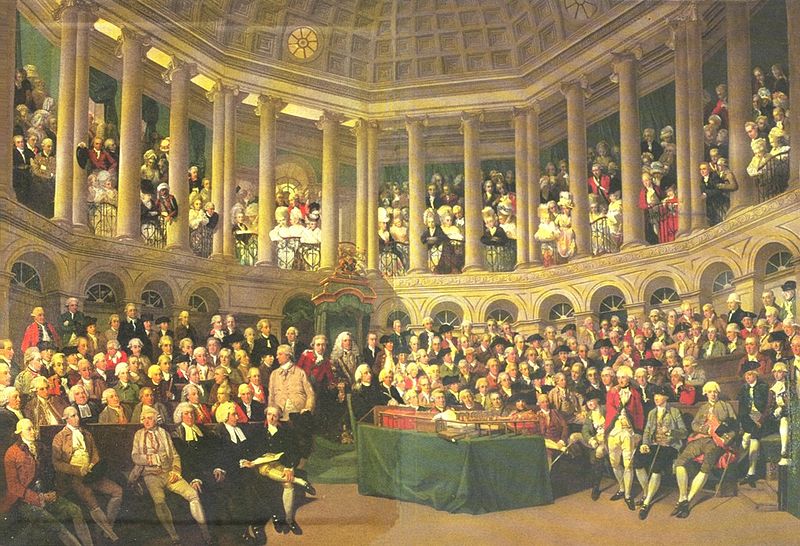
Birth of Irish statesman and parliamentarian Henry Grattan. Grattan was member of the Patriot Movement that won legislative independence for Ireland in 1782.
He said “I found Ireland on her knees, I watched over her with a paternal solicitude; I have traced her progress from injuries to arms, and from arms to liberty. Spirit of Swift! Spirit of Molyneux! Your genius has prevailed! Ireland is now a nation! In that new character I hail her! And bowing to her august presence, I say, Esto perpetua (May it be forever)” It was not to be forever. The 1800 Act of Union abolished the Irish Parliament. On the demise of the Irish Parliament, he said to a friend, “I sat by its cradle and followed its hearse.”
Henry Grattan (in red) addressing Irish House of Commons. Painting by Francis Wheatley
1863: Irish at Gettysburg – Pickett’s Charge – Day 3
At Gettysburg on day 3, “About noon a stillness reigned that was deathlike and unusual at such a time,” Anthony McDermott of the 69th Pa Irish Volunteers later wrote.
“An anxious look could plainly be seen on the faces of the men, and feelings of mingled dread and determination pervaded the minds of all — a harbinger of the coming storm that was to cover the fields with so much blood… It was the presage of that storm of artillery missiles unprecedented in field battles for the number of guns and the fury of its metallic hail. At one o’clock the stillness was broken by the discharge of one gun from the enemy’s lines ……….. “ A Brief History of the 69th Regiment Pennsylvania Veteran Volunteersby Adjutant Anthony McDermott.
Pickett’s Charge had begun and the 69th Pa would suffer dreadful losses. 151 of the 258 who started the day would be killed, wounded or captured. Colonel Dennis O’Kane from Coleraine was one of those mortally wounded.
1878: Legendary song and dance man George M. Cohan is born in Providence Rhode Island to Irish Catholic parents. His catalogue of songs include Give My Regards to Broadway, Yankee Doodle Boy and Over There.
George M. Cohan 1878-1942
Appropriately, Irish American Jimmy Cagney played Cohan in the 1942 movie Yankee Doodle Dandy
This history is written by Irish author, business keynote speaker and award winning humorist IrishmanSpeaks – Conor Cunneen. If you spot any inaccuracies or wish to make a comment, please don’t hesitate to contact us via the comment button.
Visit Conor’s YouTube channel IrishmanSpeaksto Laugh and Learn.
Tags: Best Irish Gift, Creative Irish Gift, Unique Irish Gifts, Irish Books, Irish Authors, Today in Irish History TODAY IN IRISH HISTORY (published by IrishmanSpeaks)
After enduring dreadful torture, Father John Murphy is executed, and his decapitated head displayed on a pike for his part in the 1798 Rebellion.
Father John Murphy
Murphy is an iconic figure in Irish rebel history who is celebrated in the song Boolavogue.
“Then Father Murphy from old Kilcormack
Spurred up the rocks with a warning cry:
‘Arm! Arm!’ he cried, ‘For I’ve come to lead you;
For Ireland’s freedom we’ll fight or die!”
Murphy, like most of the Catholic clergy did not support the original uprising, but following a skirmish where two English yeoman were killed, he realized it was “fight or die.” Over a five week period, he led a scattered, brave and ultimately futile insurrection against an increasingly vicious English response which involved murder and mass rape. The Irish rebels were no saints themselves indulging in sectarian outrages including burning of Protestants to death. Murphy was not directly involved in these atrocities, some of which were reactive and some borne from a deep hatred of English occupation.
The rebel priest was an effective leader of the 5,000 plus rebels winning a number of battles against the English including famously taking Enniscorthy on May 28th. The rebels suffered a fatal defeat at the Battle of Vinegar Hill on June 21 which effectively ended the rebellion.
1800: Act of Union. Ireland Loses Legislative Body
The Act of Union is passed which united the Kingdom of Great Britain and the Kingdom of Ireland to create the United Kingdom of Great Britain and Ireland. The act mean Ireland lost its own independent Parliament and was now to be ruled from England. It would be 1922 before Ireland regained legislative independence.
.
. 1863:Irish Brigade at Gettysburg
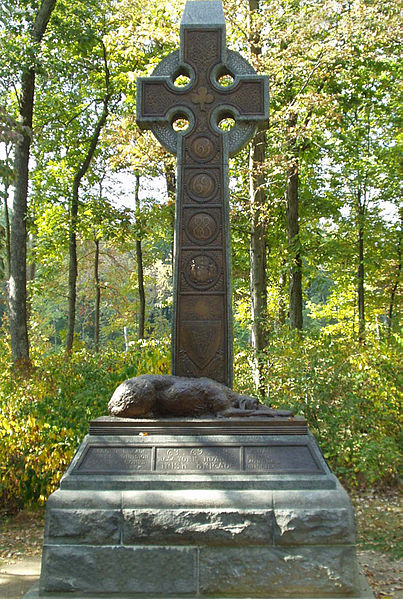
More than six hundred men of the Irish Brigade fight at Gettysburg, losing one third of their number in The Wheatfield. The Irish Brigade suffered severe losses during the Civil War, initially starting with over 2,500 volunteers. The Brigade distinguished itself in numerous conflicts including Chancellorsville, Fair Oaks and Fredericksburg.
Colonel Richard Byrnes of 28th Massachusetts reported:
“At 3p.m., July 2 the order was given toadvance and the regiment proceeded a short distance forward and to the left, and then was ordered back to its original position. Soon after was ordered to move to the left, and about 5:30 o’clock became engaged with the enemy, who were posted in an advantageous position on the crest of a rocky hill. We forced them to retire from this eminence, and advanced over the top and almost to the bottom of the other side of the hill, being all the time exposed to a very severe fire of musketry, and losing many men in killed and wounded.
About 7 p.m., finding all save this regiment were retiring from the hill, and that the enemy were on both our flanks, as well as in front, I brought my command from the field, losing many men from the concentrated fire of the rebels. Our loss in this action was 100 in killed, wounded, and missing, out of 224 taken into the engagement.”
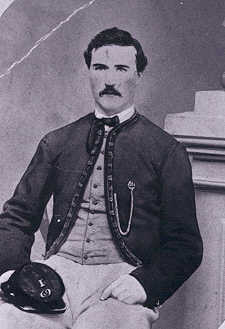
One of those who died at Gettysburg on July 2nd was Cavan-born Colonel Patrick “Paddy” O’Rorke, who was killed at Little Round Top.
Colonel Paddy O’Rorke
.
Interestingly, the Irish Brigade commenced in a rather inauspicious manner and not with universal buy-in. In his memoirs, General William T. Sherman writes of the early days of the war:
“Soon after I had assumed the command, a difficulty arose in the Sixty-ninth, an Irish regiment. This regiment had volunteered in New York, early in April, for ninety days; but, by reason of the difficulty of passing through Baltimore, they had come via Annapolis, had been held for duty on the railroad as a guard for nearly a month before they actually reached Washington, and were then mustered in about a month after enrollment. Some of the men claimed that they were entitled to their discharge in ninety days from the time of enrollment, whereas the muster-roll read ninety days from the date of muster-in.
One day, Colonel Corcoran explained this matter to me. I advised him to reduce the facts to writing, and that I would submit it to the War Department for an authoritative decision. He did so, and the War Department decided that the muster-roll was the only contract of service, that it would be construed literally; and that the regiment would be held till the expiration of three months from the date of muster-in, viz., to about August 1, 1861. General Scott at the same time wrote one of his characteristic letters to Corcoran, telling him that we were about to engage in battle, and he knew his Irish friends would not leave him in such a crisis. Corcoran and the officers generally wanted to go to the expected battle, but a good many of the men were not so anxious.”
For the Love of Being Irish written by Chicago based Corkman Conor Cunneen and illustrated by Mark Anderson is an A-Z of all things Irish. This is a book that contains History, Horror, Humor, Passion, Pathos and Lyrical Limericks that will have you giving thanks (or wishing you were) For the Love of Being Irish
This history is written by Irish author, business keynote speaker and award winning humoristIrishmanSpeaks – Conor Cunneen. If you spot any inaccuracies or wish to make a comment, please don’t hesitate to contact us via the comment button.
Visit Conor’s YouTube channel IrishmanSpeaksto Laugh and Learn. Tags: Best Irish Gift, Creative Irish Gift, Unique Irish Gifts, Irish Books, Irish Authors, Today in Irish History TODAY IN IRISH HISTORY (published by IrishmanSpeaks)
This history is written by Irish author, business keynote speaker and award winning humorist IrishmanSpeaks – Conor Cunneen. If you spot any inaccuracies or wish to make a comment, please don’t hesitate to contact us via the comment button.
Visit Conor’s YouTube channel IrishmanSpeaksto Laugh and Learn.
Tags: Best Irish Gift, Creative Irish Gift, Unique Irish Gifts, Irish Books, Irish Authors, Today in Irish History TODAY IN IRISH HISTORY (published by IrishmanSpeaks)










 Today In Irish History