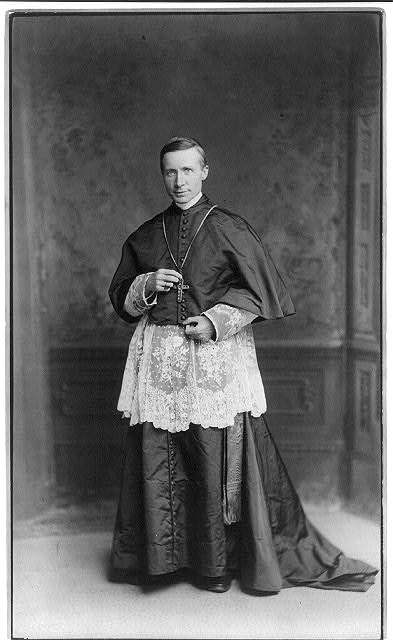
James Gibbons, American Cardinal, Bishop of Richmond from and Archbishop of Baltimore is born in Baltimore MD to parents Thomas and Bridget (née Walsh) Gibbons who had emigrated from Tourmakeady, County Mayo. Not long after his birth, the family returned to Ireland. After his father’s death in 1847 at the height of the Famine, Gibbons’ mother moved the family back to the United States.
He was elevated to Cardinal in 1886, only the second American to gain the honor.
Cardinal James Gibbons
Gibbons was an active supporter of the working class and unions at a time when labor was exploited by numerous employers, stating “”It is the right of laboring classes to protect themselves, and the duty of the whole people to find a remedy against avarice, oppression, and corruption.”
.
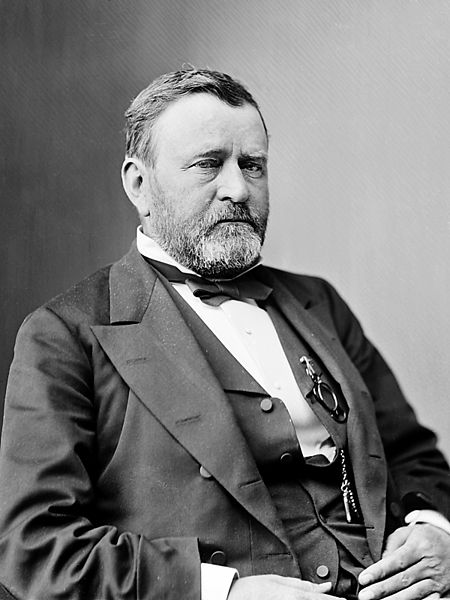
1883: Ulysses S. Grant
Ulysses S. Grant dies after a long painful battle with throat cancer. Grant’s great grandfather John Simpson was born in Northern Ireland around 1738.
Grant visited Ireland 1879, after he left the White House. His reception ranged from heroic in Northern Ireland to a rebuff from Cork Corporation who declined to invite a man they deemed to be anti-Catholic. This does not seem to be particularly accurate and something which the Catholic Generals William T. Sherman and “Little Phil” Sheridan, and others totally disagreed with.
Crime novelist Raymond Chandler (Farewell my Lovely, The Big Sleep) is born in Chicago to Waterford born Florence Thornton. After her marriage dissolved Thornton returned to Waterford with a young Raymond.
This history is written by Irish author, business keynote speaker and award winning humorist IrishmanSpeaks – Conor Cunneen. If you spot any inaccuracies or wish to make a comment, please don’t hesitate to contact us via the comment button.
Visit Conor’s YouTube channel IrishmanSpeaksto Laugh and Learn.
Tags: Best Irish Gift, Creative Irish Gift, Unique Irish Gifts, Irish Books, Irish Authors, Today in Irish History TODAY IN IRISH HISTORY (published by IrishmanSpeaks)
1858: Chauncey Olcott – My Wild Irish Rose Composer
Stage actor, songwriter and singer Chancellor “Chauncey” Olcott is born in Buffalo, New York to parents of Irish extraction. In collaboration with Ernest Ball, he would write lyrics for numerous “Irish” songs include My Wild Irish Rose and When Irish Eyes are Smiling. He is a member of the Songwriters Hall of Fame.
.
.
1861: Irish Brigade at Bull Run
The Irish Brigade fights at the First Battle of Bull Run under Generall Michael Corcoran from County Sligo. Corcoran was wounded and captured by the Confederate forces, but released some time later.
Sligo Born Brigadier Michael Corcoran on left with 69th_New_York_Militia
“Colonel Corcoran, who, in his turn, led his regiment over the crest; and had in full, open view the ground so severely contested; the fire was very severe, and the roar of cannon, musketry, and rifles, incessant; it was manifest the enemy was here in great force, far superior to us at that point. The Sixty-ninth held the ground for some time, but finally fell back in disorder…………
I directed Colonel Corcoran to move along the ridge to the rear, near the position where we had first formed the brigade. General McDowell was there in person, and need all possible efforts to reassure the men. By the active exertions of Colonel Corcoran, we formed an irregular square against the cavalry which were then seen to issue from the position from which we had been driven, and we began our retreat toward the same ford of Bull Run by which we had approached the field of battle………….
Corcoran and I formed the brigade into an irregular square, but it fell to pieces; and, along with a crowd, disorganized but not much scared, the brigade got back to Centreville to our former camps. Corcoran was captured, and held a prisoner for some time.”
Colonel Michael Corcoran
Some days after the battle, President Lincoln spoke to the troops. Sherman writes the troops gathered about “about Mr. Lincoln, who would speak to them. He made to them the same feeling address, with more personal allusions, because of their special gallantry in the battle under Corcoran, who was still a prisoner in the hands of the enemy.”
.
.
1919: House of Commons Debate on Ireland
Prime Minister Lloyd George
Fascinating debate in House of Commons on Ireland. Lloyd George outlines the issues as he sees them. (Source: Hansard)
“My hon. Friend appealed to the Government to apply the principles of President Wilson to the case of Ireland, and he asked me a question, whether I was prepared to do so? I will answer that question if he will answer me another, and I am not asking him that question, let him believe me, merely to get out of answering his question, but because it will help me to answer it. Will he apply those principles to the whole of Ireland? Because as he himself realises—no one knows better—that is the supreme obstacle in the way of settlement lie talked about forcing authority upon a free people by arms. In principle it is the same thing whether you force 1,500,000 of people or 3,000,000 of people. It is the same principle, and he must know that that is the difficulty.
The real difficulty is that you cannot, if he will allow me to say so, get his countrymen to face the facts. They are not satisfied with getting self-determination for themselves without depriving others of the right of self-determination. I tried to apply the principles of President Wilson to Ireland. [An HON. MEMBER: “Ah.”] Oh, I did. I tried the principle of self-determination. It was suggested to me that a Convention of Irishmen should be summoned. I thought it was a very good idea. I said, “We have all failed. Every party has failed. Every Government has failed. We have tried one expedient after another, and for some reason or other they have always come to nought.” I said, “Clearly we do not understand them. Let them settle it themselves.”
So a Convention was summoned upon lines suggested before it was summoned. 1 consulted the Nationalist Leader as to who should be summoned. He was perfectly satisfied with the composition of the Convention. Here was an opportunity for Ireland to determine its own fate. What happened? Two parties 1052 refused absolutely to come near the place. One of them, the party represented by the late Member for Cork, had a very considerable following in Ireland. The other party was that one which not merely claimed a majority, but at the last election demonstrated it by an overwhelming majority. They would not come near the place. What happened to the rest? The Nationalists—this is my recollection—were divided into three different sections. The Unionists were divided into three or four. That was my attempt to apply the principles of President Wilson to Ireland.
.
.
1972: Bloody Friday – Devastating IRA Bombing of Belfast
Fourteen year old Glynn Stephen Parker is the youngest of nine people to die as nineteen IRA bombs rip through Belfast in an indiscriminate act of carnage that has become known as Bloody Friday.
Fourteen year old Glynn Parker
Speaking to the House of Commons, William Whitelaw, Secretary of State for Northern Ireland reported ” Seven civilians and two soldiers were killed and at least 130 civilians injured-many gravely. I hardly need point out that all sections of the community are indiscriminately affected by these outrages. Of the dead two were Roman Catholics. Of the 130 injured at least 40 were Roman Catholics. 53 were men and boys, 77 women and children.”
.
BBC DOCUMENTARY on BLOODY FRIDAY
A Mirror Group newspaper stated “Complete carnage. A fireman with a shovel, shoveling up what was left of a woman shopper.”
The Provisional IRA claimed that the Samaritans, the Public Protection Agency and the press “were informed of bomb positions at least 30 minutes to one hour before each explosion”. While some warnings were received, with more than twenty bombs planted, many people simply ran from one explosion into another one.
In 2002, the IRA issued a statement apologizing for the bombing, something that was received with extraordinary equanimity by Colin Parry, whose son was killed by the IRA, said: “In truth it offers no comfort. My hurt is absolute and my loss is absolute and no word from the IRA can mitigate for the loss of my son. “That said, I am as active in the peace process as a private individual can be, and from that perspective I appreciate what they are doing.”
British ambassador to Ireland Christopher Ewart-Biggs is assassinated by the IRA when his car hits a landmine outside of Dublin. No one was ever convicted of the offense.
.
Interview with Brian O’Driscoll, driver for Christopher Ewart-Biggs
This history is written by Irish author, business keynote speaker and award winning humorist IrishmanSpeaks – Conor Cunneen. If you spot any inaccuracies or wish to make a comment, please don’t hesitate to contact us via the comment button.
Visit Conor’s YouTube channel IrishmanSpeaksto Laugh and Learn.
Tags: Best Irish Gift, Creative Irish Gift, Unique Irish Gifts, Irish Books, Irish Authors, Today in Irish History TODAY IN IRISH HISTORY (published by IrishmanSpeaks)





 Today In Irish History