Posts tagged ‘Irish medal of honor winners’

June 11,

FOUR Irish win Medal of Honor – Kevin Sheedy and Italia 90 at Today in Irish History

June 11: TODAY in Irish History:

** ** **

Kevin Sheedy

Snippets of Irish History by Conor Cunneen IrishmanSpeaks 

Conor is a Chicago based Motivational Humorous Business Speaker, Author and History buff.

***********************
WATCH: A Short History of Ireland

***********************

NEW                    NEW

Product Details

SHEIFGAB! Staying Sane, Motivated and Productive in Job Search.

An insightful, realistic, yet humorous book on the job search process by Today in Irish History Curator Conor Cunneen

Special accessible price for job seekers on Kindle of $2.99

.
shamrockshamrockshamrockshamrockshamrockshamrockshamrockshamrock

.

1871: Four Irishmen win Medal of Honor

During the Korean Expedition FOUR Irishmen were awarded the Medal of Honor.

The citation for Patrick Henry Grace reads:

“The President of the United States of America, in the name of Congress, takes pleasure in presenting the Medal of Honor to Chief Quartermaster Patrick Henry Grace, United States Navy, for extraordinary heroism in action on board the U.S.S. Benicia during the attack on the Korean forts, 10 and 11 June 1871. Carrying out his duties with coolness, Chief Quartermaster Grace set forth gallant and meritorious conduct throughout this action.”

James Dougherty (born Langash? Ireland 1839) citation:

“On board the U.S.S. Carondelet in various actions of that vessel. Wounded several times, Dougherty invariably returned to duty, presenting an example of constancy and devotion to the flag.”

Cork born John Coleman’s citation:

“The President of the United States of America, in the name of Congress, takes pleasure in presenting the Medal of Honor to Private John Coleman, United States Marine Corps, for extraordinary heroism in action on board the U.S.S. Colorado in action at Korea on 11 June 1871. Fighting hand-to-hand with the enemy, Private Coleman succeeded in saving the life of Alexander McKenzie.”

Michael McNamara (County Clare) Citation:

The President of the United States of America, in the name of Congress, takes pleasure in presenting the Medal of Honor to Private Michael McNamara, United States Marine Corps, for extraordinary heroism in action on board the U.S.S. Benecia during the capture of the Korean forts, 11 June 1871. Advancing to the parapet, Private McNamara wrenched the match-lock from the hands of an enemy and killed him.

.

shamrockshamrockshamrockshamrockshamrockshamrockshamrockshamrock

.

1886: Belfast Riots Continue

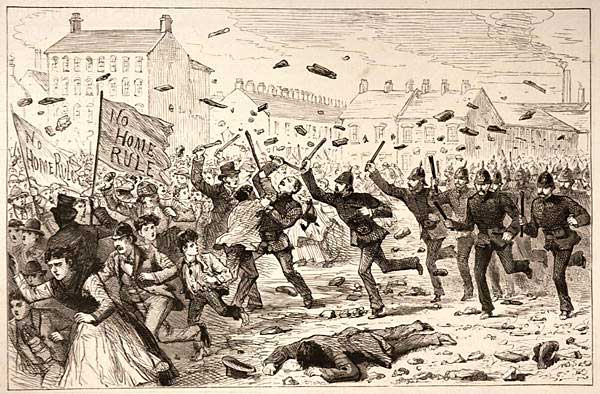
The ongoing riots in Belfast partly spawned by the Loyalist victory in defeating Gladstone’ Home Rule bill are referenced in the House of Commons.

Belfast Riots (from ‘The Illustrated London News’, 19th June 1886 (engraving), English School, (19th century) / Private Collection / The Bridgeman Art Library)
.

THE SECRETARY OF STATE FOR THE HOME DEPARTMENT (Mr. CHILDERS) (Edinburgh, S.) I will read to the House, in reply to the hon. Member’s Question, the whole of the information which has reached me from my right hon. Friend the Chief Secretary. My right hon. Friend telegraphed to me at 1 o’clock this afternoon the following:— In addition to the statement made by me in the House last night, the only official information received goes to show that the rioting was continued in Belfast last night over a more extended area than on the previous night, that all available police and military were employed, and that there were no fatal results. One policeman is reported to have been shot in the face. We have a large number of very experienced magistrates in Belfast, and every requisition made by them has been promptly attended to. There are now over 1,600 constabulary in the town, the normal force being 502, and the military have been augmented by 250 men despatched from Dublin last night. I received a second telegram at 4 o’clock this afternoon, which is as follows:— Further telegrams from Belfast show no material change of any sort. The most serious rioting last night took place at York Street and Henley Street, at the junction of which the police were obliged to fire on the mob who were stoning the police and wrecking houses, and several men were more or less injured, but none seriously, so far as at present ascertained. Several of the police were knocked down before they fired. The rioting spread to other parts of the town, and several public-houses were wrecked and liquor carried away. This rioting was more directed against public-houses than against the police. Public-houses will be closed this evening, and the Mayor will 1491 issue a notice with a view of preventing assembling of people in the streets. That is every word I have received from the right hon. Gentleman, and I am unable to answer anything further.

.

shamrockshamrockshamrockshamrockshamrockshamrockshamrockshamrock

.

1990: Italia ’90 – Ireland draw with England

Ireland plays England in its first ever match in the World Cup Finals. England took an early lead courtesy of master poacher Gary Lineker. Ireland, under the managership of “Big Jack” Charlton (who had won a World Cup medal with England 1966) fought back to equalize with a goal by Welsh-born Kevin Sheedy. Irish football authorities took advantage of FIFA rules which allowed anyone with an Irish born parent / grandparent to play for Ireland. A soccer mad Irish nation didn’t care as Ireland came to a complete stop during Italia 90.

.

READ: Biography Kevin Sheedy

.

In an amazing journey, Ireland managed to qualify for the quarter finals without winning a game! Draws against England, Egypt 0-0, Netherland 1-1 and finally a penalty kick victory 5-4 agaisnst Romania after another 0-0 draw saw Ireland matched against hosts Italy in Rome. The dream ended after a 1-0 defeat.

Ireland team (and place of birth if not Ireland) Vs. England

Pat (Packy) Bonner, Chris Morris (England), Steve Staunton, Mick McCarthy (England), Kevin Moran, Paul McGrath (England), Ray Houghton (Scotland), Kevin Sheedy (England), Andy Townsend (England), John Aldridge (England), Tony Cascarino (England)

IRELAND’S WORLD CUP JOURNEY 1990

.

shamrockshamrockshamrockshamrockshamrockshamrockshamrockshamrock

.

WATCH: A Short History of Ireland

Want to learn more about Ireland? See these images and more in the acclaimed For the Love of Being Irish

Irish gift ideas. Best selling Irish booksRonnie Drew and Luke Kelly - Musical Irish Gifts to the worldJoyce Image in For the Love of Being IrishMichael Collins: Image from For the Love of Being Irish

___________________________________

This history is written by Irish author, business keynote speaker and award winning humorist IrishmanSpeaks – Conor Cunneen. If you spot any inaccuracies or wish to make a comment, please don’t hesitate to contact us via the comment button.

Visit Conor’s YouTube channel IrishmanSpeaks to Laugh and Learn.

Tags: Best Irish Gift, Creative Irish Gift, Unique Irish Gifts, Irish Books, Irish Authors, Today in Irish History TODAY IN IRISH HISTORY (published by IrishmanSpeaks)


May 11,

Medal of Honor Winner Charles H.T. Collis – Black and Tans at Today in Irish History

May 11: TODAY in Irish History:

** ** **

Charles H.T. Collis irish medal of honor winner

Charles H.T. Collis

Snippets of Irish History by Conor Cunneen IrishmanSpeaks 

Conor is a Chicago based Motivational Humorous Business Speaker, Author and History buff.

.

shamrockshamrockshamrockshamrockshamrockshamrockshamrockshamrock

.

1902: Death of Medal of Honor winner Charles H.T. Collis

Collis was born in Ireland in 1838.

Charles H.T. Collis irish medal of honor winner
Charles H.T. Collis

.

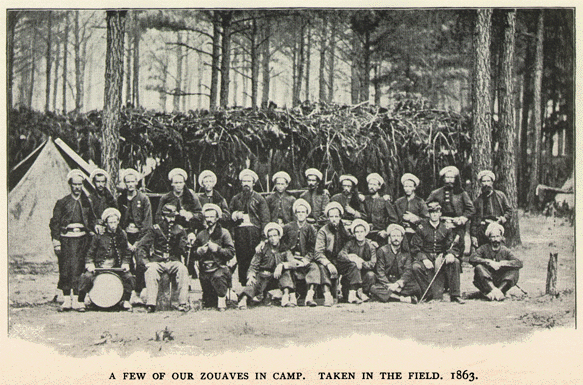
The fifteen year old Collis arrived in Philadelphia with his father in 1853. He studied law and was admitted to the bar on February 4, 1859. At the start of the Civil War Collis joined the 18th Pennsylvania Infantry Regiment as sergeant major. Collis formed the Zouaves D’ Afrique, modeled after the elite Algerian troops of the French Army. The regiment became the 114th Pennsylvania Infantry, known as Collis’ Zouaves. Collis won the Medal of Honor for his bravery at Fredericksburg. Due to life threatening wounds received at Chancellorsville, he did not fight at Gettysburg. In 1865 he was breveted Major General at Grant’s prompting.

.

Zoave troops of Collis' regiment
Zoave troops of Collis’ regiment

.

Following the war Collis built a house in Gettysburg which still stands on Seminary Ridge. He died on May 11, 1902 and is buried in the National Cemetery at Gettysburg, where he is honored by a monument.

Collis later wrote an interesting little book titled The Religion of Abraham Lincoln

Free Download: The Religion of Abraham Lincoln

.

Collis’ wife who was from South Carolina and had family fighting for the Confederacy also was an author, writing a short powerful book about the war.

“What better illustration of the abnormal condition of society in those days can be given than a statement of the fact that my daughter was born on September 25, 1862, and that her father, although within twelve hours’ reach of us, did not see her until June, 1863; – and he would not have seen her then, but that he was brought home, it was believed, to die. Careful nursing and desperate fighting by myself and one or two faithful allies restored him soon to health, and he returned to the front, – to find himself at twenty-five years of age in command of a brigade. This promotion was of course gratifying to my pride, but how much more did I value it when I learned that brigade commanders could have their wives with them in camp during the winter, while the unfortunate officers below that rank could not. Yet with all my joy at God’s mercy to me, some days came to me laden with great sorrow. My brother, David Cardoza Levy, a handsome, gallant lieutenant in the Southern army commanded by General Bragg, was about this time killed at the battle of Murfreesborough; seen by his companions to fall, his remains were never afterwards found, though General Rosecrans, to oblige my husband, made every effort to discover them. He lies to-day, God only knows where.
“Without a grave, unknelled, uncoffined, and unknown.”

This was the horrible episode of the civil war to me, and although I had many relatives and hosts of friends serving under the Confederate flag all the time, I never fully realized the fratricidal character of the conflict until I lost my idolized brother Dave of the Southern army.”

READ: A Woman’s War Record by Mrs. Charles Collis

.

READ: Biography of Charles Collis

.

shamrockshamrockshamrockshamrockshamrockshamrockshamrockshamrock

.

1920: The Auxiliaries and Black and Tans

In response to ongoing violence and rebellion in Ireland and a brutal campaign of attrition against members of the RIC (Royal Irish Constabulary), Winston Churchill, Secretary of State for War  suggests the formation of a “Special Emergency Gendarmerie, which would become a branch of the Royal Irish Constabulary.” Thus were the “Auxiliaries” born, a group of undisciplined mercenaries and ex-World War I vets who wreaked havoc in Ireland 1920-21. While the Black and Tans are reviled in Irish history as murderous thugs, their role was primarily as a back-up  unit to what often amounted to search and destroy operations conducted by the Auxiliaries.

The Auxiliaries most infamous action occurred on Bloody  Sunday 1920. Following the assassination of twelve English intelligence operatives (the Cairo Gang) on the orders of Michael Collins, Auxiliary troops forced their way into Croke Park Dublin where up to 10,000 people were watching a football game between Tipperary and  Dublin. The troops fired indiscriminately into the crowd killing fourteen people.  On December 11th, Auxiliaries rampaged through Cork City, burning parts of the city to the ground in retaliation for an ambush they suffered earlier in the day.

Auxiliary troops in Ireland

Cork City Following Auxiliary Rampage December 1920

.

shamrockshamrockshamrockshamrockshamrockshamrockshamrockshamrock

.

1969: Erik (Chink) Dorman – From British Army Chief of Staff to IRA Supporter

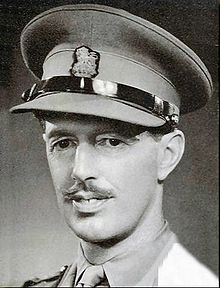
Eric (Chink) Dorman Smith (b. 1895) dies in Cavan Hospital. The Cavan born Smith went from being a senior officer in the British Army to an IRA supporter during the Border Campaign of the 1950s.

During World War I, Smith fought and was wounded on numerous occasions, winning the Military Cross for his actions.

In 1940 he became commandant of the Middle East Staff College and subsequently became Chief of Staff to General Claude Auchinleck of the 8th Army. Auchinleck’s leadership of the 8th Army did not inspire confidence in London and on 6th August 1942, Dorman-Smith was sacked along with Auchinleck and never held any important military positions again.

On his return to his family estate in Cavan, Smith’s Irish heritage drew him to sympathize with the IRA to such an extent that he allowed his lands to be used as training ground for IRA activists during the 1950s.

.

shamrockshamrockshamrockshamrockshamrockshamrockshamrockshamrock

.

1971: Death of former Taoiseach (Prime Minister) Sean Lemass.

Sean Lemass. It is doubtful if Time would run this cover with Leprechaun on it today!

.

A veteran of the 1916 Easter Rising, the War of Independence and the Civil War, Lemass was first elected as a Sinn Féin Teachta Dála (TD) for the Dublin South constituency in a by-election on 18 November 1924 and was re-elected at each election until his retirement in 1969. He was a founder-member of Fianna Fáil in 1926, serving in numerous cabinet positions under Eamonn De Valera until he became Taoiseach in 1959. Along with Dr. Patrick T. Whitaker, Lemass created a modern Irish economy free of the protectionist Puritanism of De Valera. He was also the first Taoiseach to meet with the Prime Minister of Northern Ireland.

.

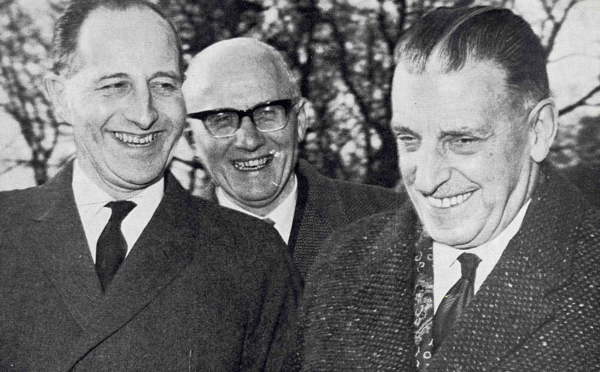
Northern Ireland Prime Minister Terence O’Neill and Sean Lemass

.

shamrockshamrockshamrockshamrockshamrockshamrockshamrockshamrock

.

Want to learn more about Ireland? See these images and more in the acclaimed For the Love of Being Irish

Irish gift ideas. Best selling Irish booksRonnie Drew and Luke Kelly - Musical Irish Gifts to the worldJoyce Image in For the Love of Being IrishMichael Collins: Image from For the Love of Being Irish

___________________________________

This history is written by Irish author, business keynote speaker and award winning humorist IrishmanSpeaks – Conor Cunneen. If you spot any inaccuracies or wish to make a comment, please don’t hesitate to contact us via the comment button.

Visit Conor’s YouTube channel IrishmanSpeaks to Laugh and Learn.

Tags: Best Irish Gift, Creative Irish Gift, Unique Irish Gifts, Irish Books, Irish Authors, Today in Irish History TODAY IN IRISH HISTORY (published by IrishmanSpeaks)