

May 28: TODAY in Irish History:
** ** **

Audie Murphy 1924-1971
Snippets of Irish History by Conor Cunneen IrishmanSpeaks 
Conor is a Chicago based Motivational Humorous Business Speaker, Author and History buff.
***********************
***********************
NEW NEW

SHEIFGAB! Staying Sane, Motivated and Productive in Job Search.
An insightful, realistic, yet humorous book on the job search process by Today in Irish History Curator Conor Cunneen
Special accessible price for job seekers on Kindle of $2.99
.
.

.
1779: Songwriter Thomas Moore
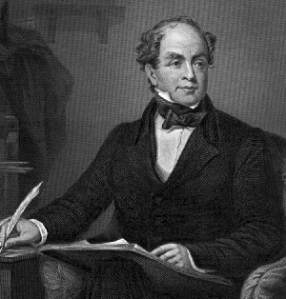
- Thomas Moore 1779-1852

Poet and songwriter Thomas Moore is born in Dublin, Moore wrote some of Ireland’s finest melodies including The Minstrel Boy: She is far from the Land: Believe me, if all those endearing young charms and literally hundreds of others.
Moore was also an accomplished satirist and poet who in Enigma wrote about the growing public debt….. (even back then!!!)
Come riddle-me-ree, come riddle-me-ree,
And tell me, what my name may be.
I am nearly one hundred and thirty years old,
And therefore no chicken, as you may suppose; —
Though a dwarf in my youth (as my nurses have told),
I have, ev’ry year since, been outgrowing my clothes;
Till, at last, such a corpulent giant I stand,
That if folks were to furnish me now with a suit,
It would take ev’ry morsel of scrip in the land
But to measure my bulk from the head to the foot.
Click for a comprehensive list of Thomas Moore’s works.
.
.
1824: Archishop Thomas William Croke
Birth of Thomas William Croke in County Cork. Croke became the second Catholic Bishop of Auckland New Zealand before returning to Ireland as Archbishop of Cashel and Emly.
He was a strong and public supporter of Irish nationalism aligning himself with the Irish National Land League during the Land War, and wit the chairman of the Irish Parliamentary Party, Charles Stewart Parnell, although he distanced himself from disgraced Parnell after the politician’s liaison with Kitty O’Shea became public.
The main GAA stadium in Dublin – Croke Park – is named in his honor.

- Archbishop Thomas Croke

.
.
1923: End of Irish Civil War
After close to a year of brutal internecine conflict, Eamonn De Valera calls a halt to the Civil War.He issued a statement to the Anti-Treaty forces accepting defeat at the hands of a Free State government.
“Soldiers of the Republic. Legion of the Rearguard: The Republic can no longer be defended successfully by your arms. Further sacrifice of life would now be in vain and the continuance of the struggle in arms unwise in the national interest and prejudicial to the future of our cause. Military victory must be allowed to rest for the moment with those who have destroyed the Republic.”
Nothing was achieved by De Valera and his supporters when they rejected a democratic Dail vote approving the Treaty and pitching the country into civil war. The country would be bitterly divided for generations following a war that took the life of Michael Collins. Almost 100 years later, despite all De Valera’s rhetoric, the island of Ireland is still a two-nation state.
.
READ: Overview of Irish Civil War
.
The Madness Within – The Irish Civil War
.
.
1971: Actor and Hero Audie Murphy
Audie Murphy dies in a plane crash. Murphy – born in Texas to share-cropping parents of Irish descent – was the most decorated US soldier of World War II

- Audie Murphy 1924-1971
His Citation for the Medal of Honor reads:
Second Lt. Murphy commanded Company B, which was attacked by six tanks and waves of infantry. 2d Lt. Murphy ordered his men to withdraw to a prepared position in a woods, while he remained forward at his command post and continued to give fire directions to the artillery by telephone. Behind him, to his right, one of our tank destroyers received a direct hit and began to burn. Its crew withdrew to the woods. 2d Lt. Murphy continued to direct artillery fire, which killed large numbers of the advancing enemy infantry. With the enemy tanks abreast of his position, 2d Lt. Murphy climbed on the burning tank destroyer, which was in danger of blowing up at any moment, and employed its .50 caliber machine gun against the enemy. He was alone and exposed to German fire from three sides, but his deadly fire killed dozens of Germans and caused their infantry attack to waver. The enemy tanks, losing infantry support, began to fall back. For an hour the Germans tried every available weapon to eliminate 2d Lt. Murphy, but he continued to hold his position and wiped out a squad that was trying to creep up unnoticed on his right flank. Germans reached as close as 10 yards, only to be mowed down by his fire. He received a leg wound, but ignored it and continued his single-handed fight until his ammunition was exhausted. He then made his way back to his company, refused medical attention, and organized the company in a counterattack, which forced the Germans to withdraw. His directing of artillery fire wiped out many of the enemy; he killed or wounded about 50. 2d Lt. Murphy’s indomitable courage and his refusal to give an inch of ground saved his company from possible encirclement and destruction, and enabled it to hold the woods which had been the enemy’s objective.”
Murphy was awarded thirty two other medals for gallantry including the Distinguished Service Cross, the Silver Star, four Purple Hearts, a Bronze Star, and the French and Belgian Croix de Guerre.
Following the war, Murphy became a movie actor, starring in numerous films including his own bio-pic To Hell and Back.
.
.
.
.
Want to learn more about Ireland? See these images and more in the acclaimed For the Love of Being Irish


___________________________________
This history is written by Irish author, business keynote speaker and award winning humorist IrishmanSpeaks – Conor Cunneen. If you spot any inaccuracies or wish to make a comment, please don’t hesitate to contact us via the comment button.
Visit Conor’s YouTube channel IrishmanSpeaks to Laugh and Learn.
Tags: Best Irish Gift, Creative Irish Gift, Unique Irish Gifts, Irish Books, Irish Authors, Today in Irish History TODAY IN IRISH HISTORY (published by IrishmanSpeaks)



 Today In Irish History