

April 24: TODAY in Irish History: 1916 Rising – Patrick Pearse  _______________________________________________________________________
Today in Irish History: Curated by Conor Cunneen IrishmanSpeaks Chicago Motivational Humorous Business Speaker, Author and History buff. 


 _____________________________________________________________________________
.
1916:The pivotal Irish insurrection against British rule in Ireland commences. The Easter Rising of 1916 had little chance of success (which its leaders knew) and had limited support from the Irish population, but a series of major mis-steps by British authorities lit a fuse that ultimately saw Britain withdraw from 26 counties of Ireland just six years later.
Timeline: At noon, Patrick Pearse reads the Proclamation of the Irish Republic outside the General Post Office in Dublin to a bemused and some reports suggest an amused crowd, not realizing the import of his statement. Insurgents would occupy the GPO until Saturday April 29 and a rag-tag group of not much more than 1,000 Irish rebels would change history.
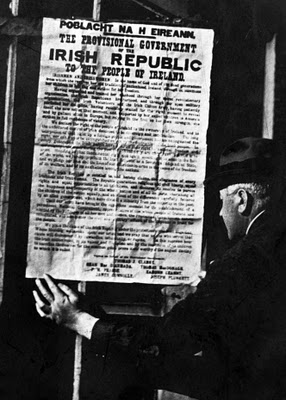
Dr. Andrew McWeeney reading copy of proclamation on Easter Monday 1916. National Library of Ireland image
Ten minutes previously, a group of volunteers led a botched attempt to capture Dublin Castle, the seat of British authority in Ireland. The first casulty of the 1916 rising was a policeman on duty at Dublin castle.
Volunteer Helena Moloney stated later ““It was at the castle the first shot was fired. I, with my girls, followed Sean Connolly and his party. We went right up to the Castle gate, up the narrow street. Just then a police sergeant came out, and seeing our determination he thought it was a parade, and that it would probably be going up Ship Street. When Connolly went to go past him, the sergeant put out his arm, and Connolly shot him dead. When the military guard saw that it was serious, he pulled the gates to.”
Buildings seized by the rebels included Boland’s Mills occupied by Eamonn De Valera and Jacobs factory occcupied by about 150 volunteers under the command of Thomas McDonagh. As it was a bank holiday, many senior British personnel were enjoying a race day at Fairyhouse race track. In general, the administration was slow to react. The first serious action took place and probably the first time authorities appreciated the seriousness of events was when a group of mounted Lancers riding towards the GPO were shot at, killing at least three soldiers.

The Seven Signatories of the Irish Proclamation
Patrick Pearse, Jame Connolly, Tom Clarke, Thomas MacDonagh, Sean MacDiarmada, Joseph Plunkett, Eamonn Ceannt. Want to learn more about Ireland? See these images and more in the acclaimed For the Love of Being Irish 


 BUY Quality Quality Guinness and Ireland Rugby Shirts
 For the Love of Being Irish written by Chicago based Corkman Conor Cunneen and illustrated by Mark Anderson which is an A-Z of all things Irish. This is a book that contains History, Horror, Humor, Passion, Pathos and Lyrical Limericks that will have you giving thanks (or wishing you were) For the Love of Being Irish Watch For the Love of Being Irish author Conor Cunneen – IrishmanSpeaks on his Youtube channel IrishmanSpeaks. Laugh and Learn. ___________________________________ This history is written by Irish author, business keynote speaker and award winning humoristIrishmanSpeaks – Conor Cunneen. If you spot any inaccuracies or wish to make a comment, please don’t hesitate to contact us via the comment button. Visit Conor’s YouTube channel IrishmanSpeaksto Laugh and Learn. Tags: Best Irish Gift, Creative Irish Gift, Unique Irish Gifts, Irish Books, Irish Authors, Today in Irish History



 Today In Irish History