Archive for December, 2012

December 20,

Richard J. Daley – Thomas Francis Meagher – Treaty Debate at Today in Irish History

Dec 20 TODAY in Irish History:

** ** **

Richard J Daley: “Da Mare” died on this day

Snippets of Irish History by Conor Cunneen IrishmanSpeaks

Conor is a Chicago based Motivational Humorous Business Speaker, Author and History buff.

** ** **

.
1862: Thomas Francis Meagher on The Battle of Fredericksburg

In the report penned on this date, Brigadier General Thomas Frances Meagher wrote about the day after the terrible battle.

“Two hundred and eighty men only appeared under arms to represent the Irish Brigade. This little band, unswerved and undeterred, still full of heart, inspired by a bright sense of duty, sorrowful for their comrades, but prouder and still more emboldened that such men had fallen bravely as they did, awaited the word that was once again to precipitate them against the batteries and defenses of the enemy.”

Over twelve hundred men of the Irish Brigade started that battle.

Thomas Francis Meagher 1823-1867

FOR MORE ON THOMAS FRANCIS MEAGHER

.

** ** **

.

1891 Annie Moore –  First Ellis Island Immigrant

Fifteen year old Annie Moore departs Queenstown (now Cobh) with her two brothers. On January 1, she would be the first immigrant to be processed through Ellis Island.
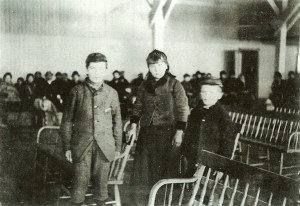
Annie Moore Ellis Island with brothers??

This MAY be young Annie Moore and brothers at Ellis Island.

.

** ** **

.

1921: Vitriolic Treaty Debate Continues.

Passions continue to rise during a debate that will tear the country asunder. In general despite the emotions involved, the quality of the debate was substantially better than anything we see today in Dail Eireann.

MR. SEAN ETCHINGHAM (anti-Treaty): …. “Yes, they might hold up their heads, but they are holding up their hands, for this is a Treaty of surrender of the principles they are here to uphold. I have heard gentlemen speak of the dead—let the dead rest. I can well understand that, for the boy Kevin Barry marched to the gallows with his head up, but his hands were pinioned to his side, and other men faced the firing parties, and other men faced the hangman with their heads up but their hands pinioned to their sides…… Let us go in with our heads up, but this I say to you finally, if you do vote for this thing, that posterity—the Assistant Minister of Local Government says he does not mind posterity—will denounce you, for if you do it it will be a renunciation of your principles, of your allegiance to the Irish Republic. Nay, it is more, it is the burial service over the grave of the Irish Nation, and there is to be no firing party.”

FINIAN LYNCH (pro-Treaty): Deputy Etchingham is trying to tell this House and trying to tell the people of Ireland that Lloyd George, shaking a paper in front of the face of Michael Collins was able to put the wind up Michael Collins. Let the people of Ireland judge whether it is so easy to put the wind up Michael Collins. That kind of eyewash is not going to go down with me or with any man who has soldiered with Collins, or with any person in Ireland who knows what he has done……………..

Now I stand for this Treaty on four grounds, and the one I mention last is the one that will mean the most to me. I stand for it because it gives us an army, because it gives us evacuation, because it gives us control over the finances of the country, and lastly, and greatest of all to me, because it gives us control over our education.
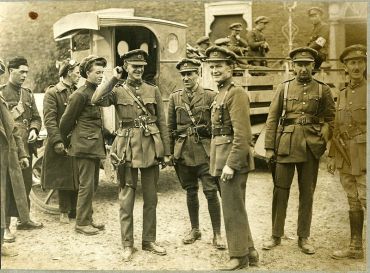
Finian Lynch, second from right during Civil War

Finian Lynch, second from right during Civil War

MRS. KATHLEEN O’CALLAGHAN (anti-Treaty): For myself, since girlhood I have been a Separatist. I wanted, and I want, an independent Ireland, an Ireland independent of the British Empire, and I can assure you that my life in Limerick during 1920, culminating in the murder of my husband last March—my life and that event have not converted me to Dominion status within the British Empire. I would like to say here that it hurts me to have to vote against the Minister for Foreign Affairs. He was a friend of my husband. Every night in my home, as in most Irish homes, prayers went up for him, and for the President, and for all who were standing by the country. I have the greatest admiration for him, but this is not a matter of devotion to a leader, or devotion to a party, it is a matter of principle, and you may sneer at principle, some of you. It is a matter of principle, a matter of conscience, a matter of right and wrong.

Kathleen O"Callaghan

Kathleen O”Callaghan

.

MR. SEAN T. O’CEALLAIGH (anti-Treaty): I cannot bear to live to see such a man as Arthur Griffith, who has been an inspiration to us all, or even younger men who have won fame the wide world over for a heroism that is peculiar to Ireland, men such as Michael Collins, Dick Mulcahy, Seán MacKeon, and many, many of their associates—I cannot bear to see these men acting as Ministers and Generals in the name of his Majesty King George V. in Ireland supported by time-servers, surrounded by shoneens, West Britons, and all the shallow toadies and place-hunters that Ireland produces in as much abundance as any other country. For it is not making much of a prophecy to say that the loyal, true-hearted, genuine Irishman will not rally round them. The Irish Ireland in which they grew up, for which they fought so valiantly will soon know them no more. We should all throw back at England this instrument of our subversion
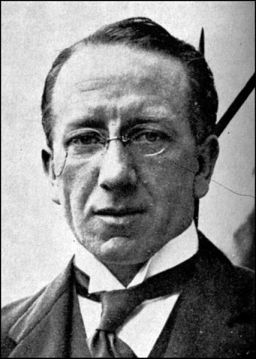
Sean T. O'Ceallaigh Treaty debate

Sean T. O’Ceallaigh

.

READ: FASCINATING  New York Times Report on Debate

.

** ** **

.

1976: Death of Richard J. Daley
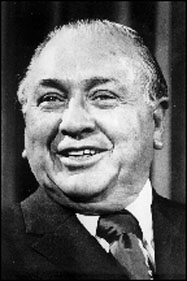
Richard J. Daley 1972-1976

Richard J. Daley 1902-1976

“Da Mare” of Chicago. Daley twenty one years in office (a period only surpassed by his son Richard M. Daley). Daley was a controversial figure who regularly mangled the English Language. In For the Love of Being Irish, author Conor Cunneen references one of Daley’s more memorable quotes. “They have vilified me, they have crucified me; yes, they have even criticized me.”

Daley is often credited for stealing the election for John Fitzgerald Kennedy in 1960 by ensuring the democratic candidate won Illinois. While there may be some truth that a number of Kennedy supporters voted early and often, Illinois was not critical. Even had the vote gone the other way and the states 27 Electoral College votes had gone to Nixon, Kennedy would still have had sufficient electoral college votes as he won 303 to Nixon’s 219. After all, Lyndon Johnson ensured Texas voted Democratic and there was a man who was never associated with electoral rigging in his life!!

Richard J. Daley Telephone Conversation with JFK

Daley’s ability to make things happen are evidenced in a telephone conversation he had with JFK on October 28th, 1963 in relation to civil rights legislation the President was pushing.

JFK: (IL. Democratic Congressman) Roland Libonati is sticking it right up us.

Daley: Is, he is?

JFK: Yeah, because he’s standing with the extreme liberals who are gonna end up with no bill at all. Then when we put together, uh, he’ll, gonna vote for the extreme bill. Then I asked him, “If you’ll vote for this package which we got together with the Republicans which gives us about everything we wanted,” and he says, “No.”

Daley: Daley: He’ll vote for it. He’ll vote for any goddamned thing you want….. That’s better. But he’ll do it. The last time I, I told him, “Now look it, I don’t give a goddamned what it is, you vote for, for anything the President wants and this is the way it will be and this is the way we want it and that’s the way it’s gonna be.”

Daley and JFK - 1963   AP

Daley and JFK – 1963                                 AP

.

.

LISTEN to Daley / Kennedy Phone Conversation

.

.

** ** **

Want to learn more about Ireland? See these images and more in the acclaimed For the Love of Being Irish

Irish gift ideas. Best selling Irish booksRonnie Drew and Luke Kelly - Musical Irish Gifts to the worldJoyce Image in For the Love of Being IrishMichael Collins: Image from For the Love of Being Irish

___________________________________

This history is written by Irish author, business keynote speaker and award winning humorist IrishmanSpeaks – Conor Cunneen. If you spot any inaccuracies or wish to make a comment, please don’t hesitate to contact us via the comment button.

Visit Conor’s YouTube channel IrishmanSpeaks to Laugh and Learn.

Tags: Best Irish Gift, Creative Irish Gift, Unique Irish Gifts, Irish Books, Irish Authors, Today in Irish History TODAY IN IRISH HISTORY (published by IrishmanSpeaks)

December 19,

Acrimonious Treaty Debate – Eamonn Andrews – Germany Sinks Irish Ship – Today in Irish History

Dec 19: TODAY in Irish History:

** ** **

arthur griffith

Treaty Signatory – Arthur Griffith

Snippets of Irish History by Conor Cunneen IrishmanSpeaks       

Conor is a Chicago based Motivational Humorous Business Speaker, Author and History buff.

** ** **

.

1921: Acrimonious  Treaty debate starts in Dail Eireann.

Ireland starts to tear itself apart as opposing forces debate the Treaty, setting the for a vicious civil war

Following are some passionate speeches from Arthur Griffith, Eamonn De Valeran and Michael Collins.

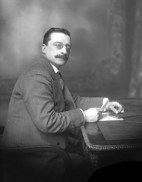
Arthur Griffith:

arthur griffith

Arthur Griffith

“(I move) that Dáil Eireann approves of the Treaty between Great Britain and Ireland, signed in London on December 6th, 1921.”

Nearly three months ago Dáil Eireann appointed plenipotentiaries to go to London to treat with the British Government and to make a bargain with them. We have made a bargain. We have brought it back. We were to go there to reconcile our aspirations with the association of the community of nations known as the British Empire. That task which was given to us was as hard as was ever placed on the shoulders of men. We faced that task; we knew that whatever happened we would have our critics, and we made up our minds to do whatever was right and disregard whatever criticism might occur. We could have shirked the responsibility. We did not seek to act as the plenipotentiaries; other men were asked and other men refused. We went. The responsibility is on our shoulders; we took the responsibility in London and we take the responsibility in Dublin. I signed that Treaty not as the ideal thing, but fully believing, as I believe now, it is a treaty honourable to Ireland, and safeguards the vital interests of Ireland.

And now by that Treaty I am going to stand, and every man with a scrap of honour who signed it is going to stand. It is for the Irish people—who are our masters (hear, hear), not our servants as some think—it is for the Irish people to say whether it is good enough. I hold that it is, and I hold that the Irish people—that 95 per cent. of them believe it to be good enough. We are here, not as the dictators of the Irish people, but as the representatives of the Irish people, and if we misrepresent the Irish people, then the moral authority of Dáil Eireann, the strength behind it, and the fact that Dáil Eireann spoke the voice of the Irish people, is gone, and gone for ever…………………………

What we have to say is this, that the difference in this Cabinet and in this House is between half-recognising the British King and the British Empire, and between marching in, as one of the speakers said, with our heads up. The gentlemen on the other side are prepared to recognise the King of England as head of the British Commonwealth. They are prepared to go half in the Empire and half out. They are prepared to go into the Empire for war and peace and treaties, and to keep out for other matters, and that is what the Irish people have got to know is the difference. Does all this quibble of words —because it is merely a quibble of words—mean that Ireland is asked to throw away this Treaty and go back to war?

So far as my power or voice extends, not one young Irishman’s life shall be lost on that quibble. We owe responsibility to the Irish people. I feel my responsibility to the Irish people, and the Irish people must know, and know in every detail, the difference that exists between us, and the Irish people must be our judges. When the plenipotentiaries came back they were sought to be put in the dock. Well, if I am going to be tried, I am going to be tried by the people of Ireland (hear, hear). Now this Treaty has been attacked. It has been examined with a microscope to find its defects, and this little thing and that little thing has been pointed out, and the people are told—one of the gentlemen said it here—that it was less even than the proposals of July. It is the first Treaty between the representatives of the Irish Government and the representatives of the English Government since 1172 signed on equal footing.

It is the first Treaty that admits the equality of Ireland. It is a Treaty of equality, and because of that I am standing by it. We have come back from London with that Treaty—Saorstat na hEireann recognised—the Free State of Ireland. We have brought back the flag; we have brought back the evacuation of Ireland after 700 years by British troops and the formation of an Irish army (applause). We have brought back to Ireland her full rights and powers of fiscal control. We have brought back to Ireland equality with England, equality with all nations which form that Commonwealth, and an equal voice in the direction of foreign affairs in peace and war. Well, we are told that that Treaty is a derogation from our status; that it is a Treaty not to be accepted, that it is a poor thing, and that the Irish people ought to go back and fight for something more, and that something more is what I describe as a quibble of words……………..

We took an oath to the Irish Republic, but, as President de Valera himself said, he understood that oath to bind him to do the best he could for Ireland. So do we. We have done the best we could for Ireland. If the Irish people say “We have got everything else but the name Republic, and we will fight for it,” I would say to them that they are fools, but I will follow in the ranks. I will take no responsibility. But the Irish people will not do that. Now it has become rather a custom for men to speak of what they did, and did not do, in the past. I am not going to speak of that aspect, except one thing. It is this. The prophet I followed throughout my life, the man whose words and teachings I tried to translate into practice in politics, the man whom I revered above all Irish patriots was Thomas Davis. In the hard way of fitting practical affairs into idealism I have made Thomas Davis my guide. I have never departed in my life one inch from the principles of Thomas Davis, and in signing this Treaty and bringing it here and asking Ireland to ratify it I am following Thomas Davis still.”

.

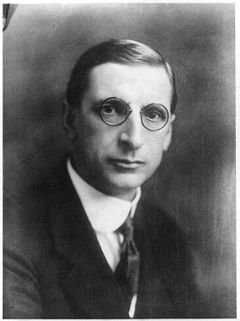
De Valera responded just as passionately:

Eamonn De Valera

Eamonn De Valera

“I am once more asking you to reject the Treaty for two main reasons, that, as every Teachta knows, it is absolutely inconsistent with our position; it gives away Irish independence; it brings us into the British Empire; it acknowledges the head of the British Empire, not merely as the head of an association, but as the direct monarch of Ireland, as the source of executive authority in Ireland.

The Ministers of Ireland will be His Majesty’s Ministers, the Army that Commandant MacKeon spoke of will be His Majesty’s Army. (Voices: “No.”) You may sneer at words, but I say words mean, and I say in a Treaty words do mean something, else why should they be put down? They have meanings and they have facts, great realities that you cannot close your eyes to. This Treaty means that the Ministers of the Irish Free State will be His Majesty’s Ministers (cries of “No, no,”) and the Irish Forces will be His Majesty’s Forces (“No, no.”) Well, time will tell, and I hope it won’t have a chance, because you will throw this out. If you accept it, time will tell; it cannot be one way in this assembly and another way in the British House of Commons. The Treaty is an agreed document, and there ought [27] to be pretty fairly common interpretation of it. If there are differences of interpretation we know who will get the best of them.

I hold, and I don’t mind my words being on record, that the chief executive authority in Ireland is the British Monarch—the British authority. It is in virtue of that authority the Irish Ministers will function. It is to the Commander-in-Chief of the Irish Army, who will be the English Monarch, they will swear allegiance, these soldiers of Ireland. It is on these grounds as being inconsistent with our position, and with the whole national tradition for 750 years, that it cannot bring peace. Do you think that because you sign documents like this you can change the current of tradition? You cannot. Some of you are relying on that ‘cannot’ to sign this Treaty. But don’t put a barrier in the way of future generations.”

.

Michael Collins Response:

Michael Collins in For the Love of Being Irish

Michael Collins in For the Love of Being Irish

“It has also been suggested that the Delegation broke down before the first bit of English bluff. I would remind the Deputy who used that expression that England put up quite a good bluff for the last five years here and I did not break down before that bluff (applause, and a voice, “That is the stuff”). And does anybody think that the respect I compelled from them in a few years was in any way lowered during two months of negotiations? That also is beside the point. The results of our labour are before the Dáil. Reject or accept. The President has suggested that a greater result could have been obtained by more skilful handling. Perhaps so. But there again the fault is not the delegation’s; it rests with the Dáil. It is not afterwards the Dáil should have found out our limitations………………

The communication of September 29th from Lloyd George made it clear that they were going into a conference not on the recognition of the Irish Republic, and I say if we all stood on the recognition of the Irish Republic as a prelude to any conference we could very easily have said so, and there would be no conference. What I want to make clear is that it was the acceptance of the invitation that formed the compromise. I was sent there to form that adaptation, to bear the brunt of it. Now as one of the signatories of the document I naturally recommend its acceptance. I do not recommend it for more than it is. Equally I do not recommend it for less than it is. In my opinion it gives us freedom, not the ultimate freedom that all nations desire and develop to, but the freedom to achieve it.”

.

READ: Full Treaty Debate Dec 19th

.

** ** **

.

1922: Eamonn Andrews

Famed Irish broadcaster, boxing commentator and long time host of This Is Your Life Eamonn Andrews is born in Dublin.

Andrews was the consummate broadcaster and television personality who was a regular and popular face on Irish and UK television for many years. Andrews is most famous for This Is Your Life which he hosted for 19 years. This writer’s favorite episode of the show featured Andrews interviewing Muhammad Ali (who just happens to have Irish blood!) in an often hilarious program that showcased Ali at his very best. Andrews was also a gifted boxing commentator for the BBC.

.

.

Here Eamonn Andrews spars with another famous “Irishman” Muhammad Ali.

.

Eamonn Andrews is Surprised by This is Your Life Host

** ** **

.

1940: German Bombers Sink Irish Lights Ship

The Irish Lights ship Isolda which was resupplying light houses of the coast of Wexford is sunk by German bombers, despite Irish neutrality. Six sailors are killed.

.

** ** **

.

1973: Supreme Court Rules Constitutional Right to Contraceptives

By a ruling of four to one, the Irish Supreme Court rules in McGee v. Attorney General and the Revenue Commissioners that Irish Customs (Revenue Commissioners), had interfered with plaintiff’s constitutional rights to marital privacy when it seized contraceptives which Mary McGee, a married mother of four was attempting to import. The decision was to lead to years of legislative inaction as many politicians feared the power of the Catholic Church.

.

** ** **

Want to learn more about Ireland? See these images and more in the acclaimed For the Love of Being Irish

Irish gift ideas. Best selling Irish booksRonnie Drew and Luke Kelly - Musical Irish Gifts to the worldJoyce Image in For the Love of Being IrishMichael Collins: Image from For the Love of Being Irish

___________________________________

This history is written by Irish author, business keynote speaker and award winning humorist IrishmanSpeaks – Conor Cunneen. If you spot any inaccuracies or wish to make a comment, please don’t hesitate to contact us via the comment button.

Visit Conor’s YouTube channel IrishmanSpeaks to Laugh and Learn.

Tags: Best Irish Gift, Creative Irish Gift, Unique Irish Gifts, Irish Books, Irish Authors, Today in Irish History TODAY IN IRISH HISTORY (published by IrishmanSpeaks)

arthur griffith