

March 5: TODAY in Irish History:
** ** **
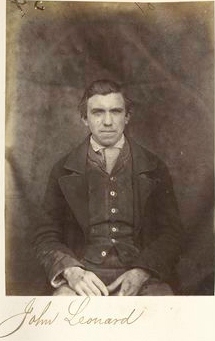
Fenian Prisoner Mountjoy Jail
Snippets of Irish History by Conor Cunneen IrishmanSpeaks 
Conor is a Chicago based Motivational Humorous Business Speaker, Author and History buff.
** ** **
.
1867: The Fenian Rising.

Captured Fenians Mountjoy Prison
Another ill-fated and short lived rebellion takes place against English rule. Poorly trained, ill-disciplined Fenian volunteers were involved in skirmishes with police in Dublin, Tipperary and Cork. Few fatalities occured on either side. A number of Fenian leaders were sentenced to death, commuted to life and exiled. The Fenian leadership did issue a proclamation of Irish independence stating:
“We therefore declare that, unable longer to endure the curse of Monarchical Government, we aim at founding a Republic based on universal suffrage, which shall secure to all the intrinsic value of their labour. The soil of Ireland, at present in the possession of an oligarchy, belongs to us, the Irish people, and to us it must be restored.”
At Midleton Heritage provides a newspaper report on the events in this East Cork town during the rising. “The rising began in Midleton- that is, the assembly there seems to have been the earliest. The Fenians collected on the fair green to the number of about 50, and marched through the town in military order. They were all armed, and had haversacks of provisions. At the end of the town, near Copinger’s-bridge, they were met by an armed police patrol of four men. The Fenian leader called on the patrol to surrender, and the demand was followed up by a volley, by which one of the four constables were killed and another slightly wounded. The uninjured men returned the fire, with what effect is not known, and made their escape hastily into an adjoining house, whence they afterwards regained the barracks. The Fenians marched from Midleton to Castlemartyr, leaving the police barrack at the former town unmolested. On the route they were joined by several parties of armed men, and arrived in Castlemartyr with a force about 200 strong. Daly, the Fenian leader, drew up his men in front of the police-barrack, which had been closed and barricaded on their approach, and called on its occupants to surrender. The policemen, who did not exceed six or seven in number, replied by a well-directed fire, killing Daly and wounding several of his band. The remainder then retired in the direction of Killeagh, to which place small parties of men were seen making their way from Cloyne, Youghal and several other places during the night.”
In general, the rising was a shambolic affair, but it achieved major significance in Irish folklore.
Some died by the glenside, some died near a stranger
And wise men have told us their cause was a failure
But they fought for old Ireland and never feared danger
Glory O, Glory O, to the bold Fenian men
.
The Bold Fenian Men (Rio Grande)
.
Note: Despite this wonderful rendition and tribute to General Philip Sheridan, the song itself was not composed until 1916 by Peadar Kearney!
.
** ** **
.
1921: IRA Ambush Kills Senior British Officer
The IRA ambush a British army convoy near Clonbanin, County Cork, killing Brigadier General H. R. Cumming, one of the highest ranked British officers to die in the Irish War of Independence.
.
READ: NY Times Report of Clonbanin Ambush
.
** ** **
.
1976: Dissolution of Northern Ireland Convention

Northern Ireland Secretary Merlyn Rees
In the House of Commons, Secretary of State for Northern Ireland Merlyn Rees announces the dissolution of the short lived Northern Ireland Constitutional Convention, an ill-fated effort to bring an element of democratically elected domestic rule to the strife torn province. The United Unionist Ulster Council which won 46 of the 78 seats refused to participate in power sharing of any form with the Nationalist minority, something that at this stage was now unacceptable to the London government.
“The Convention did not, however, agree on the central issue—that is, how, in a divided community, a system of government could be devised which would have sufficient support in both parts of that community to provide stable and effective government. As I told the House on 12th January: Experience in recent years has made plain that no system of government within Northern Ireland will be stable or effective unless both parts of the community acquiesce in that system and are willing to work to support it. The proposals in the Convention’s Report did not meet this basic need.”
.
** ** **



 Today In Irish History