Posts tagged ‘home rule’

April 11,

Titanic Photographer Fr. Browne – JFK No to Irish Citizenship – GAA Revokes Ban at Today in Irish History

April 11: TODAY in Irish History:

** ** **

Father Brown

Father Frank Brown

Snippets of Irish History by Conor Cunneen IrishmanSpeaks 

Conor is a Chicago based Motivational Humorous Business Speaker, Author and History buff.

** ** **

.

shamrockshamrockshamrockshamrockshamrockshamrockshamrockshamrock

.

1784: General Abraham Roberts

.General Sir Abraham Roberts 1784-1873

(General Sir) Abraham Roberts is born in Waterford, the son of a local magistrate.  As an officer in the British East India Company Army he  served nearly 50 years in India.

Roberts son and a grandson would win the Victoria Cross.

.

READ: Detailed biography of General Sir Abraham Roberts

.

shamrockshamrockshamrockshamrockshamrockshamrockshamrockshamrock

.

1912: The Titanic at Queenstown (now Cobh), Cork.

The doomed ship anchors two miles off shore at Roches Point as the port could not accommodate a ship of its size. 123 mainly 3rd class passengers who had paid 15, 10 shillings for a one way trip embarked. 8 people who boarded at either Southampton or Cherbourg disembarked.  Only 48 of the Queenstown passengers would survive. Those who would die include 18 year old Mary Delia Burns from Sligo, 20 year old Katherine Buckley from Cork. One of the passengers who disembarked was Frank Brown, then training for Jesuit priesthood. Brown took the only photographs of the Titanic’s final stop that are known to survive. Brown had been gifted a ticket for the Southampton- Queenstown part of Titanic’s fateful voyage.

Father Brown
Father Frank Brown Titanic photographer

Frank Brown took the last published photograph of Titanic Capt Edward Smith. Following Brown’s ordination, he became a decorated chaplain with the Irish Guards during World War I.

Brown continued his passion for photography through his life and his tenure as Superior of St Xavier’s church. Frank Brown died in 1960.

Titanic Passengers wait at Queenstown, Cork

.

shamrockshamrockshamrockshamrockshamrockshamrockshamrockshamrock

.

1912: Final Home Rule Bill

 Liberal Prime Minister Herbert Asquith introduces Third Home Rule Bill which would provide self-government for Ireland, an apparent triumph for Nationalist leader John Redmond. The bill would never take effect due to Ulster Loyalist intransigence, the onset of World War I and the 1916 Easter Rising.

Nationalist Leader John Redmond

.

shamrockshamrockshamrockshamrockshamrockshamrockshamrockshamrock

.

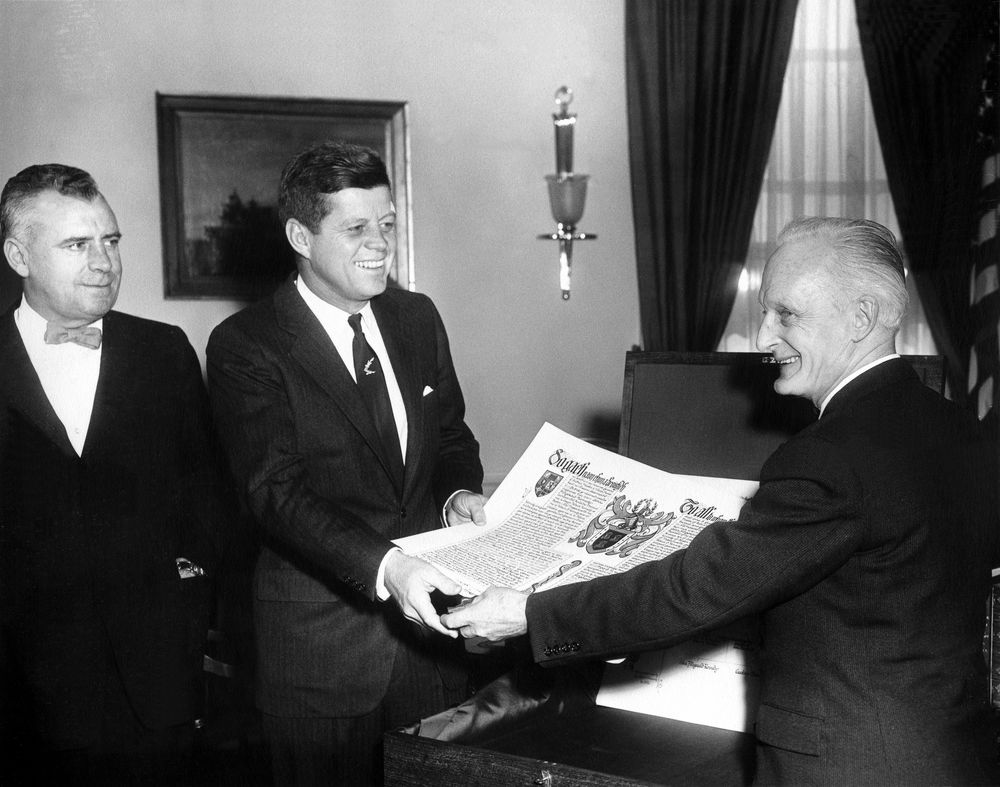
1963: JFK Refuses Irish Citizenship

JFK aide McGeorge Bundy advises Thomas J. Kiernan, Ireland’s Ambassador to the U.S. that the President would not be able to accept honorary Irish citizenship on his then putative visit to Ireland (which would occur June 1963).

JFK and Ambassador Kiernan

Kiernan recounts Kennedy’s comments about Irish citizenship during a conversation when presenting shamrock to the President for St. Patrick’s day.  “You know, the thing has to go through—there are all kinds of procedures and it probably will need legislation. The Senate would have to approve. In any case, he said, “It’s gone to my brother [Robert F. Kennedy]. He’s the main fellow and he may turn me down. I’d love it, but we’ll see what he says.” (source: JFK library)

.

shamrockshamrockshamrockshamrockshamrockshamrockshamrockshamrock

.

1971: GAA Bans the Ban 

The GAA (Gaelic Athletic Association) finally revokes its infamous Rule 27, commonly known as “The Ban.”

The rule banned all GAA members from playing or watching in non-Gaelic games. Non-Gaelic included rugby, soccer, hockey and cricket. GAA members who broke Rule 27 were expelled from the GAA. This famously included Irish President and GAA-Patron Dr. Douglas Hyde who attended an international soccer match in 1938 prompting the Irish Times to write “The notion that the game by which a round ball is kicked only, and not punched as well as kicked, is detrimental to the national culture, is of course the most utterly childish form of humbug”.

The ludicrous rule ensured that Irish soccer international Liam Brady was expelled from his secondary school, St Aidan’s Christian Brothers school for captaining Ireland in an under 15 soccer international. Irish rugby international Moss Keane, played GAA under an assumed name in his youth to avoid being expelled while Waterford County player Tom Cheasty was suspended for six months in 1963 for attending a dance organized by a soccer club.

.

shamrockshamrockshamrockshamrockshamrockshamrockshamrockshamrock

.

Want to learn more about Ireland? See these images and more in the acclaimed For the Love of Being Irish

Irish gift ideas. Best selling Irish booksRonnie Drew and Luke Kelly - Musical Irish Gifts to the worldJoyce Image in For the Love of Being IrishMichael Collins: Image from For the Love of Being Irish

___________________________________

This history is written by Irish author, business keynote speaker and award winning humorist IrishmanSpeaks – Conor Cunneen. If you spot any inaccuracies or wish to make a comment, please don’t hesitate to contact us via the comment button.

Visit Conor’s YouTube channel IrishmanSpeaks to Laugh and Learn.

Tags: Best Irish Gift, Creative Irish Gift, Unique Irish Gifts, Irish Books, Irish Authors, Today in Irish History TODAY IN IRISH HISTORY (published by IrishmanSpeaks)


March 6,

Irish at Battle of Alamo. General Philip Sheridan. Nationalist Leader John Redmond

March 6: TODAY in Irish History (by IrishmanSpeaks) Twitter Icon

1831: Birth of cival war general Philip Sheridan. Sheridan’s parents had emmigrated from County Cavan. Sheridan’s diminutive stature of 5 feet five inches earned him the nickname “Little Phil.) He was involved in the Battle of Perryville, Chickamauga and participated in the Chatanooga and Appotamatox campaigns.

.

GeneralPhilip Sheridan

.

Below: Portrayal of a mournful Philip Sheridan in John Ford’s Rio Grande

.


In his wonderful memoir, Ulysses S. Grant writes of Sheridan:

“Sheridan was a first lieutenant in the regiment in which I had served eleven years, the 4th infantry, and stationed on the Pacific coast when the war broke out. He was promoted to a captaincy in May, 1861, and before the close of the year managed in some way, I do not know how, to get East. He went to Missouri. Halleck had known him as a very successful young officer in managing campaigns against the Indians on the Pacific coast, and appointed him acting-quartermaster in south-west Missouri. There was no difficulty in getting supplies forward while Sheridan served in that capacity; but he got into difficulty with his immediate superiors because of his stringent rules for preventing the use of public transportation for private purposes. He asked to be relieved from further duty in the capacity in which he was engaged and his request was granted. When General Halleck took the field in April, 1862, Sheridan was assigned to duty on his staff. During the advance on Corinth a vacancy occurred in the colonelcy of the 2d Michigan cavalry. Governor Blair, of Michigan, telegraphed General Halleck asking him to suggest the name of a professional soldier for the vacancy, saying he would appoint a good man without reference to his State. Sheridan was named; and was so conspicuously efficient that when Corinth was reached he was assigned to command a cavalry brigade in the Army of the Mississippi. He was in command at Booneville on the 1st of July with two small regiments, when he was attacked by a force full three times as numerous as his own. By very skilful manoeuvres and boldness of attack he completely routed the enemy. For this he was made a brigadier-general and became a conspicuous figure in the army about Corinth.”

.

1836: Battle of the Alamo. An estimated 200 men die at the battle of the Alamo including Davy Crockett who was of Irish extraction. An estimated ten of the defenders were actually Irish born fighters. Some of the Irish who died include Samuel E. Burns (b.1810), Andrew Duvalt (b.1804) who immigrated to Texas by way of Missouri and settled in Gonzales. He was a plasterer by trade. James McGee, James Rusk, Burke Tranmel (b.1810), Sergeant William B. Ward (b.1806) When the Mexican army appeared on February 23, 1836, Ward was seen manning the artillery position at the Alamo’s main gate, while the rest of the garrison retreated into the Alamo. Source: Alamo.org

.

1918: Death of Irish nationalist leader John Redmond. Although a somewhat peripheral figure in Irish politics following the 1916 rising, he had been hugely influential and effective in gaining acceptance for Irish Home Rule. In1912, the House of Commons passed the Irish Home Rule bill which allowed for Irish self-government. Unionist intransigence delayed implementation of Home Rule for two years. The commencement of World War I forced a further delay until after a war which was expected to be shortlived! It would be 1922 before Ireland reached any form of independence following a brutal war of Independence 1919-1921.

.

Nationalist Leader John Redmond

.

1921: New York Times runs a fascinating report on the death of Brigadier General H. R. Cumming in an IRA ambush in Co. Cork. See PDF.

.

1988: Three IRA activists (two men, one woman) are shot dead in Gibraltar by the SAS. The three had primed a car bomb to explode 48 hours later during a ceremony involving the 1st Battalion Royal Anglian Regiment who had recently deployed from Northern Ireland.The shooting sparked massive controversy raising claims of a shoot-to-kill policy. The official response was that the SAS (aware of the IRA mission) thought the IRA members were about to detonate a bomb immediately. While the official inquest found the shootings justified, in 1995 the European Court of Justice ruled that the fundamental right to life of the IRA members had been violated.

Want to learn more about Ireland? See these images and more in the acclaimed For the Love of Being Irish
Irish gift ideas. Best selling Irish booksRonnie Drew and Luke Kelly - Musical Irish Gifts to the worldJoyce Image in For the Love of Being IrishMichael Collins: Image from For the Love of Being Irish

BUY Quality Quality Guinness and Ireland Rugby Shirts
Guinness Rugby Shirts - Brilliant!Rugby Shirt - Ireland


For the Love of Being Irish written by Chicago based Corkman Conor Cunneen and illustrated by Mark Anderson which is an A-Z of all things Irish. A work that should reside in any list of Best Irish Gift Books, this lavishly illustrated book contains History, Horror, Humor, Passion, Pathos and Lyrical Limericks that will have you giving thanks (or wishing you were) For the Love of Being Irish

Watch For the Love of Being Irish author Conor Cunneen – IrishmanSpeaks on his Youtube channel IrishmanSpeaks. Laugh and Learn.

___________________________________

This history is written by Irish author, business keynote speaker, humorous motivational speaker and award winning humorist IrishmanSpeaks – Conor Cunneen. If you spot any inaccuracies or wish to make a comment, please don’t hesitate to contact us via the comment button.

Visit Conor’s YouTube channel IrishmanSpeaksto Laugh and Learn. Tags: Best Irish Gift, Creative Irish Gift, Unique Irish Gifts, Irish Books, Irish Authors, Today in Irish History