

December 6: TODAY in Irish History:
** ** **
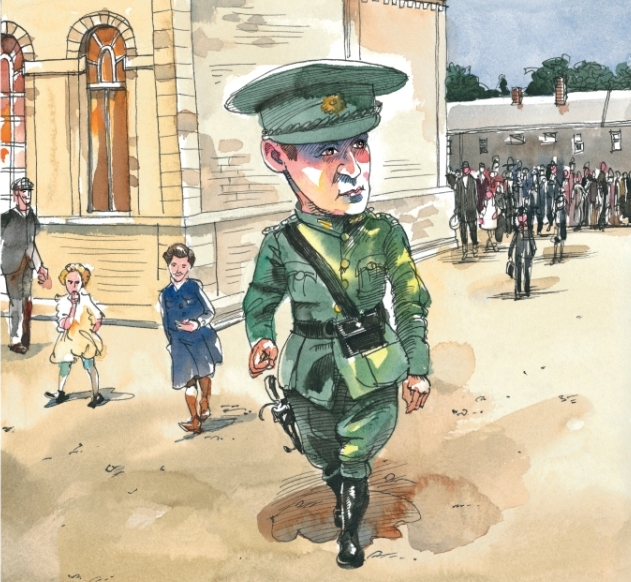
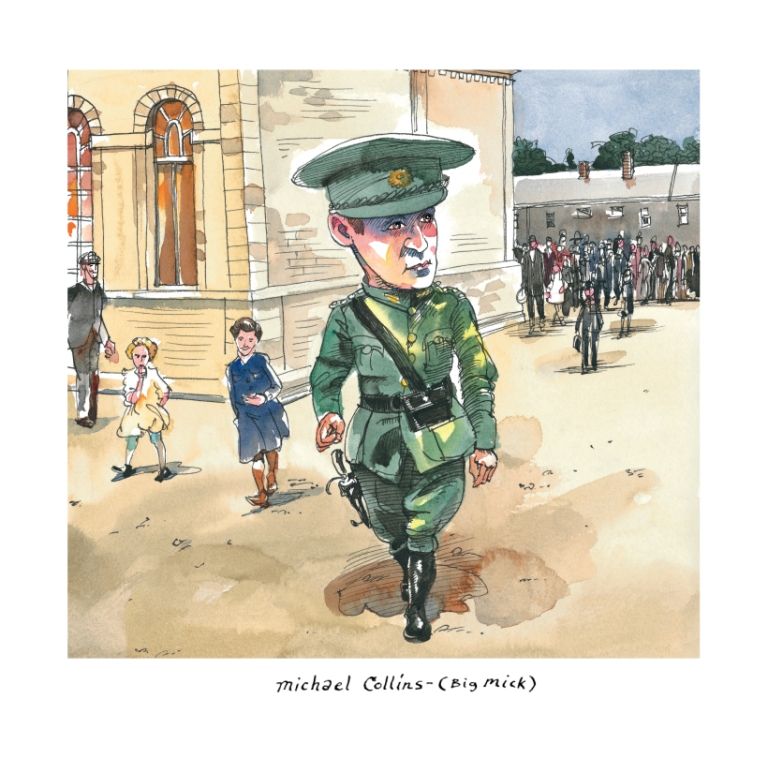
Michael Collins image in For the Love of Being Irish – An A-Z of Irish History
Snippets of Irish History by Conor Cunneen IrishmanSpeaks 
Conor is a Chicago based Motivational Humorous Business Speaker, Author and History buff.
***********************
WATCH: A Short History of Ireland
***********************
.

.
1921: Treaty is Signed. Ireland Gains (a level of) Independence
In the early hours Dec 6th, the Articles of Agreement for a Treaty between Great Britain and Ireland are signed in London. It brought to an end the Irish War of Independence, though tragically led to the Irish Civil War. The treaty allowed for twenty-six counties of Ireland to have autonomy from Britain while remaining in the British Empire. Northern Ireland, which had been created by the 1920 Government of Ireland Act had the option to opt out of the new Irish Free State, an option it duly exercised.
.
Superb Video on Treaty Negotiations
.

.
The final lines of Robert Barton’s notes on the meeting read:
“Lloyd George then asked whether we as a Delegation were prepared to accept these Articles of Agreement and to stand by them in our Parliament as they as a Delegation would stand by them in theirs.
Arthur Griffith replied ‘We do.’
We then discussed the release of the prisoners and procedure for ratification and other matters whilst awaiting the final draft.
The final draft was read over, agreed to and signed; also the Annex.
The British Delegation lined up to shake hands and say good-bye, and the Conference ended at 2.20 a.m. on December 6th.”
The War of Independence was over. But tragically, the new nation was not finished with war.
.
SEE: Documents on Irish Foreign Policy for excellent detail on Treaty negotiations.

Michael Collins image in For the Love of Being Irish
Collins wrote later that day a terribly prophetic statement:
“When you have sweated, toiled, had mad dreams, hopeless nightmares, you find yourself in London’s streets, cold and dank in the night air. Think—what have I got for Ireland? Something which she has wanted these past seven hundred years. Will anyone be satisfied at the bargain? Will anyone? I tell you this; early this morning I signed my death warrant. I thought at the time how odd , how ridiculous —a bullet may just as well have done the job five years ago.”
SEE: Pathe News Film of Treaty Negotiators
.
READ FREE eBook: Detailed Correspondence on Treaty from The Royal Irish Academy’s Documents on Irish Foreign Policy series.
.
Robert Barton on Treaty Signing.
During a vitriolic Treaty debate in the Dail on Decembe 19th, signatory Robert Barton explained why he signed.
“I am going to make plain to you the circumstances under which I find myself in honour bound to recommend the acceptance of the Treaty. In making that statement I have one object only in view, and that is to enable you to become intimately acquainted with the circumstances leading up to the signing of the Treaty and the responsibility forced on me had I refused to sign. I do not seek to shield myself from the charge of having broken my oath of allegiance to the Republic—my signature is proof of that fact (hear, hear). That oath was, and still is to me, the most sacred bond on earth. I broke my oath because I judged that violation to be the lesser of alternative outrages forced upon me, and between which I was compelled to choose. On Sunday, December 4th, the Conference had precipitately and definitely broken down. An intermediary effected contact next day, and on Monday at 3 p.m., Arthur Griffith, Michael Collins, and myself met the English representatives. In the struggle that ensued Arthur Griffith sought, repeatedly to have the decision between war and peace on the terms of the Treaty referred back to this assembly. This proposal Mr. Lloyd George directly negatived. He claimed that we were plenipotentiaries and that we must either accept or reject. Speaking for himself and his colleagues, the English Prime Minister with all the solemnity and the power of conviction that he alone, of all men I met, can impart by word and gesture—the vehicles by which the mind of one man oppresses and impresses the mind of another— declared that the signature and recommendation of every member of our delegation was necessary or war would follow immediately. He gave us until 10 o’clock to make up our minds, and it was then about 8.30. We returned to our house to decide upon our answer. The issue before us was whether we should stand behind our proposals for external association, face war and maintain the Republic, or whether we should accept inclusion in the British Empire and take peace.
Arthur Griffith, Michael Collins, and Eamonn Duggan were for acceptance and peace; Gavan Duffy and myself were for refusal—war or no war. An answer that was not unanimous committed you to immediate war, and the responsibility for that was to rest directly upon those two delegates who refused to sign. For myself, I preferred war. I told my colleagues so, but for the nation, without consultation, I dared not accept that responsibility. The alternative which I sought to avoid seemed to me a lesser outrage than the violation of what is my faith. So that I myself, and of my own choice, must commit my nation to immediate war, without you, Mr. President, or the Members of the Dáil, or the nation having an opportunity to examine the terms upon which war could be avoided. I signed, and now I have fulfilled my undertaking I recommend to you the Treaty I signed in London.”
.
** ** **
.
1922: One year after the signing of the Treaty, the Irish Free State is established as a Dominion of the British Empire. For one day, it encompassed ALL of Ireland. On December 7th, Northern Ireland opted out and remained part of the United Kingdom.
.
.
NEW NEW

SHEIFGAB! Staying Sane, Motivated and Productive in Job Search.
An insightful, realistic, yet humorous book on the job search process by Today in Irish History Curator Conor Cunneen
Special accessible price for job seekers on Kindle of $2.99
.
Want to learn more about Ireland? See these images and more in the acclaimed For the Love of Being Irish


___________________________________
This history is written by Irish author, business keynote speaker and award winning humorist IrishmanSpeaks – Conor Cunneen. If you spot any inaccuracies or wish to make a comment, please don’t hesitate to contact us via the comment button.
Visit Conor’s YouTube channel IrishmanSpeaks to Laugh and Learn.
Tags: Best Irish Gift, Creative Irish Gift, Unique Irish Gifts, Irish Books, Irish Authors, Today in Irish History TODAY IN IRISH HISTORY (published by IrishmanSpeaks)




 Today In Irish History