Archive for June, 2013

June 20,

Irish Military Heroes, Union General Robert Nugent, Audie Murphy – Birth of Wolfe Tone

June 20: TODAY in Irish History:

** ** **
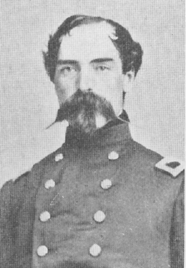
Colonel Robert Nugent 1824-1901

Snippets of Irish History by Conor Cunneen IrishmanSpeaks 

Conor is a Chicago based Motivational Humorous Business Speaker, Author and History buff.

***********************

***********************

NEW                    NEW

Product Details

SHEIFGAB! Staying Sane, Motivated and Productive in Job Search.

An insightful, realistic, yet humorous book on the job search process by Today in Irish History Curator Conor Cunneen

Special accessible price for job seekers on Kindle of $2.99

.

shamrockshamrockshamrockshamrockshamrockshamrockshamrockshamrock

.

1763: Wolfe Tone

Birth of Irish patriot Theobald Wolf Tone. Tone was one of the founding fathers of the United Irishmen which with the aid of France attempted to gain independence for Ireland. On October 12 1798, he was captured off the coast of Donegal in the French shop Hoche as it attempted to land French invastion forces. On November 10th, he was found guilty of treason and sentenced to be hanged. Before this sentence could be carried out, he attempted suicide by cutting his throat. He died a long lingering death 9 days later on November 19th.

File:Theobald Wolfe Tone - Project Gutenberg 13112.png

.

shamrockshamrockshamrockshamrockshamrockshamrockshamrockshamrock

.

1901: County Down born General Robert Nugent

Colonel Robert Nugent 1824-1901

Death of Kilkeel, Co. Down born  (June 27, 1824) General Robert Nugent served in the U.S. Army during the American Civil War and the Indian Wars. He served with the Irish Brigade’s 69th Infantry Regiment, from its days as a National Guard unit and into its incorporation into the Union Army at the start of the war, and was one of its senior officers at the First Battle of Bull Run. His obituary in the Brooklyn Eagle read:

General Robery Nugent died at his home,
332 McDonough street, yesterday, as the
final result of a bullet wound in the stomach
received at the battle of Fredericksburg, De-
cember 13, 1862, while leading his command
up Marye’s Hill.  For seventeen years he
suffered from chronic dyspepsia. General
Nugent was born in Killkeel, County Down,
Ireland, July 24, 1824, and came to New York
when a young man. He joined the Seventh
Regiment as a private and afterward was a
captain in the Fourteenth Regiment. In 1853
he became a member of the Sixty-ninth
Regiment, New York State Militia, and rose
to the colonelcy before the beginning of the
Civil War.  At the firing on Fort Sumter he
led the regiment to Virginia. On it return
he helped organize the Sixty-ninth New York
Volunteers, which was the first in Meagher’s
Irish Brigade. He served as colonel of the
regiment until 1862, when, General Meagher
becoming incapacitated, he succeeded to the
command of the Irish Brigade.  It was while
leading this charge that he received the
wound that finally caused his death. He was
carried from the field and brevetted for his
bravery. During his convalescence in New
York he was appointed deputy provost mar-
shal of New York and Brooklyn, serving as
such from May to November, 1863. During
that time the draft riots took place. He
returned to the Army, reaching the rank of
brigadier general. At the close of the war
he became a captain in the regular Army
and commanded a company in many battles
in Montana, Dakota, and Wyoming, against
the Sioux and other Indians, being with Gen-
eral Miles in the battles against Sitting Bull.
In 1877 he was retired as major and returned
to Brooklyn to live. His wife, three daugh-
ters and a son survive him

.

shamrockshamrockshamrockshamrockshamrockshamrockshamrockshamrock

.

1924: Audie Murphy is born in Texas to share-cropping parents of Irish descent. He would become the most decorated US soldier of World War II.

Audie Murphy 1924-1971

His Citation for the Medal of Honor reads:

Second Lt. Murphy commanded Company B, which was attacked by six tanks and waves of infantry. 2d Lt. Murphy ordered his men to withdraw to a prepared position in a woods, while he remained forward at his command post and continued to give fire directions to the artillery by telephone. Behind him, to his right, one of our tank destroyers received a direct hit and began to burn. Its crew withdrew to the woods. 2d Lt. Murphy continued to direct artillery fire, which killed large numbers of the advancing enemy infantry. With the enemy tanks abreast of his position, 2d Lt. Murphy climbed on the burning tank destroyer, which was in danger of blowing up at any moment, and employed its .50 caliber machine gun against the enemy. He was alone and exposed to German fire from three sides, but his deadly fire killed dozens of Germans and caused their infantry attack to waver. The enemy tanks, losing infantry support, began to fall back. For an hour the Germans tried every available weapon to eliminate 2d Lt. Murphy, but he continued to hold his position and wiped out a squad that was trying to creep up unnoticed on his right flank. Germans reached as close as 10 yards, only to be mowed down by his fire. He received a leg wound, but ignored it and continued his single-handed fight until his ammunition was exhausted. He then made his way back to his company, refused medical attention, and organized the company in a counterattack, which forced the Germans to withdraw. His directing of artillery fire wiped out many of the enemy; he killed or wounded about 50. 2d Lt. Murphy’s indomitable courage and his refusal to give an inch of ground saved his company from possible encirclement and destruction, and enabled it to hold the woods which had been the enemy’s objective.”

Murphy was awarded thirty two other medals for gallantry including the Distinguished Service Cross, the Silver Star, four Purple Hearts, a Bronze Star, and the French and Belgian Croix de Guerre.

Following the war, Murphy became a movie actor, starring in numerous films including his own bio-pic To Hell and Back.

.

.

shamrockshamrockshamrockshamrockshamrockshamrockshamrockshamrock

.

WATCH: A Short History of Ireland

Want to learn more about Ireland? See these images and more in the acclaimed For the Love of Being Irish

Irish gift ideas. Best selling Irish booksRonnie Drew and Luke Kelly - Musical Irish Gifts to the worldJoyce Image in For the Love of Being IrishMichael Collins: Image from For the Love of Being Irish

___________________________________

This history is written by Irish author, business keynote speaker and award winning humorist IrishmanSpeaks – Conor Cunneen. If you spot any inaccuracies or wish to make a comment, please don’t hesitate to contact us via the comment button.

Visit Conor’s YouTube channel IrishmanSpeaks to Laugh and Learn.

Tags: Best Irish Gift, Creative Irish Gift, Unique Irish Gifts, Irish Books, Irish Authors, Today in Irish History TODAY IN IRISH HISTORY (published by IrishmanSpeaks)


June 19,

The Man Who Gave Us Boycott – Austin Currie Northern Ireland Activist at Today in Irish History

June 19: TODAY in Irish History:

** ** **

Charles Boycott 1832-1897

Charles Boycott 1832-1897

Snippets of Irish History by Conor Cunneen IrishmanSpeaks 

Conor is a Chicago based Motivational Humorous Business Speaker, Author and History buff.

***********************

***********************

NEW                    NEW

Product Details

SHEIFGAB! Staying Sane, Motivated and Productive in Job Search.

An insightful, realistic, yet humorous book on the job search process by Today in Irish History Curator Conor Cunneen

Special accessible price for job seekers on Kindle of $2.99

.

shamrockshamrockshamrockshamrockshamrockshamrockshamrockshamrock

.

1897: The Man who gave us “Boycott”

Charles Boycott 1832-1897

Charles Boycott 1832-1897

The man who gave the English language the word “boycott” dies in England. Charles Cunningham Boycott was an English landlord who was ostracized by his Irish neighbors and laborers after he attempted to evict a number of his tenants for non-payment of rent. The “boycott” was substantially instigated by Charles Stuart Parnell who on September 19, 1880 a few days prior to the action against Boycott, had suggested in a speech that unfit landlords should be shunned: “Shun him in the streets of the town, you must shun him in the shop, you must shun him in the fairgreen and in the marketplace, and even in the place of worship, by leaving him alone, by putting him in a moral Coventry, by isolating him from the rest of his country as if he were the leper of old, you must show your detestation of the crime he has committed”.

On October 14th 1880, Boycott wrote to the The Times of London about his situation in Ireland.

THE STATE OF IRELAND

Sir, The following detail may be interesting to your readers as exemplifying the power of the Land League. On the 22nd September a process-server, escorted by a police force of seventeen men, retreated to my house for protection, followed by a howling mob of people, who yelled and hooted at the members of my family. On the ensuing day, September 23rd, the people collected in crowds upon my farm, and some hundred or so came up to my house and ordered off, under threats of ulterior consequences, all my farm labourers, workmen, and stablemen, commanding them never to work for me again.

My herd has been frightened by them into giving up his employment, though he has refused to give up the house he held from me as part of his emolument. Another herd on an off farm has also been compelled to resign his situation. My blacksmith has received a letter threatening him with murder if he does any more work for me, and my laundress has also been ordered to give up my washing. A little boy, twelve years of age, who carried my post-bag to and from the neighbouring town of Ballinrobe, was struck and threatened on 27th September, and ordered to desist from his work; since which time I have sent my little nephew for my letters and even he, on 2nd October, was stopped on the road and threatened if he continued to act as my messenger.

The shopkeepers have been warned to stop all supplies to my house, and I have just received a message from the post mistress to say that the telegraph messenger was stopped and threatened on the road when bringing out a message to me and that she does not think it safe to send any telegrams which may come for me in the future for fear they should be abstracted and the messenger injured. My farm is public property; the people wander over it with impunity. My crops are trampled upon, carried away in quantities, and destroyed wholesale. The locks on my gates are smashed, the gates thrown open, the walls thrown down, and the stock driven out on the roads. I can get no workmen to do anything, and my ruin is openly avowed as the object of the Land League unless I throw up everything and leave the country. I say nothing about the danger to my own life, which is apparent to anybody who knows the country.

Boycott and his family (supported by Loyalist volunteers from the north of Ireland) were forced to bring in their own harvest (protected by a large police force) while being watched and jeered by tenants and local Irish. The boycott garnered national attention when the Captain wrote a letter to the London Times as to his situation.

.

shamrockshamrockshamrockshamrockshamrockshamrockshamrockshamrock

.

1968: Austin Currie – Northern Ireland Civil Rights Activist

Nationalist MP for Tyrone Austin Currie asks a question in Stormont, (Northern Ireland Parliament) that might well be seen as the pivotal moment in Civil Rights politics in Ireland and in some ways the forerunner to the troubles that bedevilled Northern Ireland for almost forty following years. Catholics in the North were subject to a level of employment and housing descrimination comparable to Jim Crow in the southern United States.

The moderate Currie asked about the allocation of a house to a nineteen-year-old unmarried Protestant woman who was secretary to a Unionist parliamentary candidate. A Catholic family who had squatted in the house was evicted to make room for her, and a number of other Catholic families in the area were also denied houses. The following day, Currie would squat in the house and the modern Civil Rights movement in Northern Ireland had its iconic moment.

.

On YouTube CeadMileFailte has uploaded numerous clips from the excellent documentary The Troubles by Thames Television. This is one of 24 uploads.

shamrockshamrockshamrockshamrockshamrockshamrockshamrockshamrock

.

WATCH: A Short History of Ireland

Want to learn more about Ireland? See these images and more in the acclaimed For the Love of Being Irish

Irish gift ideas. Best selling Irish booksRonnie Drew and Luke Kelly - Musical Irish Gifts to the worldJoyce Image in For the Love of Being IrishMichael Collins: Image from For the Love of Being Irish

___________________________________

This history is written by Irish author, business keynote speaker and award winning humorist IrishmanSpeaks – Conor Cunneen. If you spot any inaccuracies or wish to make a comment, please don’t hesitate to contact us via the comment button.

Visit Conor’s YouTube channel IrishmanSpeaks to Laugh and Learn.

Tags: Best Irish Gift, Creative Irish Gift, Unique Irish Gifts, Irish Books, Irish Authors, Today in Irish History TODAY IN IRISH HISTORY (published by IrishmanSpeaks)