Conor is a Chicago based Motivational Humorous Business Speaker, Author and History buff.
*********************** WATCH: A Short History of Ireland
***********************
.
.
1494: Poyning’s Law
English hegemony is extended in Ireland with the advent of Poynings’ Law passed by the Irish Parliament at Drogheda. The Lord Deputy of Ireland Sir Edward Poynings declared that the Parliament of Ireland was to be subject to the authority of the English Parliament. This was effectively the formal start of direct English rule of Ireland.
.
.
1921: Treaty Negotiations Continue in London
British negotiators present proposals to Irish team that would ultimately form basis for the Anglo-Irish treaty that would see Ireland partitioned and a dreadful civil war ensue.
Michael Collins in London for Treaty Negotiations
.
.
1946: Gilbert O’Sullivan born in Waterford.
Singer / Songwriter and very successful 70’s pop star Gilbert (Raymond) O’Sullivan is born in Waterford. O’Sullivan’ s quirky image combined with an ability to write catchy pop songs generated some hugely successful singles including Nothing Rhymed, Clair and his biggest success Alone Again (Naturally) which was top of the Billboard charts for six weeks in 1972.
.
.
1956: Ronnie Delany wins Olympic 1500 meter Gold at Melbourne Olympics
1991: Death of Dr. PAT O’CALLAGHAN – Ireland’s First Olympic Gold Medalist
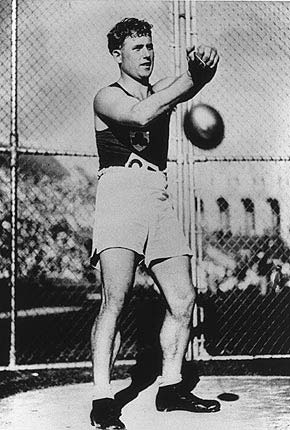
Pat O’Callaghan was born near Kanturk, Co. Cork. Twenty three years later, Dr. Pat O’Callaghan would become a national hero winning the first ever Olympic gold medal for the Independent Ireland in the Hammer Throw competition at the Amsterdam Olympics. O’Callaghan had to pay his own fare from Ireland to compete! He repeated the gold medal in Los Angeles in 1932.
.
Hammer Thrower Pat O’Callaghan 1905-1991
.
O’Callaghan spent a number of years in the US after winning his second gold medal. His high public profile with Irish America ensured a number of unique offers including movies and wrestling. He returned to Ireland in the late 30s and pursued a distinguished medical career.
The following interesting articles on O’Callaghan each offer different birth days for a man who helped generate strong positive international profile for Ireland
This history is written by Irish author, business keynote speaker and award winning humorist IrishmanSpeaks – Conor Cunneen. If you spot any inaccuracies or wish to make a comment, please don’t hesitate to contact us via the comment button.
Visit Conor’s YouTube channel IrishmanSpeaksto Laugh and Learn.
Tags: Best Irish Gift, Creative Irish Gift, Unique Irish Gifts, Irish Books, Irish Authors, Today in Irish History TODAY IN IRISH HISTORY (published by IrishmanSpeaks)
Conor is a Chicago based Motivational Humorous Business Speaker, Author and History buff.
*********************** WATCH: A Short History of Ireland
***********************
.
.
November 30:Death of Confederate General, Cork born Patrick Cleburne – the “Stonewall of the West.”
1864: Death of Cork born Confederate General Patrick Cleburne at the Battle of Franklin, “pierced with forty-nine bullets, through and through.” Cleburne was the highest ranking Irish General during the Civil war and is recognized as one of the finest officers to serve on either side of that terrible campaign. Robert E. Lee referred to him as a “a meteor shining from a clouded sky.” He became known as the “Stonewall of the West” Cleburne’s campaigns included the Battles of Shiloh, Richmond and Chickamauga.
.
Patrick Cleburne 1828-1864
.
The Patrick R. Cleburne Confederate Memorial Cemetery in Georgia is the final resting place of Confederate soldiers who fell during the Battle of Jonesboro. Cleburne County in Alabama is named after the Corkman. The town of Cleburne Texas was named in honor of Gen. Patrick R. Cleburne, under whom many of the men had fought during the Civil War..
.
Some of the best recollections of Cleburne’s abilities are referenced inCo Aytch, a truly interesting memoir by Confederate soldier Sam Watkins. Of the Battle of Ringold Gap where Cleburne’s 4,000 men fought 12,000 of Hooker’s Northern forces, he writes:
“Cleburne had had the doggondest fight of the war. The ground was piled with dead Yankees; they were piled in heaps. The scene looked unlike any battlefield I ever saw. From the foot to the top of the hill was covered with their slain, all lying on their faces. It had the appearance of the roof of a house shingled with dead Yankees. They were flushed with victory and success, and had determined to push forward and capture the whole of the Rebel army, and set up their triumphant standard at Atlanta—then exit Southern Confederacy. But their dead were so piled in their path at Ringgold Gap that they could not pass them. The Spartans gained a name at Thermopylae, in which Leonidas and the whole Spartan army were slain while defending the pass. Cleburne’s division gained a name at Ringgold Gap, in which they not only slew the victorious army, but captured five thousand prisoners besides. That brilliant victory of Cleburne’s made him not only the best general of the army of Tennessee, and covered his men with glory and honor of heroes, but checked the advance of Grant’s whole army.”
Cleburne at the Battle of Atlanta (from Co. Aytch by Sam Watkins)
“The plan of battle, as conceived and put into action by General Cleburne, was one of the boldest conceptions, and, at the same time, one of the most hazardous that ever occurred in our army during the war, but it only required nerve and pluck to carry it out, and General Cleburne was equal to the occasion. The Yankees had fortified on two ranges of hills, leaving a gap in their breastworks in the valley entirely unfortified and unprotected. They felt that they could enfilade the valley between the two lines so that no troop would or could attack at this weak point. This valley was covered with a dense undergrowth of trees and bushes. General Walker, of Georgia, was ordered to attack on the extreme right, which he did nobly and gallantly, giving his life for his country while leading his men, charging their breastworks. He was killed on the very top of their works. In the meantime General Cleburne’s division was marching by the right flank in solid column, the same as if they were marching along the road, right up this valley, and thus passing between the Yankee lines and cutting them in two, when the command by the left flank was given, which would throw them into line of battle. By this maneuver, Cleburne’s men were right upon their flank, and enfilading their lines, while they were expecting an attack in their front. It was the finest piece of generalship and the most successful of the war.”
Mary Harris “Mother” Jones was once deemed “the most dangerous woman in America” because of her union activities. Loved by the labor movement, she suffered major tragedies in her own life losing her husband and four children to Yellow Fever and then some years later losing everything in the Chicago Fire.
A lengthy biography at AFLCIO.org states “In June 1897, after Mary addressed the railway union convention, she began to be referred to as “Mother” by the men of the union. The name stuck. That summer, when the 9,000-member Mine Workers called a nationwide strike of bituminous (soft coal) miners and tens of thousands of miners laid down their tools, Mary arrived in Pittsburgh to assist them. She became “Mother Jones” to millions of working men and women across the country for her efforts on behalf of the miners. Mother Jones was so effective the Mine Workers sent her into the coalfields to sign up miners with the union. She agitated in the anthracite fields of eastern Pennsylvania, the company towns of West Virginia and the harsh coal camps of Colorado.”
Clinton becomes the first U.S. President to visit Northern Ireland and is greeted with rapturous reception from both Protestant and Catholic communities. Speaking at the Mackie Plant in a sectarian plagued Belfast, he said:
“Here in Northern Ireland, you are making a miracle, a miracle symbolized by those two children who held hands and told us what this whole thing is all about. In the land of the harp and the fiddle, the fife and the lambeg drum, two proud traditions are coming together in the harmonies of peace. The cease-fire and negotiations have sparked a powerful transformation.”
“Here in Northern Ireland, you are making a miracle, a miracle symbolized by those two children who held hands and told us what this whole thing is all about. In the land of the harp and the fiddle, the fife and the lambeg drum, two proud traditions are coming together in the harmonies of peace. The cease-fire and negotiations have sparked a powerful transformation.”
.
Bill Clinton speaking at Mackie Plant Belfast 1995
This history is written by Irish author, business keynote speaker and award winning humorist IrishmanSpeaks – Conor Cunneen. If you spot any inaccuracies or wish to make a comment, please don’t hesitate to contact us via the comment button.
Visit Conor’s YouTube channel IrishmanSpeaksto Laugh and Learn.
Tags: Best Irish Gift, Creative Irish Gift, Unique Irish Gifts, Irish Books, Irish Authors, Today in Irish History TODAY IN IRISH HISTORY (published by IrishmanSpeaks)








 Today In Irish History